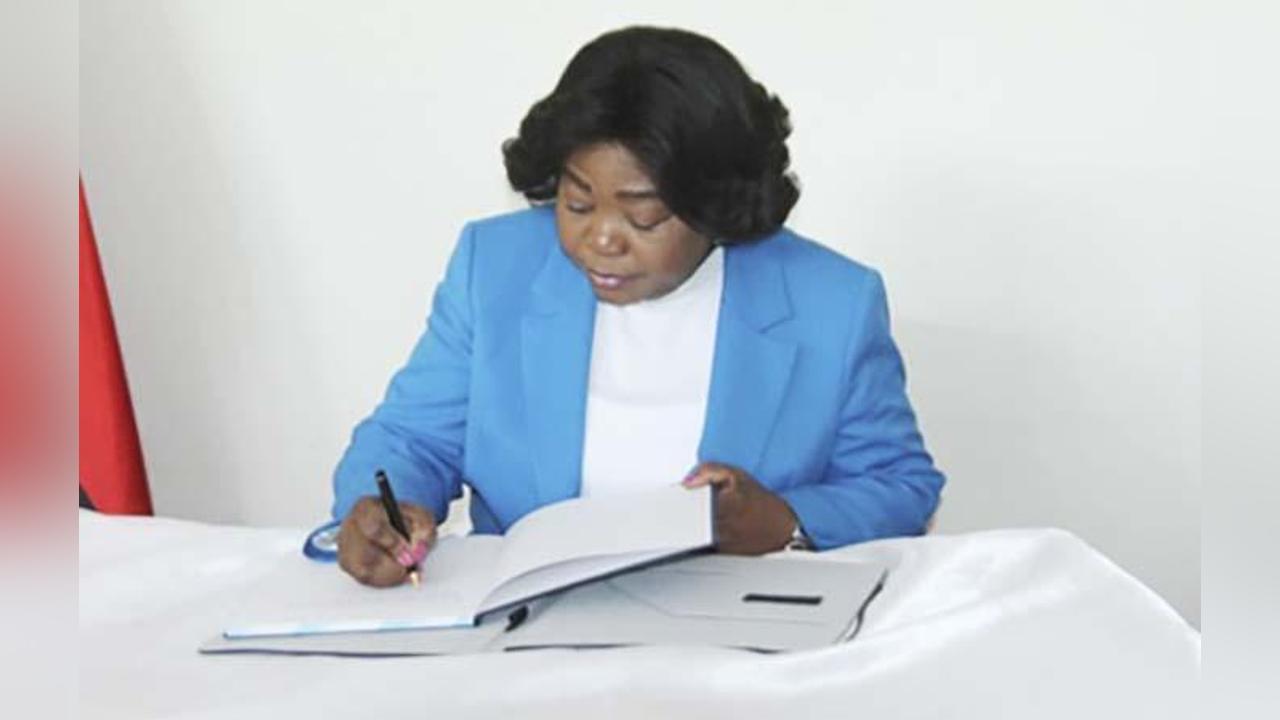
Africa-Press – Angola. The Vice-President of the Republic, Esperança da Costa, urged, on Thursday, in the province of Huambo, the academic community, as a scientific arm, to support the implementation of programs aimed at food security in the country.
The call for the province to further explore its technical-scientific and human potential was made during a meeting with members of the academic community, attended by the minister of Higher Education, Science, Technology and Innovation, Maria do Rosário Bragança, and the local governor, Lotti Nolika.
Esperança da Costa referred to the global problem linked to food and various crises occurring around the world, which force countries, including Angola, to identify new strategies and programs to guarantee food security and ensure sustainable development.
For the Vice-President, Huambo, especially the community linked to academia in the areas of economics and agronomy, must be aggressive towards the business community and show projects, especially in the field of food technology, a strong contribution to ensuring security in this area .
He highlighted that the province can support the improvement of seed production, as it is located in the same area as the germplasm bank, one of the largest in the SADC region, as well as assist farmers with soil quality and recommend the type of cultures to be applied.
The germplasm bank, he said, has all the genetic heritage of varieties that the country has and can be used, as they are species adaptable to the climate and resistant to pests.
The fact that it is located in an area that includes many springs, he added, makes Huambo recommend the practice of aquaculture, using the country’s native species, and identifying plant species that can be used in terms of exploring bio-resources.
The leader also pointed out forest resources and the need to survey all traditional knowledge of the communities.
Esperança da Costa considered Huambo an example, whose process must be scaled so that the country can appear in an advantageous position on the biodiversity list, for access to global financing from the climate fund.
The region, he added, must look at the climate/biodiversity nexus and participate in the preparation of the Action Plan on Climate Change, within the scope of the strategy approved by the Executive on climate change, which runs until 2035.
On the other hand, the Vice-President announced, for 2024, the return of budgeted units in all higher education institutions and the existence of 10 thousand scholarships, guaranteed by INAGBE, to expand access to that level of education.
Esperança da Costa defended greater promotion and integration of women in postgraduate courses, an area for which 300 scholarships are guaranteed.
For More News And Analysis About Angola Follow Africa-Press