Africa-Press – Botswana. Botswana hold a memorial service in honour of former Namibia President, Dr Hage Geingob.
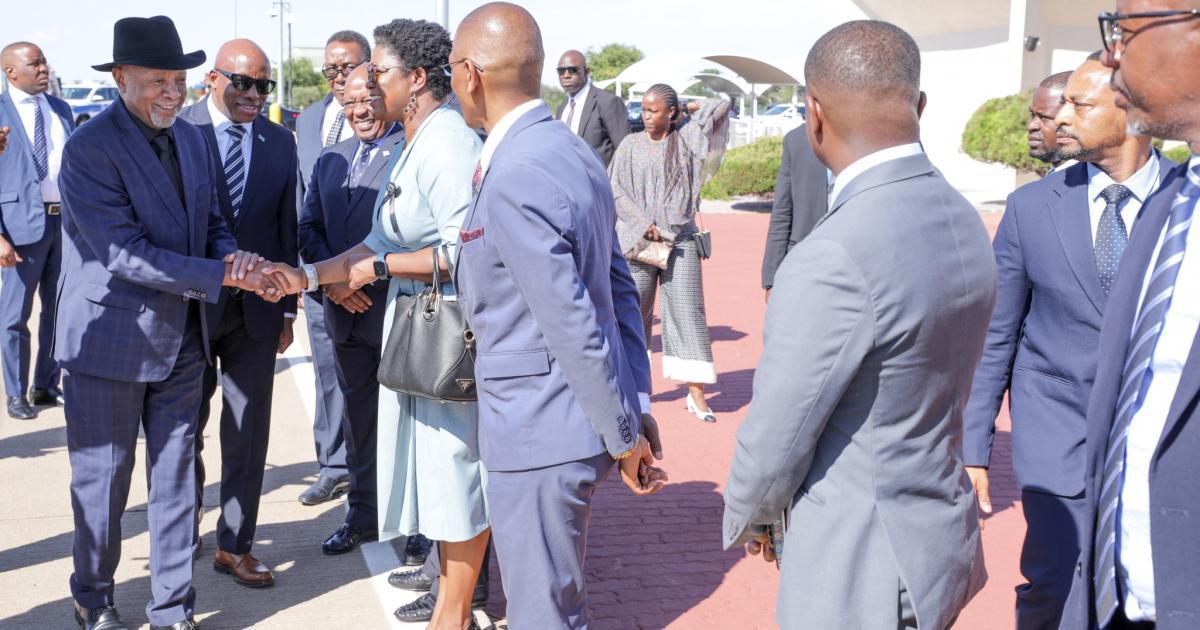
The memorial service, to be held at the Gaborone International Convention Centre, was attended by President Dr Mokgweetsi Masisi and the new Namibia President, Dr Nangolo Mbumba, who is on his first visit to the country since he was sworn in to replace the late Dr Geingob.
The memorial service is seen as a befitting farewell for a man who had meant a lot to the country, both at personal and national level. Dr Geingob spent a good part of his life in exile at Francistown during his country’s struggle for independence.
After ascending to the presidency, he cultivated good working relations between Botswana and Namibia.
Dr Geingob had also struck a personal relationship with President Masisi, which benefitted both countries. This was attested by the Minister of Foreign Affairs, Dr Lemogang Kwape in a previous interview, stating that the relationship between the two leaders made bilateral relations smooth.
“As Minister of Foreign Affairs, it is even easier for me to just pick the phone and talk to my Namibian counterpart. That is how the relations between the two heads of state has made thing easy,” he said.
Dr Geingob passed on when Botswana and Namibia were looking to a new era in cooperation and had established a commission.
The inaugural Botswana and Namibia Bi-National Commission first met in Gaborone in September 2022, after which the two governments agreed to abolish the requirement of passports, introduced the use of national identity cards as travel documents between the two countries.
“Our two countries not only share a common border, but also a common people and heritage. A symbiotic and inter-dependent relationship exists along our common borders,” Dr Geingob had said in support of the initiative.
The commission focused on a wide range of issues of mutual interest, including politics and diplomacy, their economies, and defence and security matters.
Being a man of broader vision, Dr Geingob had also viewed the initiative as a key step towards integration among Southern African Development Community (SADC) members, and ultimately the entire continent.
“We are taking the first steps towards realisation of the SADC Protocol on the facilitation of movement of persons, not only goods but persons. In the same vein, steps like these could form a foundation whose stepping stones may lead to the path in inspiring Africans to attain continental integration,” he said.
Dr Geingob passed away on February 04, shortly after being diagnosed with cancer.
Born on August 3, 1941 in the district of Grootfontein, Dr Geingob began his schooling at Otavi in 1948. In 1958 he attended Augustineum College, where the first seeds of political consciousness were planted, at one point, leading protests as a pupil against the unfair treatment of learners.
In 1961, he completed his teachers’ training and started teaching at Tsumeb, where he started taking part in SWAPO activities, joining the party officially in 1962.
In December 1962, Geingob left Namibia for exile, commencing in Botswana where he joined other freedom fighters in pursuit of Namibia’s independence. He left Botswana for Léopoldville in the Congo and was eventually offered a scholarship in 1964 to go to the United States of America, where he schooled at Temple University.
While in the USA, Geingob was appointed as SWAPO’s representative to the Americas and the United Nations. He obtained a Bachelor’s Degree in Political Science from Fordham University in 1970 and later read for a Master’s Degree in International Relations in 1974.
He obtained a Doctorate in Philosophy from Leeds University in the United Kingdom in 2004, with his thesis titled, State Formation in Namibia: Promoting Democracy and Good Governance.
Later in his political life, Dr Geingob was chosen by the SWAPO leadership to lead a cohort of senior SWAPO leaders and Namibians in exile to Namibia under the UN Security Council Resolution.
Following the successful UN supervised elections in 1989, Dr Geingob was elected chairman of the Constituent Assembly, the body that was responsible for drafting the Constitution of the Republic of Namibia.
At independence on March 21 1990, Dr Geingob was appointed the first Prime Minister, where he dismantled the apartheid administrative system in favour of an inclusive public service geared towards serving the interests of all Namibians.
Dr Geingob served for 12 years in the position of Prime Minister before taking a brief break from politics, returning in 2005 to serve as SWAPO chief whip in the National Assembly.
He was elected vice president of SWAPO in November 2007 and was re-elected in 2012, following which he was reappointed as prime minister until his election as President of Namibia in November 2014.
A fervent defender of the unity of the Namibian people, his themes are: ‘Inclusivity spells harmony, exclusivity spells conflict’; ‘One Namibia, one nation’ and ‘No one should feel left out of the Namibian house.’
Dr Geingob’s initiatives meant for the betterment of citizens included the social progression of the vulnerable and the economic and infrastructure advancement for Namibia.
At international level, he will be remembered for his advocacy on the continental recognition of green hydrogen as a strategic vector for Africa’s green industrialisation and a key component for combating climate change.
For More News And Analysis About Botswana Follow Africa-Press