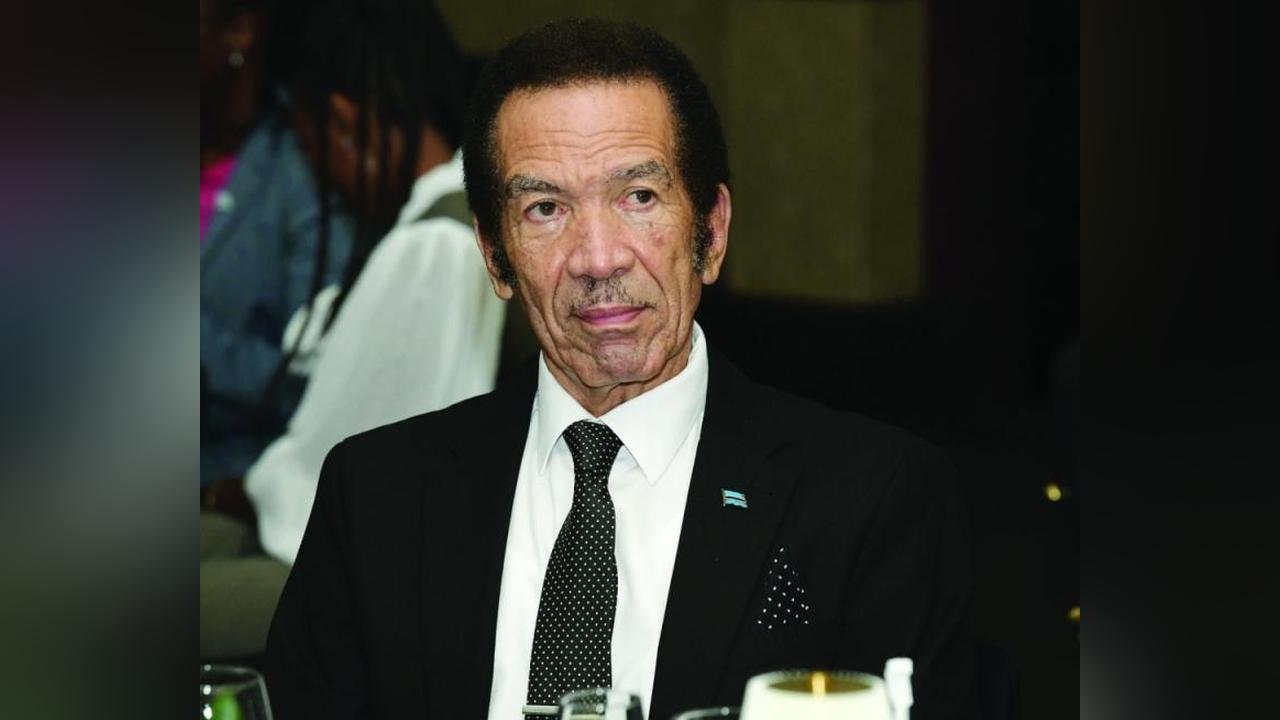
Africa-Press – Botswana. Khama, known for his confrontational approach to foreign policy during his presidency, used the Ntlo ya Dikgosi platform to corner the Ministry of International Relations into explaining Botswana’s voting behavior at the United Nations, particularly its decision to abstain on resolutions condemning Russia’s conduct in Ukraine.
Khama questioned the government on its stance regarding the protection of civilians, especially children in war-torn zones, a line of inquiry that inevitably led to Botswana’s posture on the Russia–Ukraine conflict. The intervention has compelled the government to publicly defend a foreign policy approach it has traditionally managed quietly.
Responding to the concerns, Minister of International Relations Dr Phenyo Butale acknowledged the humanitarian gravity of the conflict but stressed that Botswana’s UN voting decisions are shaped by complex legal and institutional considerations.
“Botswana is seriously concerned about the protection of children, especially the abuse of children in war-torn zones. However, voting on resolutions before UN organs is a complex interplay of legal, institutional, and political considerations,” Butale said.
He explained that only eight African countries voted in favour of the resolution in question, while Botswana chose to abstain in line with its long-standing policy of neutrality.
“Botswana’s vote was to avoid being seen as taking sides in ongoing military and political hostilities between the parties,” he explained.
Khama’s line of questioning also drew out the government’s position on its deepening diplomatic engagement with Russia. Butale confirmed that preparations are underway to establish a diplomatic mission in Moscow, with a technical team expected to travel to Russia to conduct a costing exercise. “If there are any atrocities being committed by Moscow, it is the responsibility of the United Nations Security Council to discuss,” the minister said, distancing Botswana from unilateral judgments outside established multilateral mechanisms.
He reiterated that Botswana’s foreign policy remains anchored on respect for state sovereignty and non-interference in the internal affairs of other nations, principles that have guided the country’s diplomatic conduct since independence.
During his tenure, Khama had an outspoken diplomacy that went against Botswana’s traditional cautious style. Rather than adhering strictly to quiet diplomacy, he publicly criticised leaders he viewed as violating democratic norms and human rights.
Khama frequently used this approach against entrenched African leaders. He openly condemned Robert Mugabe’s prolonged rule in Zimbabwe, calling for fresh elections and refusing to recognise governments formed without genuine power-sharing, while also criticising Joseph Kabila in the Democratic Republic of Congo for delaying elections beyond constitutional limits. In each case, Khama framed his interventions as necessary to uphold democracy and regional stability, even when many SADC members preferred a more cautious, consensus-driven approach Khama also probed whether Botswana intended to actively support regional unity against what he framed as external interference on SADC affairs by the United States of America.
Previously, the US has had diplomatic brawls with South Africa, spiked by what the US calls anti-American sentiments seen in South Africa’s stance on Israel. The tension reached an all-time high when the US refused to attend the G20 summit hosted by South Africa last year. The controversy surrounding the U.S. narrative on South Africa underscores the shifting dynamics of global influence in the region. Washington’s stance, widely condemned by African leaders as both unfounded and provocative, intersects with broader geopolitical currents. South Africa, as a leading SADC economy, plays a central role in regional trade, security, and diplomacy.
Historically, Botswana has cultivated a reputation as a neutral, measured voice in international relations, prioritising stability and non-confrontation over ideological alignment. While this approach has preserved its credibility in multilateral forums, critics argue that it risks marginalising the country as regional and global tensions intensify.
The recent critiques of Botswana’s silence reflect frustration with what he perceives as a pattern of diplomatic passivity. By not publicly opposing the U.S. narrative or signaling support for South Africa, Botswana risks sending the message that it is either indifferent to regional concerns or unwilling to engage in strategic advocacy, according to him.
Observers note that Botswana’s traditionally cautious foreign policy is rooted in its historical trajectory. Since independence, the country has prioritised economic stability, internal governance, and adherence to multilateral norms, often avoiding entanglement in ideological disputes. This strategy has yielded benefits, though Botswana is consistently ranked among Africa’s most stable democracies, attracts foreign investment, and maintains strong bilateral relations with both Western and emerging powers. Yet the question remains whether neutrality is sustainable in an era of increasing geopolitical polarization.