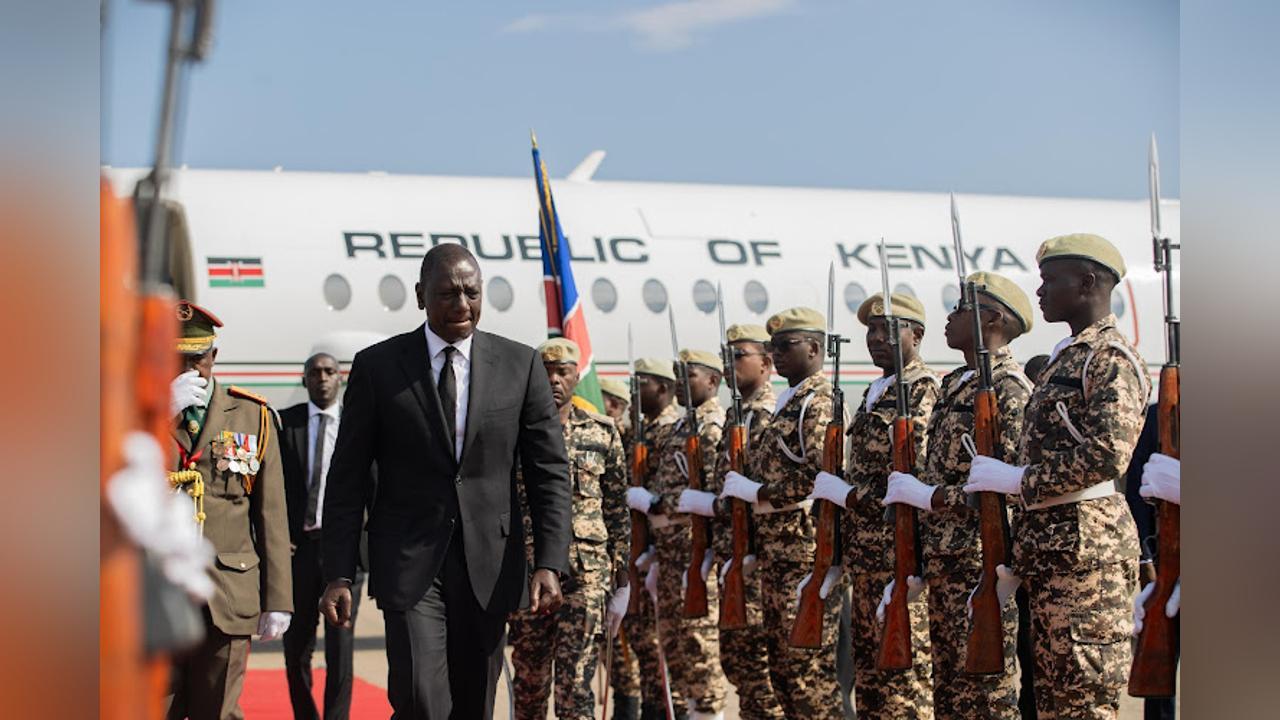
Africa-Press – Botswana. President Dr Mokgweetsi Masisi is anticipated to arrive in Windhoek, Namibia this evening to participate in the memorial service and burial of the recently deceased third Namibian President, Dr Hage Geingob.
President Masisi will join other regional heads of state and dignitaries expected for the memorial service tomorrow at the Independence Stadium in Windhoek, and the funeral on Sunday at the majestic Heroes Acre.
Dr Geingob is one of the Southern African heads of state that Dr Masisi had cultivated a good personal relationship with.
Relations between Botswana and Namibia flourished over the past few years due in part to the strong bond of friendship forged between the two presidents.
In what could be a poignant send-off with a sense of déjà vu for the Botswana delegation, Saturday’s memorial service celebrating Dr Geingob’s life falls on February 24, a date marking exactly a year since President Masisi and his Namibia counterpart launched the use of national identity cards for their citizens to cross at ports of entry between the two states without needing to use passports.
As such, as President Masisi celebrates the life of a neighbour and friend, on a date they had set aside a year earlier to cement the relationship between the two countries through the launch of a historic easing of movement, Dr Geingob’s legacy in Namib-Tswana relations could feel more relevant.
Since 2018, Presidents Masisi and Geingob worked on strengthening bilateral relations, the ease of movement of people and goods, and seeking to deepen trade links through exploring the future implementation and utilisation of the previously agreed upon proposed Trans Kalahari Railway and the existing Botswana dry port at Walvis Bay.
The two leaders also managed to quell a potential diplomatic rift when Botswana Defence Force soldiers fatally shot four Namibians in the Chobe River in November 2020, with one side insisting these were armed poachers, the other maintaining they were innocent fishermen.
They maturely oversaw the use of legal instruments to bring the matter to its logical conclusion, and greater effect, calmed tensions, to ensure similar misunderstandings stay rare, while the bond of friendship between the two sister states is accentuated.
Botswana and Namibia share 1 583km of borderline stretching from the Kgalagadi Transfrontier Park in Kgalagadi South to Kasane in Chobe, generally following straight lines and river lines, running south to north, then east to west along the Caprivi Strip.
This borderline was largely delimitated by the Anglo-German Treaty of 1890, which cemented modern borders between the two countries and saw the British, who governed Bechuanaland Protectorate, handing over the Caprivi Strip to German South West Africa (colonial Namibia) in exchange for the Germans ceding control of Namibia’s Walvis Bay and Zanzibar Island off the East African coast to the British.
After World War I, a League of Nations mandate handed South West Africa over to South Africa rule, which later officially adopted apartheid as a national policy extended to present-day Namibia.
This led to the South West African Peoples Organization (SWAPO) being founded in 1960 to lead the struggle of Namibian people for independence from apartheid South Africa.
Hage Geingob, born on August 3, 1941, in Otjiwarongo amongst the Damara people, in the early 1960s, joined the early leadership of SWAPO which included the likes of Sam Nujoma, Andimba Toivo ja Toivo, Hifikepunye Pohamba and Theo Ben Guirab in pioneering the Namibia struggle for independence.
He was first exiled to Botswana, where he served as SWAPO representative based in Francistown in 1963 and 1964, before proceeding to the United Kingdom and the United States of America, where he furthered his studies and became the SWAPO representative to the United Nations.
After independence in 1990, Dr Geingob became Namibia’s first Prime Minister under the presidency of founding President Sam Nujoma, then later became Minister of Trade and Industry, before returning to the Prime Minister portfolio, under the tenure of Namibia’s second President Hifikepunye Pohamba, whom he succeeded as President of Namibia in 2015.
He struck a close relationship with President Masisi, which helped strengthen the two neighbours with many commonalities.
Both states have a similar population of around 2.5 million and are among Africa’s most sparsely populated states; with over two-thirds of both countries desolate desert land, the Kalahari and Namib.
In addition to being similar middle-income economies, both trading in diamonds, beef and small stock among other products, there are cross-border cultural similarities; Tswana, Herero, Mbanderu, Nama, Khoi-San, Subiya and Coloured-Afrikaans linguistic identities found in both states.
For More News And Analysis About Botswana Follow Africa-Press