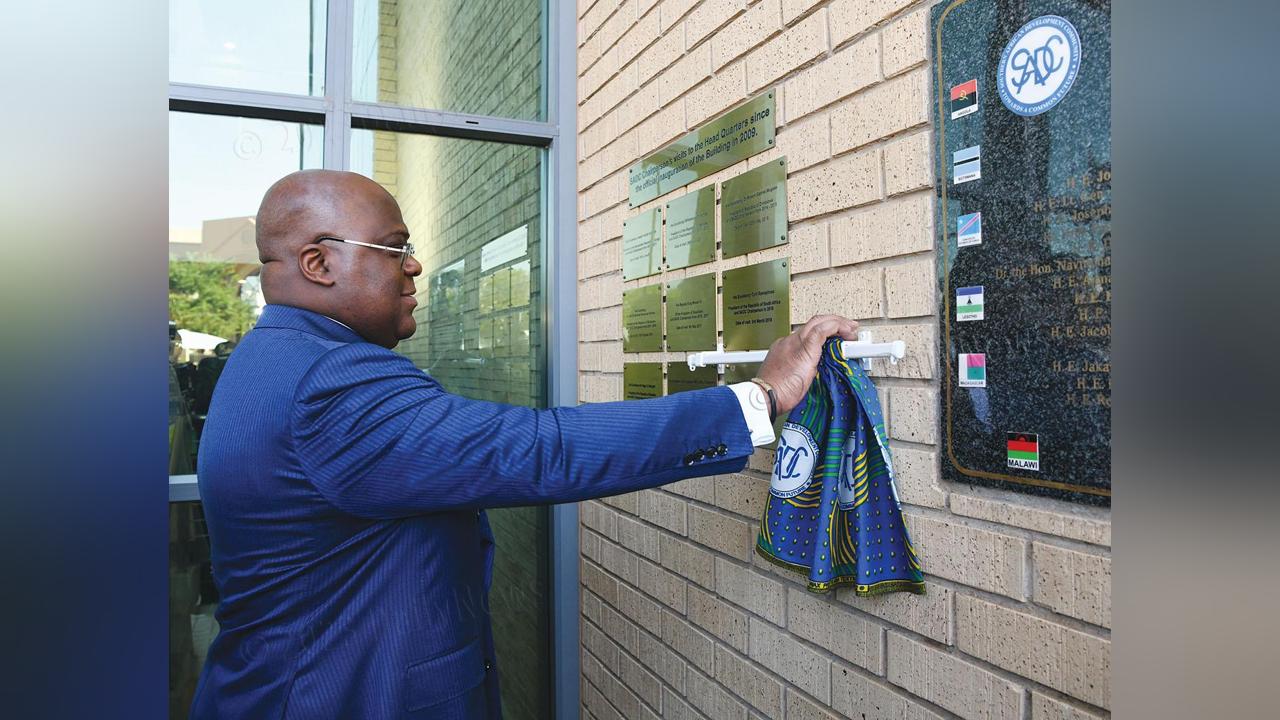
Africa-Press – Botswana. Visiting Democratic Republic of Congo (DRC) president and SADC chairperson Mr Felix Tshisekedi has called on the organisation’s staff to sensitise citizens of member states about its role and mandate which he said most had limited knowledge on.
“This low knowledge about SADC has led to a mismatch between public expectations and the actual SADC programmes and their implementation on the ground.Let me take this opportunity to encourage officials in SADC member states, including SADC ambassadors and high commissioners across the globe and the media to participate in increasing the level of knowledge about SADC. SADC is still relevant and will for a long time to come. SADC is our vehicle for promoting regional integration, economic and social-political development of our community,” he said during an engagement with the staff in Gaborone yesterday.
SADC employees were also urged to ramp up implementation and promotion of the bloc’s Industrialisation Strategy and Roadmap which prioritised increasing manufactured goods and exports, agro-processing, mineral beneficiation and regional value chain development.
Mr Tshisekedi said implementation of the strategy would help SADC economies to diversify and move away from dependence on primary commodities such as raw minerals and agricultural products to high-value manufactured goods.
However, he said the bloc had made strides in advancing regional trade initiatives among them achieving minimum conditions for the SADC Free Trade Area with 85 per cent of tariffs on goods zero rated for all countries, improvement of regional power supply through the establishment of the Southern African Power Pool, enhancement of transboundary cooperation and management of water resources through the establishment of river basin organisations as well as a general increase in the participation of women in decision-making.
The SADC chair mentioned among other achievements the signing of over 33 protocols covering a wide range of sectors including agriculture, food security and natural resources, infrastructure, industrial development, trade, investment and finance, social and human development as well as peace and security.
Over and above that, there were instruments and policies such as the Regional Indicative Strategic Development Plan, Strategic Indicative Plan for the Organ on Politics, Defence and Security Cooperation, SADC Industrialisation Strategy and Roadmap (2015-2063), SADC Regional Agricultural Policy and SADC Regional Infrastructure Development Master Plan, he said.
Briefing President Tshisekedi, SADC executive secretary, Mr Elias Magosi said the secretariat had rationalised and reprioritised SADC Regional Indicative Strategic Development Plan programmes and projects to be deliberate and more focused on critical and impactful interventions.
“Given the enormous funding required to implement the prioritised projects, we have started exploring innovative ways of financing these projects, including fast-tracking operationalisation of the SADC Regional Development Fund, to unlock resources from various sources including the private sector,” he said.
Mr Magosi said the secretariat continued to facilitate interconnection and integrated infrastructure to promote intra-regional trade.saying infrastructure development was critical for member states to promote and develop identified value chains namely agro-processing, mineral beneficiation, pharmaceuticals, consumer goods, capital goods and services.
He disclosed that the secretariat was in the process of institutionalising the SADC balanced scorecard, which would assess and reflect the impact the bloc was making.
The scorecard would enable member states to measure at regional, country and secretariat levels to ensure achievement of set targets for deeper regional integration and for the realisation of the SADC Vision 2050, he said.
Turning to other issues, Mr Magosi condoled the DRC nation for the loss of over 400 people following torrential rains and landslides experienced in the country’s South Kivu Province last week.
“We are also aware that many more are still missing and others injured and that the disaster caused extensive damage to property and infrastructure,” he said.
President Tshisekedi heard that the secretariat was working with the DRC’s Civil Protection Unit to identify the extent of the impact of the disaster and to determine how best to assist victims.
In view of the increasing recurrence and severity of disasters in the region, Mr Magosi said the secretariat continued to work with member states towards improving early warning systems and developing annual contingency plans to ensure readiness.
The secretariat, together with member states, were also working hard to fast-track operationalisation of the SADC Humanitarian and Emergency Operations Centre as well as emergency response teams, all of which were geared at enabling support in the event of disasters, he said.
For More News And Analysis About Botswana Follow Africa-Press