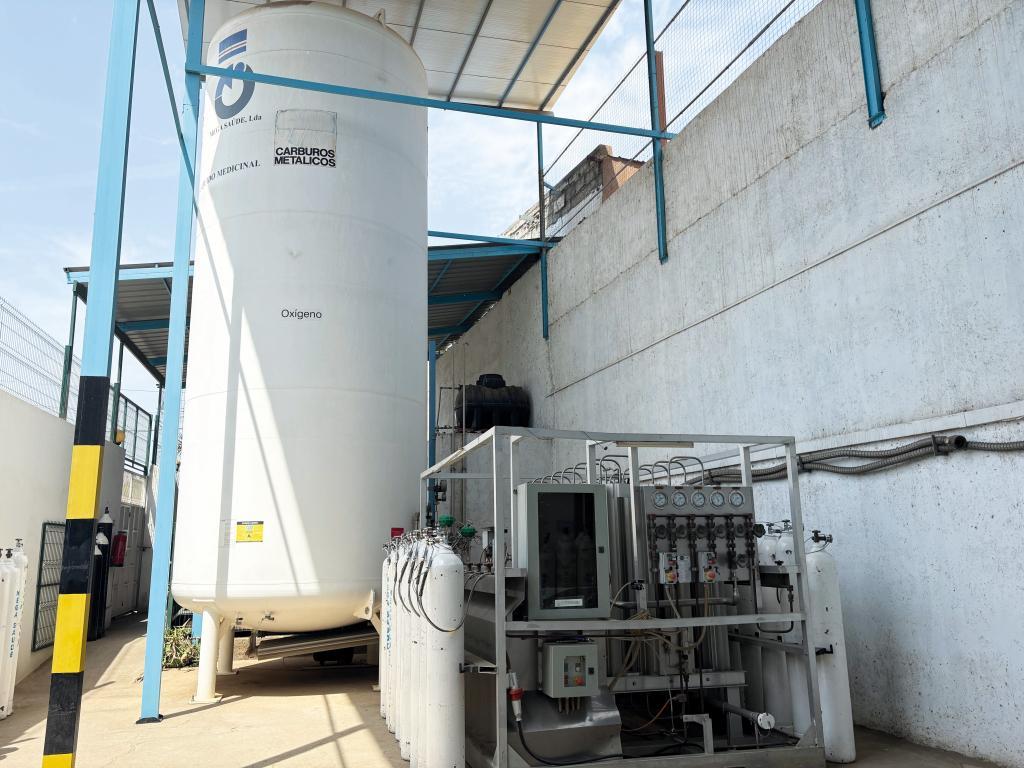
Africa-Press – Cape verde. Business leaders in the sector warn that in-house hospital production could drastically reduce the activity of private companies, despite decades of investment that ensured a continuous and secure supply during the pandemic.
In statements to Expresso das Ilhas, Pedro Delgado, from Drogaria Pincel in Praia, recalls that before the entry of private companies into the market, hospitals in Cape Verde frequently faced difficulties in accessing medical oxygen.
“It was precisely to meet this need that we decided to invest in creating our own production unit,” he states.
According to him, since then companies in the sector have worked to guarantee a regular supply to the country’s hospitals. “Over these years, together with other companies in the sector, we have managed to stabilize the supply and eliminate the shortages that previously occurred,” he says.
The COVID-19 pandemic was, according to Pedro Delgado, one of the most demanding periods, forcing companies to make a continuous effort to guarantee the supply of oxygen.
“Unlike other countries, in Cape Verde there were deaths, yes, but not due to a lack of oxygen.”
With the start of operations at the oxygen production plant of the Agostinho Neto University Hospital (HUAN), one of the largest consumers in the country, the businessman admits concerns as it could have a direct impact on the activity of companies currently operating in this sector.
“The reduction in demand from hospitals could jeopardize the sustainability of companies. We find it very strange to see a government that defends privatization (…) and, in this specific case, decides to exclude the private sector,” he says.
He argues that the Executive should support and strengthen existing companies in the sector.
Balanced solutions
In turn, the general director of Sodigás, in São Vicente, Manuel Évora, reinforced that the company has invested in the last 37 years to guarantee the continuous delivery of oxygen to hospitals, even during the pandemic, and that HUAN’s own production represents a risk of reduced activity.
“This could affect families and professionals who have served the health system, compromising years of work and investment,” he stressed.
The Director-General also stressed that any investment that strengthens healthcare is positive, but expressed concern about how the process was conducted.
“We were informed late about the plant and we have doubts as to whether the interests of users are being protected.”
Manuel Évora assured that Sodigás guarantees levels of 99.9%, exceeding the minimum required by the European Pharmacopoeia and Cape Verdean legislation.
“If the hospital comes to depend solely on this plant, our future response capacity will be limited, and investments in safety and technology have been made over decades.”
Regarding alleged cost savings, Manuel Évora said he found the disclosed value strange, although he is unaware of the hospital’s budget for medical oxygen. A bottle, he explained, costs between five and six thousand escudos, depending on the supplier, and hospitals depend on the company’s reliable supply to guarantee daily treatments.
“We want balanced solutions that protect the health system and the economy, ensuring that companies that have invested in healthcare don’t simply give up. It is essential to find ways to reconcile the new plant with private supply, so as not to discourage future investments in the sector.”
Higher costs than current ones
In turn, the company Mega Saúde Ltda, also based in Praia, denounced, in a press conference, that the new oxygen production plant inaugurated at HUAN uses a technology that produces gas with approximately 93% purity, below the 99% to 100% range required by Cape Verdean legislation for medicinal oxygen intended for hospital inhalation.
According to the technical manager, Miguel Lopes, about 95% of the market is linked to the health sector, which could drastically reduce the space for private operators. “It will certainly close the market, because 95% of the oxygen market is destined for healthcare. Taking away the 95%, you’re left with 5%, and companies may not be able to withstand a loss of that size,” he said.
Contrary to what the Finance Minister said on the day of the inauguration—that the infrastructure would allow for annual savings of more than 120 million escudos—Miguel Lopes pointed out that this would not be possible since production is done through Pressure Oscillation Adsorption (PSA).
In this sense, he pointed out that private companies currently producing medical oxygen in the country have managed to reduce production costs over the last few years, mainly after technological changes implemented in the sector.
“Before the technological transition, we paid around 700,000 escudos per month to produce oxygen. 50% of the production cost was electricity. We lowered the electricity cost, which was 50%, to about 5 to 6%. And that’s why we were able to reduce [the cost]…””It reduced the price of oxygen, which until 2016 was R$ 6,000, then dropped to R$ 5,000,” he explained.
Miguel Lopes also mentioned that the three oxygen production companies in the country did not cost 10% of the value invested in the HUAN oxygen production plant and that Mega Saúde alone has much greater production capacity, being able to produce 500 bottles per day and fill nine bottles every 24 minutes.
“Any equipment, whether it’s an oxygen plant, a car, or a house, has to consider amortization. Try amortizing R$ 770,000 with two thousand bottles per year. The amortization cost alone is more expensive than the oxygen bottle we sell today.”
“Someone informed the government that they will save R$ 120,000. Half of that R$ 120,000 will be spent on salaries to keep the equipment running.” On the contrary, it will lose around R$ 20,000 per year, which is what the three companies pay in taxes,” he argued.
For More News And Analysis About Cape verde Follow Africa-Press