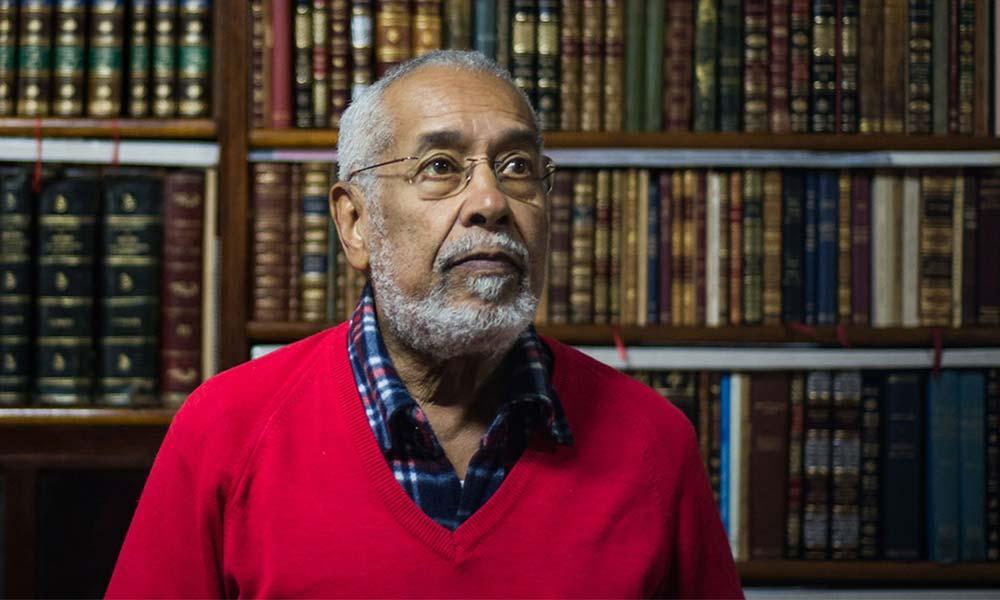
Africa-Press – Cape verde. He is considered one of the greatest collectors of rare books in Portugal, with a library valued at more than five million euros. His passion for Africa led him to travel and work in several countries on the continent. The adventure of a lifetime for this Cape Verdean from the old Rua da República, in Praia Maria, was traversed by pages of parchment and covers embroidered in gold. Works that allow you to dream of time travel.
The first of more than 40,000 books in his library, Manual de Biologia e Toxicologia, by Pereira Coutinho, Daniel Nunes bought at a used bookstore on Calçada do Combro, in Lisbon. It cost him 10 pennies, in 1953. And he asked to pay in two installments. But the bookstore, looking at him, a young African boy, curious, without much means, told him he could take it and pay later. Daniel returned at the end of the month and paid for the book and even took some more.
But the love for books and the knowledge they brought started right at home, on Rua da República, in Platô. «Our father always told us that any historical fact must always be proven. Afterwards, in the Casa dos Estudantes do Império, there was a dogma in force, when the older ones spoke, we younger ones listened and there was no question of whether it was true or not.»
Passion for Africa
His father’s advice, a Portuguese finance official, was followed to the letter by Daniel. From that first book, which he went to buy with José Leitão da Graça, Daniel never stopped. «I discovered the wonder that books about Africa were. But I also bought novels, but only for reference, I have all the Portuguese and Brazilian classics, all the important poets.»
Nephew of the poet António Nunes, whose book Poema da Manhã was presented in Lisbon, with a review by Jaime Figueiredo, Daniel has always had literature, poetry close at hand.
And he remembers how there was a center for African studies. But few people showed up. «There were more people connected to the Espírito Santo family, some friends of Amílcar Cabral, but that was where my thirst for knowledge about Africa began.»
The first purchases happened in a disorderly way, as he says. «There was still some lack of guidance. Some time later, I had to get rid of 3,000 books to make room for those about Africa, which interested me most.”
The new skills even included learning bookbinding techniques, and with them came friendships with booksellers and secondhand booksellers in Lisbon, Porto and other Portuguese cities. “Everyone has always treated me kindly. And sometimes, I was in Guinea when a book about Africa appeared, after exchanging correspondence, the book ended up at my house and I paid for it when I arrived in Lisbon. All of them still make me a significant discount today and our friendship is priceless.”
Auctions
Daniel is no longer just any buyer. When he bids at auctions, booksellers don’t bid against him. «They ask how far I go and from there, the war is between them.»
But the world of rare books and their collectors is full of stories, strokes of luck and finds. As the first book in history to address slavery, published in England, in 1758. «It is in it that the sketches of slave ships appear for the first time, explaining how enslaved people were placed, side by side, in the holds. The book cost €5,000; I got a few phone calls, but I said I didn’t have the money. The bookseller sent it to me and told me to pay when I could. It ended up being 3600 euros».
For him, more than the purchase or the deal, it is the friendship that unites them in trust, the most important element. And there will be around 10, 12 thousand books on the subject of slavery alone, says engineer Daniel Nunes, who started out working and later headed the laboratory of the Portuguese dairy company UCAL.
«In 1955, I’m in Mafra, with a good life and excellent allowances. He earned 1800 escudos a month, but he often stayed at the house of Viriato de Barros, from Tchenta, who were doing their military service at that time, also in Mafra.»
Income begins to be channeled into the acquisition of books, now of superior quality. Over time, he became an expert whose opinion is respected by sellers. «Some call me a doctor, others an engineer, others a master, and it has happened that I asked them to increase the price of the book six times, and it was sold in less than 24 hours.»
This was the case with the book of the Order of Christ, from the Monastery of Alcobaça, from 1527. «They started by asking for 125 contos, on the same day they offered 5 thousand; on my advice, the seller waited another month and the book was sold for 25 thousand contos.»
To know and analyze the value of a book, he says, it is necessary to take into account some details. «It depends on the bindings, if they are of good quality, how are the corners, the spines, if they are closed or open, if they are in gold leaf, and here the price difference can be huge.»
collector’s luck
Lucky strikes and big surprises are part of this business. «The strangest of them happened to me in the city of Santarém, in the bathroom of the local volunteer firemen’s bar; in the place of the toilet paper roll, was almost complete, the Book of Maxims of Solomon, translated by some curious person, dating from the beginning of the 19th century. I offered the owner a whole pack of toilet paper and brought the Maxims in my pocket.”
Daniel is a confessed admirer of Ibn-Battuta (1304-1369), a wise North African, explorer and considered one of the greatest travelers in the history of mankind. He is the first to describe the Great Wall of China, long before Marco Polo arrived in this country. The first publication, which gathers his reports is from 1840, about 80 copies; the second is from 1855, with only 35 copies. It has two copies of the first edition. «I bought it, in 1976, in Largo dos Mártires da Pátria, in bundles of papers that the owner was going to sell at a low price; I saw that there were several tied up and I saw the second volume of Ibn-Battuta and a few other books.
I bought everything so as not to arouse the owner’s suspicions, of course. It was all for 100 escudos, but I paid 500, hoping that the next day he would bring more. Of course it didn’t show up anymore. He saw the value of the thing. But I wrote a total of 3700 stories in those papers and books, among them the Revolt of the Slaves of Martinique, from 1840 and also all the correspondence between Portugal and England on the abolition of slavery. I doubt that the Ministry of Foreign Affairs itself has it.”
A walk through some leaves
However, in addition to luck, there are also true strokes of madness, so to speak, like exchanging a floor in Campo Grande for some leaves from the Middle Ages. «53 years ago, I was in Guinea-Bissau and assisting in Guinea Conakry, as a cooperator, when someone came to tell me that they had an epistle of D. Manuel I to report, to communicate, to the Pope, about a battle in Africa. It has only two and a half pages and it cost me 3200 contos. Only two copies are known in the world, of course the third one that is not mentioned is here at home, on my mezzanine . I gave her my apartment in Campo Grande, close to the church. Imagine how much it would be worth today.”
Among other rare books, he tells us, are the ‘Catechism for the infidels of Angola who profess our holy faith’, from 1620; the first History of Portugal, published in Paris, bound in parchment, from 1581. In addition to the rarities in the library, there are also the framed old maps that Daniel has on the walls of his living room – which he ended up not buying. They are from Guinea and Cape Verde, dating from 1570 and 1599, from the country of the Jalofos, others from 1600, a Mercader from 1620, some from 1700, 1850, from the Zaire basin, before the Berlin Conference. «The most valuable one, Isaltino (Isaltino Morais, mayor of Oeiras, where Daniel lives) said he would have it translated into Portuguese.»
portuguese overseas
Daniel avoids the question about the value of the library. Because the private collection also includes heads in terra cotta, from Nok, from the Gulf of Guinea, discovered in 1945 and over 2500 years old, according to a French museum. Next to it are bronzes from Benin, ancient masks from West and Central Africa, from the Inner Nile, aged between 250 and 2500 years. Which, of course, is not included in the price of the library.
If the walls of the living room and the mezzanine are for the oldest and rarest books, in the basement there is an important part of its special collection. There are tens of thousands of books and documents about the former Portuguese overseas territories. «About 60 percent are books that haven’t been on sale for over a century; for example, everything that concerns the ex-colonies, UN mandates, slavery, the tobacco trade, cotton, firearms, which was left by a general, Freire de Andrade, for me to put in order; I have documents from the founding of the Society of Nations, others secret, reserved, about forced labor, the wars in Guinea, Angola and Mozambique.”
As you would expect, the house of Daniel Nunes, in Oeiras, has recently become a place of pilgrimage for university, masters and doctoral students. «In 2022 alone, there were more than 400 consultation requests from the Guinea-Bissau newspaper Nô Pintcha. I told the Faculty of Letters that it was not possible, for security reasons. It’s a risk to open the doors for consultations, if they take something from here I won’t realize it until much later. I have the whole newspaper digitized, there are about 1 million and 50 thousand images.»
Cape Verde is not interested
A year ago, a French expert valued Daniel Nunes’ library and art pieces at around 5.5 million euros. As for the second question, the future of the entire estate, this could pass through the municipalities of Oeiras or Lisbon. «The latter is studying a proposal and so is the Presidency of the Republic of Portugal.»
Daniel reflects for a moment before continuing. «You know, I thought at times of leaving all this to Cape Verde, but the government has a certain type of procedure that is not very consistent with this. The only person who showed real interest was former President Jorge Carlos Fonseca, who was kind enough to visit the library.”
«I’ll give you just one example, I recently saw an RTP 2 program on Cape Verde, with historian António Correia e Silva. They spoke of the Duke of Aveiro, the grantee of the island of Santo Antão. That document you are talking about was in fact to be sold to Cape Verde, where it should have been. Family members have the manuscript and wanted to sell it, but neither the government nor the Chamber of Santo Antão even showed interest in it. It cost 9 thousand contos, there are 21 pages, dated 1700. I ended up buying it and it is here at home.»
The idea, confesses Daniel, is that the library remains intact, whole, in which consultation can only be done through an official body and only for certain books. «But without being able to enter with suitcases, bags or backpacks», he adds.
Almost turning 89 in September, Daniel Nunes lives with his youngest daughter, aged 17. He has yet another son and a daughter in her fifties. The collector also has the desire to add a few more years, at 89. «I still hope to live until I’m 117. If God gives me a good clear head to think about.» To that end, he confesses, he reads for five hours a day and doesn’t stop working with wood in his carpentry workshop. «All the woodwork in the library, the stairs, the baluster, the mezzanine, the shelves, everything was made by me, over two years, in sucupira and jatobá wood, from Brazil, and with thermal and acoustic insulation.» He still hopes to find more space, in it, for over 30,000 books that he has spread across São Tomé and Guinea-Bissau.
Return, 70 years later
Four years ago, he returned to Praia for the first time, where he had left at the age of 17. He came with a Portuguese television team SIC, for a documentary about his relationship with his youngest daughter, called ‘Daniel and Daniela’, filmed between Portugal, Cape Verde, São Tomé and Guinea-Bissau. A long delay that has its reasons, Daniel tells us:
«Cape Verde was too small for me. I had other dreams. Time passed, I walked along other paths in this world, and then I began to fear that I would no longer find people from my time alive, like Daniel Benoni, Jorge Querido, Betinho. But also, I’ve always been very talkative, wherever I’ve been. And cunbersu sabi is ladron di tempu…”
When he isn’t reading, even in the carpentry workshop, Daniel enjoys himself in his garden around the house, where he grows different fruit trees: «I have custard apples, pine cones, mangoes, bananas, sugar cane, guava, I tried papaya but it didn’t work. gives, everything that is Portuguese fruit, and also chicken, duck, rabbit, guinea fowl…”
Lately, in addition to having inaugurated a study center named after him, President Isaltino Morais called him to say that Daniel Nunes, the collector of rare books, was on a list of the 250 figures of all time in the Municipality of Oeiras.
«There are two pages dedicated to me there», he tells us.
For More News And Analysis About Cape verde Follow Africa-Press