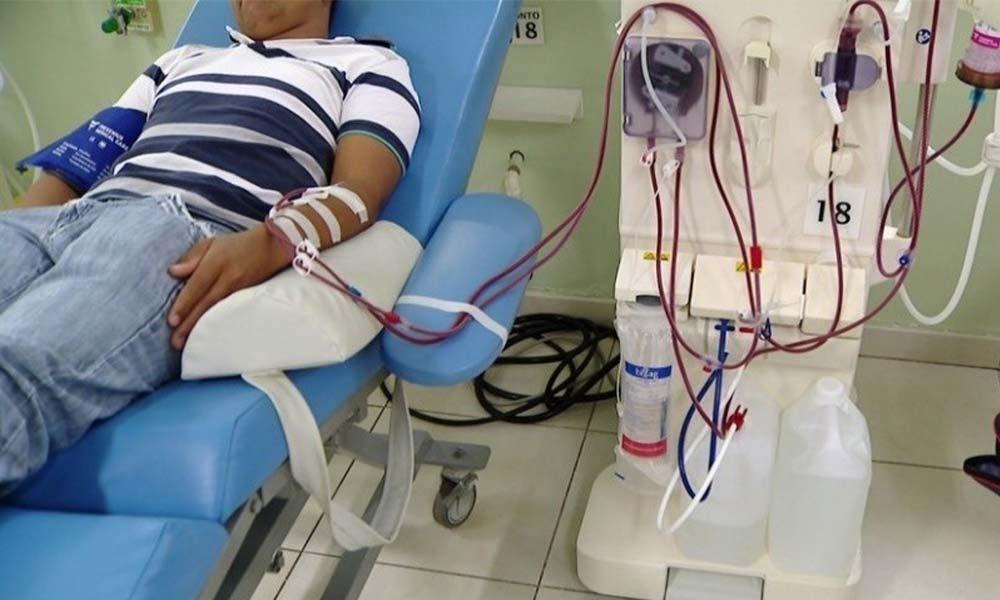
Africa-Press – Cape verde. They are literally stuck in the machine. There are three hemodialysis sessions per week lasting four hours each. A NAÇÃO tells the drama of those who depend on hemodialysis to survive, in São Vicente. With compromised routine and habits and conditioned freedom, chronic kidney patients reveal the anguish and desire for a kidney transplant that grants more freedom and reduces the constraints imposed by kidney failure.
Mondays , Wednesdays and Fridays are sacred days for Edna Gomes, a 32-year-old chronic kidney patient. It is during these days that she undergoes hemodialysis treatment at the Dialysis Center of Hospital Baptista de Sousa, in São Vicente. It’s been that way since last year when she started treatment that replaces her compromised kidney activity.
It’s four hours connected to the machine that removes liquid and toxic substances from the blood, as if it were an artificial kidney.
Treatment
Although it was not a shock, a priori, to know that she would depend on a machine to survive, Edna had difficulties facing the treatment, but she adapted some time later. The marks and scars left by the entire hemodialysis process, despite undermining self-esteem at the beginning, today reinforce the struggle for quality of life, even if limited.
“I was diagnosed with kidney failure in 2020 during the pandemic. It wasn’t until 2021 that I started hemodialysis. I received the diagnosis in a normal way, because the disease in my case is hereditary. I had the fistula surgery and since then I have been doing the treatment, although it was not easy at first”, reveals Edna.
Away from family and broken dreams
Chronic renal failure and hemodialysis completely changed the life of our interviewee. Born in Santo Antão, she had to leave her native island to live in São Vicente. She left behind her son, family and dreams interrupted by kidney disease.
Less than an hour away by boat from her family, she is not always able to visit them, due to the compromised routine involving the tiring hemodialysis sessions and dietary restrictions.
Government subsidy delays
In the midst of all the physical and psychological limitations, financial difficulties are also frequent, especially for those who are far from home, with the Government often delaying the subsidy given to the sick.
“I can’t work because I spend most of my time on hemodialysis or feeling unwell. We depend on the government subsidy that never arrives on time. There is always a month of delay, which affects our stay here and our responsibilities”, points out Edna who remembers that the subsidy has already been delayed by three months, so she asks for regularity in payments.
Diagnosis at age 19
Christianni Silva, 22, is the youngest patient at the Dialysis Center at Baptista de Sousa Hospital.
He started hemodialysis in 2019, at age 19. The frequent inflammation throughout the body sparked the warning sign for kidney disease. With renal failure confirmed and the activity of the kidneys compromised, he “took himself to the machine” to survive.
“My life practically stopped to give way to the treatment of chronic renal failure. Being very young and full of dreams, the diagnosis was not easy. I was depressed, I had to stop studying and practically live in the hospital with frequent hospitalizations, due to my body’s rejection of the catheter”, says the young woman, born in Mindelo.
Today, three years after starting hemodialysis, Christianni is able to lead a normal life, despite the limitations.
He managed to finish the 12th year of schooling and dreams of studying law, working to help his mother and having a new kidney, in a frantic attempt to return to live with more health and freedom.
“I have seen many people with kidney failure die out of nowhere. I learned to live with this hypothesis of the uncertainty of death, but I learned, above all, to live and not let the dreams that feed my desire to be alive”, she says.
Lack of medicines and laboratory tests
Christianni and Edna’s fighting partner, as their hemodialysis colleagues call them, Emerson Lima, 37, reports the constant lack of medication and laboratory tests not available in the public health system.
This young man from Santo Antão, who has been undergoing hemodialysis since 2016, cites, for example, the frequent breakdown of Calcitriol, Complex B and other medications and denounces the failure by the public health system to perform the Parathyroid PTH test, which regulates the levels of calcium and phosphate in the blood.
“There is constant disruption of essential medicines, but also laboratory tests. For example, the parathyroid hormone test is not carried out in public, only in private and has a cost of 12,500 escudos. Many are left without the exam because they cannot afford the cost”, he denounces.
The complaint also concerns another drug that has not been made available to the public: Erythropoietin, which he says costs twenty thousand escudos.
“When I was in Praia, after the hemodialysis sessions, we took this medication, which, however, was suspended due to the high cost. Practically no one can afford the cost of twenty thousand escudos for a drug that is essential in the fight against anemia”, he concludes.
Patients ask for the presence of a social worker
Furthermore, our interviewee reports the lack of a social worker at the São Vicente Dialysis Center to accompany patients and identify real needs because, as he says, there are people experiencing serious difficulties.
Emerson Lima has already passed through the Dialysis Center at Hospital Agostinho Neto, in Praia, and returned to São Vicente, where he lives with his family, amid difficulties. However, he is not let down. He is optimistic and lives one day at a time with hope for better days and the improvement of the living conditions of those who depend on hemodialysis to survive.
Kidney patients dream of a new kidney
Edna, Christianni, Emerson and all kidney patients on hemodialysis share a dream: to have a new kidney that frees them from the machine, gives them more health, freedom and independence.
It is in this sense that they call for urgency in the approval of legislation for organ transplantation and the creation of physical and material conditions for the start of kidney transplantation in the country.
Christianni, 22, is hopeful and believes she will soon get a new kidney in Cape Verde. She has already talked to family members and, in case of compatibility, she believes that someone in her family would be willing to donate.
The expectation is also shared by Edna Gomes, who says she needs a new kidney to dream again.
As she has family members with hereditary renal failure, Edna does not know if anyone in her family would be able to make a donation, but she continues to believe that the transplant will be possible in Cape Verde and that she will be one of the beneficiaries.
Fear of “false hopes”
Unlike Edna and Christianni, Emerson Lima has not yet discussed the matter with family members. Not only because it is a sensitive issue, but also because kidney transplantation is not yet a reality in Cape Verde and he prefers not to raise false hopes.
“I didn’t get to talk to my relatives about the possibility of donating a kidney in case of compatibility because the transplant does not yet exist in Cape Verde. Perhaps if this process existed, someone would have already shown a willingness to donate,” she surmises.
Emerson is afraid of frustration, not least because, as he says, they were recently deceived by the Minister of Health.
“I don’t talk about it. We recently had a false alarm from the Minister of Health who gave us hope about the start of the transplant, but then he said that the conditions were not yet met for transplantation”, explains Emerson, who believes that a large part of hemodialysis patients, at the moment, do not will have the opportunity to receive a new kidney.
In the midst of all this, kidney patients are calling for the entire kidney transplant process in the country to be speeded up, starting with the approval of the proposed law on free organ donation, harvesting and transplantation, delivered to Parliament in early 2022, still without answer.
Due to financial difficulties Maria Andrade considers giving up hemodialysis
On hemodialysis since December 2021, Maria Andrade, 54, is considering abandoning hemodialysis sessions.
Born in Santo Antão, this kidney patient says she is experiencing “serious difficulties” in São Vicente, where she is residing due to the disease.
Since he moved to Porto Grande Island for hemodialysis treatment, he has not yet received the subsidy allocated to kidney patients, despite having already submitted the request “several times”.
Since then, as he advanced to A NAÇÃO, he has been experiencing financial difficulties and has not been able to cover the costs of living far from home.
Late income and no water to drink
With the income of the house where she lives in arrears, the financial difficulties have been accentuated even more and hampered Maria’s treatment.
Our interviewee says she even gets thirsty because she doesn’t have the money to buy bottled water, as she is unable to drink running water due to kidney disease.
“I’m going through a lot of difficulties here in São Vicente. I want to go to my house. I’d rather be without hemodialysis than go through these difficulties that I’m going through at the moment. I don’t even have money for the bus to go to treatment. I go to headquarters to get an idea of how serious my situation is”, explains Maria, who asks whoever is entitled to solve her problem and gives her what she is entitled to, the monthly allowance.
Ministry of Health awaits legislation
On the part of the Ministry of Health, it is only known that it is waiting for the approval of legislation and technical support from Portugal to start with kidney implants in the country.
Recently, Minister Arlindo do Rosário confirmed that everything was ready for the start of kidney transplants, but later denied the information.
For this report, we contacted the Ministry of Health, including Minister Arlindo do Rosário, to find out where the process of starting kidney transplants is going in the country, as well as to know the costs of the two hemodialysis centers for the pockets of the State, but not answers arrived.
The NAÇÃO also sought to hear from those responsible for the dialysis sector of the Baptista de Sousa Hospital, also without results, despite our questions having been forwarded in good time for this report.
For More News And Analysis About Cape verde Follow Africa-Press