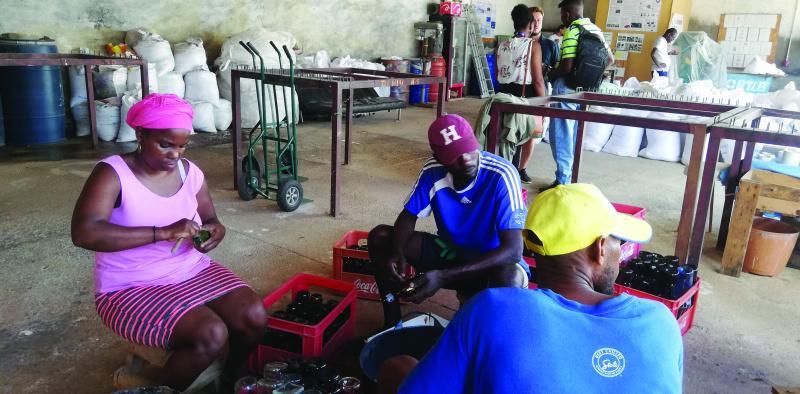
Africa-Press – Cape verde. Opening for just a couple of years, hundreds of thousands of glass bottles and many kilos of plastic have passed through Ekonatura and given a new life. Even without a great economic return, a major achievement is already visible: there has been a change in the community’s mentality regarding its waste management. Today, everyone is happy and works together to “feed” the center and keep the place clean.
The area of San Francisco is quite clean. Upon arrival, there are no empty bottles on the floor, nor the plastic that is often part of the landscape of Cape Verdean towns. The work of Ekonatura, a community company that recycles glass and plastics, will certainly have contributed to this. This is what residents, young and old, and volunteers tell us about this initiative that the entire community knows about and supports.
Nayara Spencer, 11 years old, remembers the visit she made there with her school. They saw the work carried out in the small ecocenter in São Francisco, they talked about recycling and the environment. And although she recognizes that younger people are the ones who are most aware of the issue of waste and the environment – “they teach us at school” –, older people are also beginning to worry about this issue. “The entire population is interested in keeping the environment clean,” she says.
“It’s good for the environment and the community”, argues, in the same vein, Janete Oliveira, 25 years old.
Although most of the waste – here raw material – from Ekonatura comes from partner companies (Cavibel and Tecnicil) and individuals from the city of Praia, the community contributes as much as it can. At home or in commercial establishments, many people combine plastic and bottles. And even the cleaning services help.
Janete’s aunt, for example, is a sweeper at the Chamber, and when she comes across this type of rubbish “she picks it up and takes it there”, to Ekonatura.
The result is visible. As João Moreno Mendes, a 50-year-old resident, says, before there was “a lot of trash, a lot of bottles here and there. Now it’s less and when we see the bottles collected, [San Francisco] looks much more beautiful.”
For each person, the compliments add up. Born and raised in San Francisco, Celestina Ferreira, 62 years old, says that she had only seen something like this “on television” and speaks with pride about Ekonatura. “I know the project, I think it is developing well. We are all in agreement and happy.” And she also highlights how the locality is cleaner today, thanks to this project. “Plastic things, we don’t put them on the street. We gather them, put them in a corner and give them to them. Bottles too”, she says, highlighting that the entire community collaborates in this cause.
Ekonatura
The Ekonatura project was created in 2019, within the scope of the Raiz Azul project, and implemented by the Cape Verdean Ecotourism Association (EcoCV), in partnership with the University of Cape Verde and the São Francisco Community Development Association itself. Afterwards, it was established as a community-based micro-enterprise. The pandemic, however, forced a break and work resumed in 2021/2022.
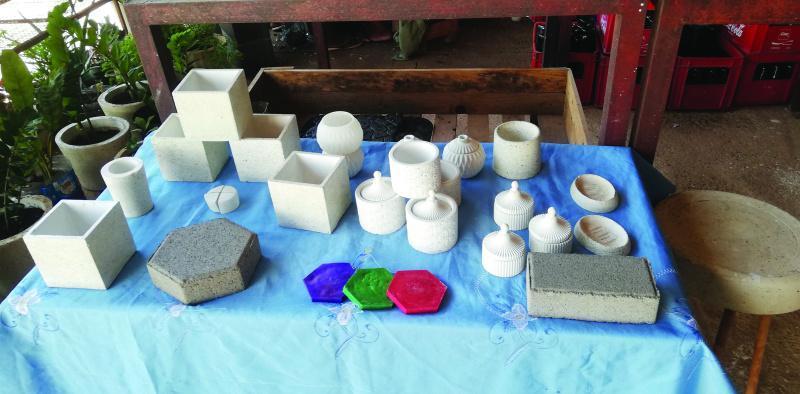
In this recycling center, glass and plastic gain a new life, transforming into decorative objects and materials for civil construction.
“With plastic we make key chains, coasters, etc., and glass is transformed into sand with which we make vases and also blocks for construction, pavés, among other materials”, says João Ferreira, administrator of Ekonatura and president of Community Association.
How many glass bottles Ekonatura has managed to process is unknown, but since the center started operating, 100 tons of glass sand have been produced. Now, given that for a bag weighing around 80 kg, more than 20 crates of bottles are needed, doing the math, it would have been around 600 thousand.
However, there are limitations to plastic recycling. At the moment, HDPE is transformed, but not PET, a more resistant material, as Ekonatura does not yet have the machinery to make modifications with PET.
The objective is to acquire more equipment and machines, but the search for financing has also been a challenge. “Companies say they are suffocated, that they have very little room for maneuver, so it is not easy to obtain partnerships and support”, he shares.
As for the demand for products created here, there hasn’t actually been much. “We still have a society that does not know the product and there is a tendency to work with traditional products, but little by little we are gaining ground”, believes the person in charge.
In the case, for example, of building blocks, there is still no “sale of the blocks because the cost is a little higher compared to common blocks. They are stronger and heavier,” he says.
But, if the economic return is not high, the impact it has had on people and the environment is relevant.
“People started to have a different vision for nature. We occasionally clean up the community, we are already starting to sort and collect plastic and glass bottles.
For More News And Analysis About Cape verde Follow Africa-Press