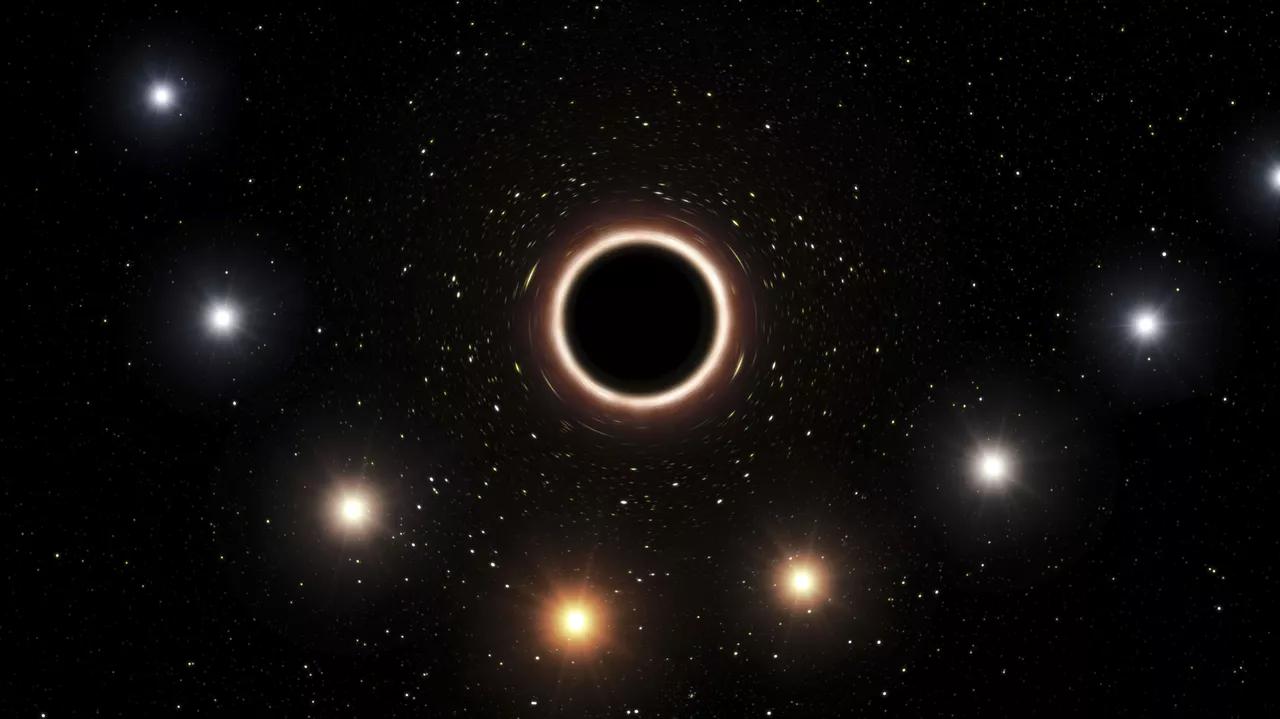
Africa-Press – Cape verde. A group of researchers from the University of Amsterdam created a black hole analog in a lab setting, which can possibly unveil some crucial data about the elusive radiation theoretically emitted by real black holes.
According to a study, published in Physical Review Research, a team led by Lotte Mertens created a one-dimensional chain of atoms served as a path for electrons to “hop” from one position to another.
This allowed them to simulate the event horizon of a black hole – i.e. the range beyond which events cannot affect an observer, since the immense density of the black hole prevents event light from escaping the boundary.
The paper suggests that the scholars were able to track the equivalent of Hawking radiation – an theoretical effect that may have taken place outside a black hole’s event horizon because of relativistic quantum effects.
The effect of this fake event horizon produced a thermal shift – but only in certain situations, when part of the chain extended beyond the event horizon.
While the Hawking radiation is too faint to be properly detected at the current level of science, the study opens up possibilities to prove its properties by creating other black hole analogs in laboratories.
For More News And Analysis About Cape verde Follow Africa-Press