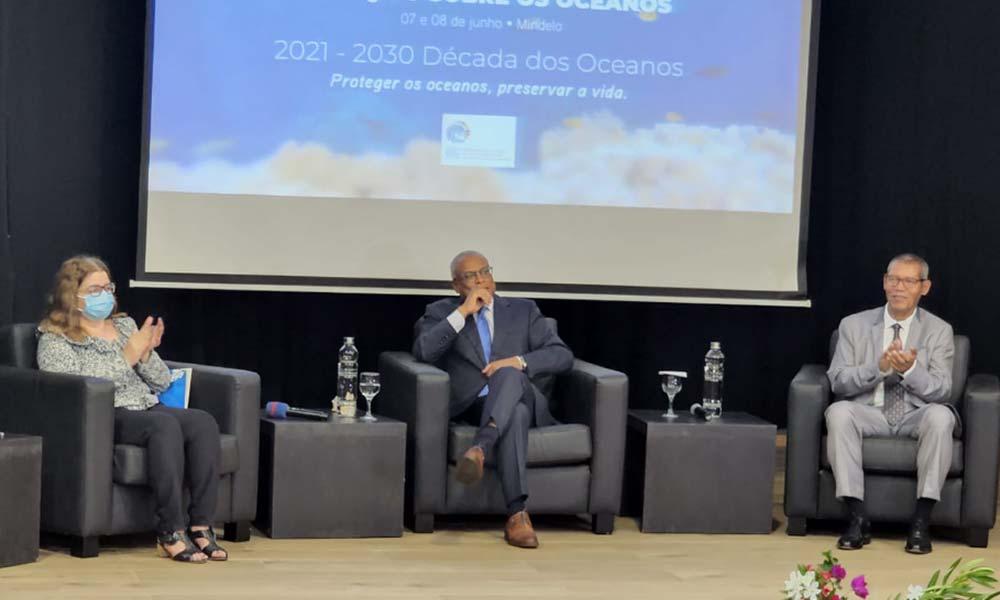
Africa-Press – Cape verde. The President of the Republic of Cape Verde defended today, in Mindelo, that Cape Verde has no more time to lose to fully meet the challenges launched by the United Nations 2030 Agenda, with regard to the sustainable development of the oceans.
José Maria Neves was speaking at the opening of the Colloquium on the Oceans, taking place in Mindelo, São Vicente, under the motto “The science we need for the ocean we want”:
The initiative is part of the activities related to the decade 2021 to 2030, which was declared by the United Nations as the decade dedicated to this issue.
“ A small and archipelagic country like ours has a fragile environmental balance and is vulnerable to the negative impacts of climate change. The protection and preservation of its coastal and marine natural resources are urgent, as the oceans are one of their main sources of resources, particularly when it comes to the Blue Economy”, warned the head of state.
Blue Economy
The Blue Economy, for a country that is 99% sea, he recalled, has long been assumed as one of the strategic axes for the development of Cape Verde, namely in the “Letter in favor of the promotion of the Blue Economy” (2015), in the “Blue Economy” (2015). Unified strategic framework for the promotion of the Blue Economy” (2019) and in the “National Plan for Investment in the Blue Economy” (2020).
These instruments, he said, demonstrate Cape Verde’s “strong commitment” to promoting the sustainable development of its sea and coastal areas, which minimize environmental degradation, loss of biodiversity and non-durable and predatory use of marine resources.
“Cape Verde has taken concrete steps towards the implementation of a Blue Economy, and, I believe, it will be successful”, said the head of state.
SV Maritime Economic Zone
José Maria Neves also said he hopes that the so-called Maritime Economic Zone of São Vicente will be able to stimulate and dynamize more initiatives of the kind, which fits in with its objectives, namely with regard to the use of the sea.
“At the same time, Campus do Mar should play an important role in this whole process, especially with regard to research and innovation,” he added.
Challenges
Among the challenges of the decade of the oceans, the PR highlighted that of feeding the Planet, to which, as he defended, solutions that necessarily go through expanding the supply of food using fishing and the cultivation of marine organisms, sustainable way.
Another challenge pointed out is to increase the resilience of communities to ocean risks, especially riverside populations, in the face of the fury with which nature has reacted to the incessant aggression that it has been suffering, with increasingly frequent extreme weather events.
“This is intended to improve multi-hazard early warning services for all risks associated with oceans and coasts, as well as community preparedness and resilience,” he noted.
The head of state also mentioned other challenges, which include knowing and mapping the seabed, strengthening the ocean observation system, with the consequent socialization of data, so that it reaches everyone in a timely manner.
avoid overexploitation
“Talking about the preservation of marine resources is equivalent to saying that we must avoid commercial overexploitation of fish stocks, for example. And the situation is sometimes more serious if the capture of protected and endangered species is involved”, he warned, on the other hand.
Within the scope of the fisheries agreements signed by Cape Verde, he specified, it is recommended that the inspection be effective, to ensure that the rules are being respected throughout the capture process, thus ruling out the possibility of being faced with a predatory activity and capable of provoking the extermination of some species.
artisanal fishing
On the other hand, he maintained, the conditions in which seafarers, who engage in artisanal fishing, carry out their activity, require a “marked improvement”, in view of their “very important” socio-economic role, however, “generally associated with poverty”.
“It must be recognized that socio-economic fragility can be associated with non-compliance with the restrictive measures that are imposed with a view to environmental conservation and protection. This is the case, for example, with the problem related to the extraction of sand on beaches or the capture of turtles ”, he emphasized.
Other initiatives
Finally, José Maria Neves congratulated Cape Verde’s higher education and research institutions, environmental NGOs linked to the sea, the Civil Society Ad hoc Commission for the Decade of the Oceans, as well as “all those who made it possible and participate ” at the event, which marks the Decade of Ocean Science for Sustainable Development.
The event, promoted by the Presidency of the Republic, takes place between today and tomorrow, and comprises a cycle of four thematic conferences, framed in the 10 challenges of the Ocean Decade.
It also includes exhibitions on best practices in the preservation of marine and coastal biodiversity, workshops on techniques for the reuse of marine litter and a film session related to the oceans.
For More News And Analysis About Cape verde Follow Africa-Press