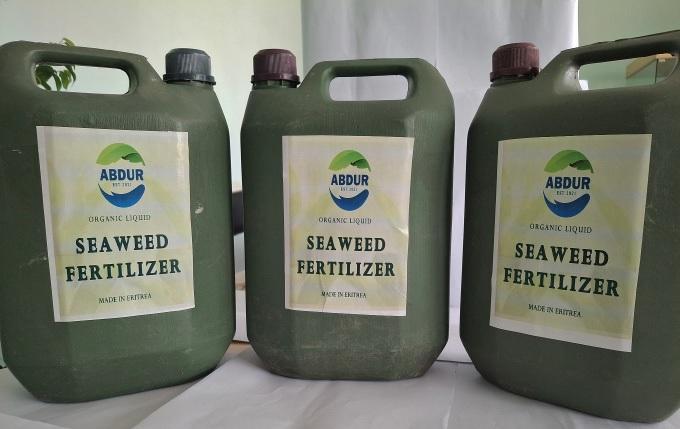
Africa-Press – Eritrea. In a strategic effort to safeguard the environment, the Ministry of Marine Resources and the Ministry of Agriculture have imposed restrictions on imports of chemical fertilizers and pesticides. This policy is designed to mitigate the harmful effects of synthetic chemicals on Eritrea’s ecosystems, with a focus on protecting vital water bodies and marine life. To provide a sustainable alternative, both ministries have launched a national campaign to promote the production and use of organic fertilizers.
At the forefront of this movement is Abdur Enterprise, a facility based in the port city of Massawa in the Northern Red Sea region. The enterprise is dedicated to the sustainable utilization of marine resources, with a core mission to enhance local livelihoods through ecological innovation.
A key figure in this transformation is Yihdego Tewelde. After graduating in 2015 from the College of Marine Science with a degree in Marine Biology, Yihdego joined the Ministry of Marine Resources in 2018. Just a year later, he and his colleagues envisioned a way to turn marine waste into a valuable resource: liquid fertilizer derived from seaweed. As a founding member and General Manager of Abdur Enterprise, Yihdego shares the journey and impact of these innovative projects.
* * *
What happened to the idea of liquid fertilizer from seaweed?
In 2019, we conducted a trial using 60 liters on the Ministry of Marine Resources premises. The trial went very well. Before we could expand production, however, the pandemic broke out, and progress was stalled for a while. Later in 2021, the Ministry of Agriculture and the Ministry of Marine Resources collaborated to form an organic fertilizer and bio-pesticide committee. This committee was instrumental in the follow-up process. We formed a team of four—two from the Ministry of Agriculture and two from the Ministry of Marine Resources—to launch the project. We sent samples to four zones across the country, where they were tested on fruits and vegetables, with excellent results. This success gave everyone a boost, and it was decided to expand production. We were provided with a warehouse facility in Massawa and began producing 1,500-2,000 liters per month until 2022.
In 2022, the Ministry of Marine Resources recruited 17 additional workers, and our production tripled to 5,000 liters per month. We distributed fertilizer free of charge until September 2023 to raise awareness among farmers. Since then, we have begun selling our products, and both our workforce and production volume have continued to evolve.
Beyond liquid fertilizer, we collaborate on other projects as well. For instance, we produce natural seaweed soap, now available on the market. We have sent samples to Europe and Africa and have participated in national conferences where we met various professionals and organizations, shared experiences, and observed the progress of similar initiatives in other countries.
Do you consider it more advantageous than other currently available fertilizers?
Yes, it actually offers more advantages than chemical fertilizers. Our liquid fertilizer is highly concentrated. In liquid form, it is much easier to transport than other fertilizers. Most importantly, our product is organic and free of hazardous chemicals found in many fertilizers. It enriches the soil and supports beneficial microorganisms, thereby increasing production while remaining environmentally friendly. Because it is organic, the resulting crops are safe for people to consume without health concerns. The fertilizer has been tested on vegetables such as potatoes, demonstrating a minimum 20% increase in yield. A minimum 20% production boost is guaranteed if you use this fertilizer. In addition to being organic and safe, our seaweed fertilizer is affordable and easy to apply.
Is the initially intended goal achieved now?
I believe we have exceeded our initial goal. Our main objective was to minimize waste and put it to good use. We aimed to avoid post-harvest losses, and we succeeded: our process generates zero waste. We turned waste into a product that is now delivering strong results. Additionally, while we previously collected seaweed ourselves, we now have approximately 500 women from coastal villages— such as Halibay, Hirgigo, Zula, and Emberemi—who collect it for income. You can see that this project is also providing significant job opportunities.
Did the feedback from farmers match the hype?
Definitely, farmers really love the fertilizer. First, they face no health risks while applying it because it is organic, so they feel safe using it. Additionally, they benefit from the fertilizer through a guaranteed increase in profit.
You have another product on the market called natural seaweed soap. Tell us more about it.
We began working on the natural seaweed soap around the same time as the liquid fertilizer. However, given our small staff, we decided to postpone the soap project to focus on the organic fertilizer. Later, we appointed Sabr Suleman to lead the seaweed soap project.
We first sent a sample to the USA. Once we received the desired results, we formed a committee with the Ministry of Health. We worked on it for three months until we received the “green light” for production. While production is currently small-scale, it is available in Asmara in about five or six shops. The natural seaweed soap is free of hazardous chemicals and is enriched with seaweed, sodium hydroxide, and vegetable oil. It helps remove excess sebum and dead skin cells through gentle exfoliation, as seaweed has natural skin-healing properties.
Our main customers are Eritreans in the diaspora who often struggle to find natural soaps free of harsh chemicals, though they are becoming more widely used in Eritrea as well. We also introduced our products to the diplomatic community on UN Day; many now use them, particularly the soap. We continue to participate in conferences to share our experiences and expand Abdur Enterprise’s knowledge and reach.
Abdur Enterprise is expanding rapidly and has additional projects, correct?
Abdur Enterprise is based in Massawa. “Abdur” is a village in the Gelalo sub-zone where people were already exploiting coastal resources 125,000 years ago. Published research identifies them as among the first to do so, which is why we chose the name for our enterprise. In addition to fish amino acid fertilizer and seaweed liquid fertilizer, we produce seaweed soap and bleach made from sea salt. We now have three branches: Abdur 1 focuses on organic fertilizer production, Abdur 2 on seaweed soap production, and Abdur 3 on seaweed and sea cucumber farming. We also have a website, Abdurenterprise.com, to help us connect with customers and gather feedback.
Thank you so much for your time, Yihdego. Is there anything you would like to add?
All of these projects began as ideas and were made practical through collaboration between the Ministry of Marine Resources and the Ministry of Agriculture. I believe that working collaboratively truly gets you somewhere. We also have many educated Eritreans in the UK, Germany, the US, and elsewhere who help us professionally and provide feedback on samples we send them. We remain open to further collaboration. I want to thank both the Ministry of Marine Resources and the Ministry of Agriculture for making this possible.
Thank you!