Africa-Press – Eswatini. The historic agreement between Eswatini Railways (ESR) and CFM (Mozambique Ports and Railways) has highly been anticipated not only to bolster trade but also ease fuel woes in the kingdom.
Courtesy of the agreement, which was signed on Friday between the two countries, transportation of various commodities which include coal, cement, sugar and fuel from Eswatini directly to Mozambique’s capital (Maputo) by rail and vice versa will now be done at ease.
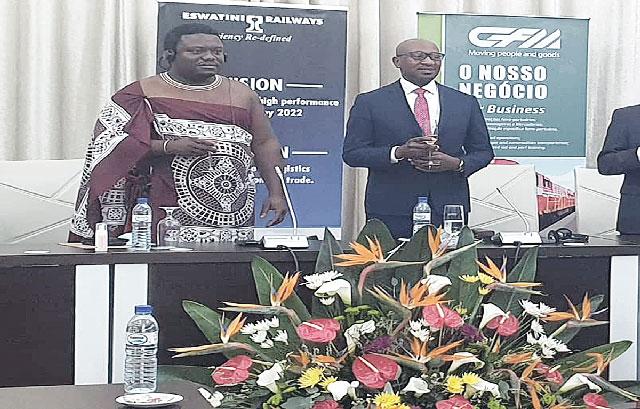
Eswatini was represented by Minister of Public Works and Transport Chief Ndlaluhlaza Ndwandwe, ESR Chief Executive Officer (CEO) Nixon Dlamini and ESR Board Chairman Alex Mngomezulu. Mozambique was represented by the Minister for Transport and Communications Mateus Magala.
Dlamini explained that the ultimate objective of the agreement would be foster seamless service provision between the two countries. He said this was expected to culminate in the elimination of bureaucratic procedures which were caused by the lack of an agreement for local trains to pass into Mozambique.
Unlike in the past when the agreement had not yet been put in place, trains from Mozambique could enter into the kingdom to Sidvokodvo rail station. Similarly, trains from Eswatini could not reach Maputo either to make deliveries or collections. Both countries worked on defined territories within the confines of their countries, there were designated interchange points where rolling stock was swapped.
Limitations
Minister of Finance Neal Rijkenberg is on record having said there were currently no limitations for importing fuel from Mozambique in order to avert fuel shortage emanating from the lack of sufficient supply from South Africa.
The lack of enough fuel to meet the local demand from Eswatini’s major trading partner, South Africa, which greatly affected supply patterns in recent months leading to a short-lived shortage, was caused by the closure of major refineries where local retailers sourced fuel.
In 2019 there were six operating refineries with the capacity of around 700 000 barrels per day bpd (oil equivalent) in South Africa.
However, as at June there were just two being Sasol Secunda (coal/gas to liquids), Natref (crude oil).
The shutdowns occurred at the Engen Refinery at the end of 2020 following an incident. Subsequently, he mentioned that the owners announced its permanent closure and conversion to an import facility. PetroSA (Mossel Bay) closed shop in late 2020 due to lack of feed, the plant now remains on care and maintenance.
Astron Energy Refinery (Cape Town) was shut down in July 2020 following an accident during start-up operations – set to recommence operation in second half of this year.
SAPREF (Durban) paused operations at the end of March after shareholders’ announcements to reconfigure their asset portfolios towards lower carbon footprint.
The decision concerning closures or pausing of operations (Engen Refinery and SAPREF) were likely linked to the significant capital requirements to invest for the production of very low sulphur fuels.
SA Petroleum Association Executive Director, Avhapfani Tshifularo, pointed out that despite prior acknowledgement of the necessity for financial assistance, the SA government was unlikely to provide support given present fiscal constraints.
“Strategically for Eswatini, consideration should be given to increase reliance on petroleum product imports directly from Mozambique (Lomahasha and Mhlumeni),” Tshifularo advised.
For More News And Analysis About Eswatini Follow Africa-Press