Africa-Press – Eswatini. How many people noticed the news of the Manzini Dobha Phansi burning down just a few weeks ago?
I also did not pay much attention to it, except to be sympathetic to the many small business owners who ply their trade in that area. This was coming from the mere fact that these people are trying to make ends meet in one clean way. Come to think of it, there is probably more to that story than just small business owners losing their wares.
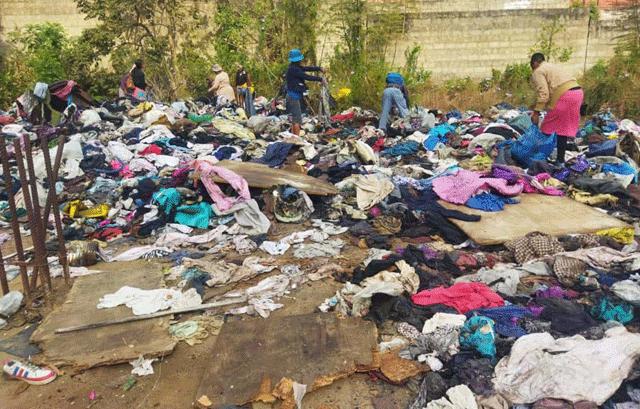
To put things into perspective, a few days ago we woke up to the sad news about the burning of stock bales for the Manzini small business owners who mainly sell second hand clothes at the Manzini bus rank. This is popularly known as the ‘Bend and Pick’ or ‘Dobha Phansi’ spot. This was after their storeroom at the Palm Beach building mysteriously caught fire. Thankfully the government through the Ministry of Commerce, Industry and Trade has pledged to assist the 430 vendors who were affected by the incident. This, as government stated, was from the understanding that these traders are significant contributors to our economy. This is great news in its own right, more so because the second hand clothes business is also good for the social and physical environment in many ways.
The economics in buying second hand clothing
Firstly, traders who sell second hand clothes normally import them from Mozambique or The Republic of South Africa. In doing that, these hawkers pay taxes for bringing their stock into the country. These taxes contribute to the pool that the government heavily relies on for service provision and infrastructural development in the country. Secondly, some of these clothes are of very good quality and are actually expensive clothing brands. These are normally sold at very affordable prices. As such many people save a lot of money. This is because when buying second hand one never pays the full price for the item, especially when buying high quality clothing from brand names that you know and trust. Sometimes these are clothing items you wouldn’t even find from the shops that sell new clothes in the country.
It should also be noted that saving money is also very crucial at a time like this when a lot of people lost their jobs and businesses from the effects of the COVID 19 pandemic.
There has also been a significant increase in the price of food and other basic commodities needed for survival. It therefore goes without saying that the opportunity of saving money from buying second hand clothes is a welcome one for many Emaswati.
However, it should also be noted that buying second hand clothes does not necessarily mean that they cannot afford new clothes. Some items are considered vintage clothes and therefore very much sought after.
Others may have been limited in stock and could not be purchased new.
The physical environment
Much as it is a noble idea for the government of Eswatini to support the second hand clothing business, because of its contribution to the economy, the most significant reason I personally find this industry very important, is how buying second hand clothes is a great way to reduce one’s negative environmental impact. Imagine the amount of new resources consumed when creating new garments. This starts from the natural resources that are used to create the very fabric and thread, to those that are used to power the machinery that is used in the line of producing the cloth and eventually the dress or shirt. Not even considering the varying amounts of natural resources used in the transportation of related goods and services. For these second hand clothes very limited, or even none, new resources are depleted to create new garments. For example, one can feel good in knowing that by buying second hand clothes they “reduce carbon emissions, save lots of resources, water, and energy and prevent old clothing from ending up in landfills or incinerators.” As stated by fashion blogger Alex Assoune. Furthermore, the 2017 report by the American Apparel Association states that “each person who buys second-hand clothing can prevent more than 500 pounds of carbon emissions every year. It reduces one’s water, waste, and carbon footprint by more than 80 per cent”.
Saving the environment by buying second hand clothes becomes even more significant when one looks into what goes into the production of new clothes. For example, the growing of cotton, as the raw material for clothes, requires a lot of fertilizers, pesticides and water. The Pulse of the fashion industry report (2018) by the Global Fashion Agenda, states that “cotton farming consumes 4 per cent of worldwide of nitrogen and phosphorous fertilizers, 16 per cent of all insecticides, and 7 per cent of all herbicides.” The report further argues that “these very toxic man-made chemicals pollute groundwater and waterways. Plus, they contaminate large areas of land, having a disastrous impact on ecosystems, the health of workers and communities.” So in buying second hand clothes, one reduces the amount of money that they spend in supporting an industry that pollutes the environment.
The social environment
Furthermore, supporting the second hand clothing industry in Eswatini also involves the support of the urban informal business. According to the World Bank, 2020 report, this industry accounts for 80.8 per cent of jobs, making it “the main source of employment and the backbone of economic activity in urban Africa.”
This is very important in a country like Eswatini where the unemployment rate is very high and has the potential to increase crime rates. Supporting this industry therefore means one contributes to the reduction in some of the social problems that would increase in the absence of this economic activity.
The report further states that “the vibrancy of the informal sector is difficult to miss in African cities as street vendors are key in ensuring food security. Those who work in transport keep the city and the economy moving. And those operating in services are critical to the overall incomes and functioning of African cities.”
This is why even the government of Eswatini pledged to assist the ‘Dobha Phansi’ vendors after the unfortunate incident.
Moreover, the urban informal industry also significantly benefits the youth and women. These social groups are normally marginalized in developing countries as they do not always get the opportunities for advancement that other social groups do. The World Bank report further highlights that “the urban informal economy is particularly common among youth (95.8 per cent ages 15-24) and women (92.1 per cent), and is an important contributor to poverty alleviation.” This is why this industry needs our full support, not only from us as customers but the government and other stakeholders.
This industry protects the youth and women, which are most vulnerable to many social ills. The World Bank emphasizes this by stating that “social protection for this industry plays a key role for business owners and workers to build human capital, prevent the sale of productive assets in case of shocks, and promote savings to build resilience.”
For More News And Analysis About Eswatini Follow Africa-Press