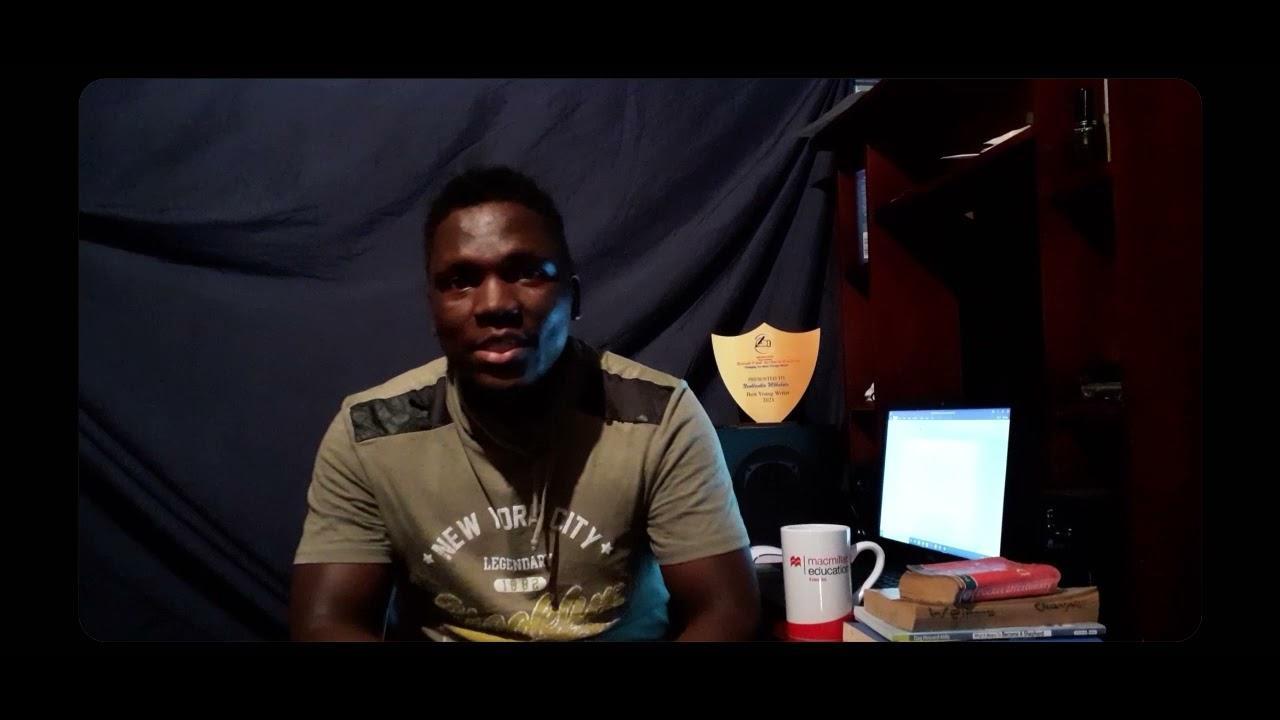
Africa-Press – Eswatini. Clement Thando Dlamini describes himself as a young, ambitious man who grew up in Bhunya, Lamgabhi with his grandmother.
He clarifies that his mother was a textile worker so she’d visit them during weekends until she passed in June 2010.
Spending most of his childhood years in the rural areas attending both his Primary and High school at Ekuthuleni Primary School and Inyandza High school respectively, he reflects that growing up with his grandmother shaped his future as she couldn’t afford to give him pocket money.
This then made him ashamed of his background to the extent that he started to runaway to the library during breaks in high school.
“I would go there and pick any book on the shelves or read the newspaper. While frequenting the school library, I fell in love with reading and eventually I started taking books home.
Reading novels made me appreciate fictional stories such that one day, whilst doing Form Five, our English Teacher gave us homework to write a narrative story. I wrote it exceptionally well such that I felt like continuing with the story. It was an amazing story,” he relays.
He states that after that story was marked and he went back home to continue writing, it became his first novel – a book he is yet to publish after so many years.
That is how, he states, he fell in love with writing. While he was at university doing his third semester, he introduced the Swazi Fest Writer’s Awards – an annual event which honours authors in the Kingdom of Eswatini.
This year marks the third edition since 2021.
Having worked with writers and authors in the kingdom of Eswatini, Dlamini has achieved a profound perspective about the arts industry – especially with book publishing. Reflecting on the many challenges faced by the writing industry in the country, Dlamini states that anonymity is one of the things that plagues local writers.
“We have a lot of writers in the Kingdom of Eswatini and the public don’t know them. Coming with the Swazi Fest Writer’s Awards was a meaningful stride to expose writers. I remember having an interview with Eswatini TV during our first edition and the Presenter asked me; ‘Do we have writers in the country?’,” he said.
A lot of locals, he reflects, who write books end up lacking the exposure. Ever since the Swazi Fest Writer’s Awards started, however, they have recorded over 200 writers and authors in the country
“We still believe a lot of them will emerge as they discover us.
Another challenge faced by our authors is lack of support as people mostly read books famous American authors instead of supporting their own.
All these challenges can be surmounted through extensive marketing to expose your craft and by also mingling with other writers. You could to share resources and contacts such as book publishing houses. The industry has a huge potential to grow only through the support of natives,” he says.
WRITING AND ARTIFICIAL INTELLIGENCE
With the growing popularity of artificial intelligence, some writers may feel as though the technology is a risk to their profession as one can generate written material simply by prompting an AI chat bot. Dlamini admits that he also feels the pinch when it comes to the Artificial Intelligence wave. He states that he feels his work is slightly threatened by the efficiency of AI.
“As a writer who runs a business that provides writing services, I feel threatened by AI due to the fact that this technology can generate accurate and quality writing.
A lot of people can now do things for themselves with the help of advanced technology. Academically, there’s even a huge concern of plagiarism and inefficiency of education as students can now use the help of this artificial intelligence,” he states.
Even though he considers the writing profession to be in danger, he still sees an advantageous perspective that shouldn’t be underestimated.
“We are the first generation to live in the ‘information age’ where a person can click a button to get information that otherwise would have cost him or her a few hundreds of bucks. Just like social media, artificial intelligence is not going anywhere so we need to adjust to the new normal and thrive. In our adaption, we can manipulate and use ingenuity by leveraging this massive technology,” he advises.
The concern of being made obsolete by AI rings through the minds of any and every writer who engages in the craft.
Dlamini states that one need not panic as there are certainly many ways in which writers can use the technology to their advantage. He highlights certain aspects that can be made more efficient by the technology such as research and proofreading.
“It’s true that AI technology is rapidly advancing, and some people worry that AI will eventually replace human writers; however, I believe that there are several ways that writers can use AI technology to their advantage.
First, AI can be used as a research tool, helping writers find information and generate new ideas. Second, AI can be used as a proofreading tool, catching grammar and spelling errors that human writers might miss. And third, AI can be used to generate content ideas, helping writers brainstorm new topics and angles for their work,” he says.
Apart from using Artificial Intelligence in these ways, Dlamini highlights other ways that the technology can be used. These include the elimination of repetitive tasks, saving writers energy and helping writers narrow down on a topic.
“In addition to the ways I mentioned, there are a few other ways that writers can use AI to their benefit. One is by using AI to automate repetitive tasks, such as formatting and transcription.
This can save writers time and energy, allowing them to focus on more creative tasks. Additionally, AI can be used to target and personalize content for specific audiences, helping writers reach the right people with their work. And lastly, AI can be used to identify trends and topics that are gaining popularity, allowing writers to stay ahead of the curve and produce content that’s relevant and timely,” he shares.
Another conversation worth having about Artificial Intelligence and writing is the issue of ethics. Due to the fact that AI softwares can be used to generate accurate content, some may feel as though writers using the technology for their writing would be cheating. Dlamini weighs the pros and cons of this phenomenon and states that transparency usually sorts out all the issues of ethics.
“Some people believe that it’s unethical for writers to use AI as a tool, because they believe it takes away from the human element of writing. However, others argue that AI is simply a tool, and that it doesn’t diminish the creativity or skill of the writer. I think the most important thing is that writers are transparent about their use of AI, and that they don’t try to pass off AI-generated content as their own work,” he says.
Like all advancements and developments in life, the rise of Artificial Intelligence is expected to impact and influence many different industries and sectors. Dlamini is well aware of this as he shares his own reflections of how this technology may change our lives both positively and negatively.
“The impact of AI will be felt across a wide range of industries, from healthcare to transportation to manufacturing. In healthcare, AI is being used to develop new drugs and treatments, as well as to analyze patient data and make predictions about disease progression.
In transportation, AI is being used to develop self-driving vehicles and other autonomous systems. And in manufacturing, AI is being used to optimize production lines and make factories more efficient.
These are just a few examples of how AI is transforming different industries,” he explains.
On the other hand, Dlamini views it as utmost importance to consider the potential downsides of AI, such as job displacement and the impact on privacy and security.
“But overall, I believe that the benefits of AI will far outweigh the risks, and that it will ultimately make our lives better and more efficient,” he adds.
HOW TO DEAL WITH WRITER’S BLOCK
Writer’s block strikes even the most prolific writers and authors. Perhaps AI can also aid in this regard as it provides writers with an increased wealth of inspiration and it is available at their fingertips. Dlamini is also not a stranger to writer’s block and faced this situation many times. He states that it can make one lose themselves as a writer.
“Coming to face a blank page on a notebook or computer must be the scariest moment for novice writers who are new to the industry. It’s a common problem for writers to experience ‘writer’s block’ – a feeling of being unable to come up with new ideas or progress on a piece of writing.
When this happens, I recommend taking a break from writing and focusing on other activities that can stimulate creativity, such as going for a walk, listening to music, or reading a book. It’s also important to be kind to yourself during these moments, and to remember that writer’s block is a normal part of the creative process,” he advises.
Most writers have a deep desire to publish their work as publishing usually results in them getting their work read by many. Others, however, tend to take the ‘self-publishing’ route as they attempt to penetrate the industry. Dlamini holds that the direction an artist must take depends exclusively on their context.
“Depending on your current standing as a writer, both approaches can conveniently work. For aspiring writers, its best to use a publishing house as they will help with marketing and with the publishing process. For established authors, they can self-publish as they have a reputation and technical knowledge on how to publish and advertise a book to get sales,” he states.
For More News And Analysis About Eswatini Follow Africa-Press