Africa-Press – Eswatini. This week we chat with Eswatini-born fine artist, Nandipha Mntambo.
Among the art circles, Mntambo’s name is synonymous with excellence. Having hosted solo exhibitions and been part of group exhibitions in various locations such as Sweden, Spain, South Africa, America, and Germany, to name a few, the award winning artist’s contribution to the arts is undeniable.
She has also been extensively about by various art institutions and publications such as The New York Times and has appeared on popular shows such as SABC 3’s ‘Top Billing’.
The artist begins by sharing her backstory and what initially got her into the artistic side of life. She highlights that her work which focuses on the female form and identity has been one of the main attributes that have catapulted her name to fame.
“I am a visual artist, born in Mbabane in 1982. I enjoy working in a multifaceted way and have become famous for my sculptures, videos and photographs that focus on the human female body and identity.
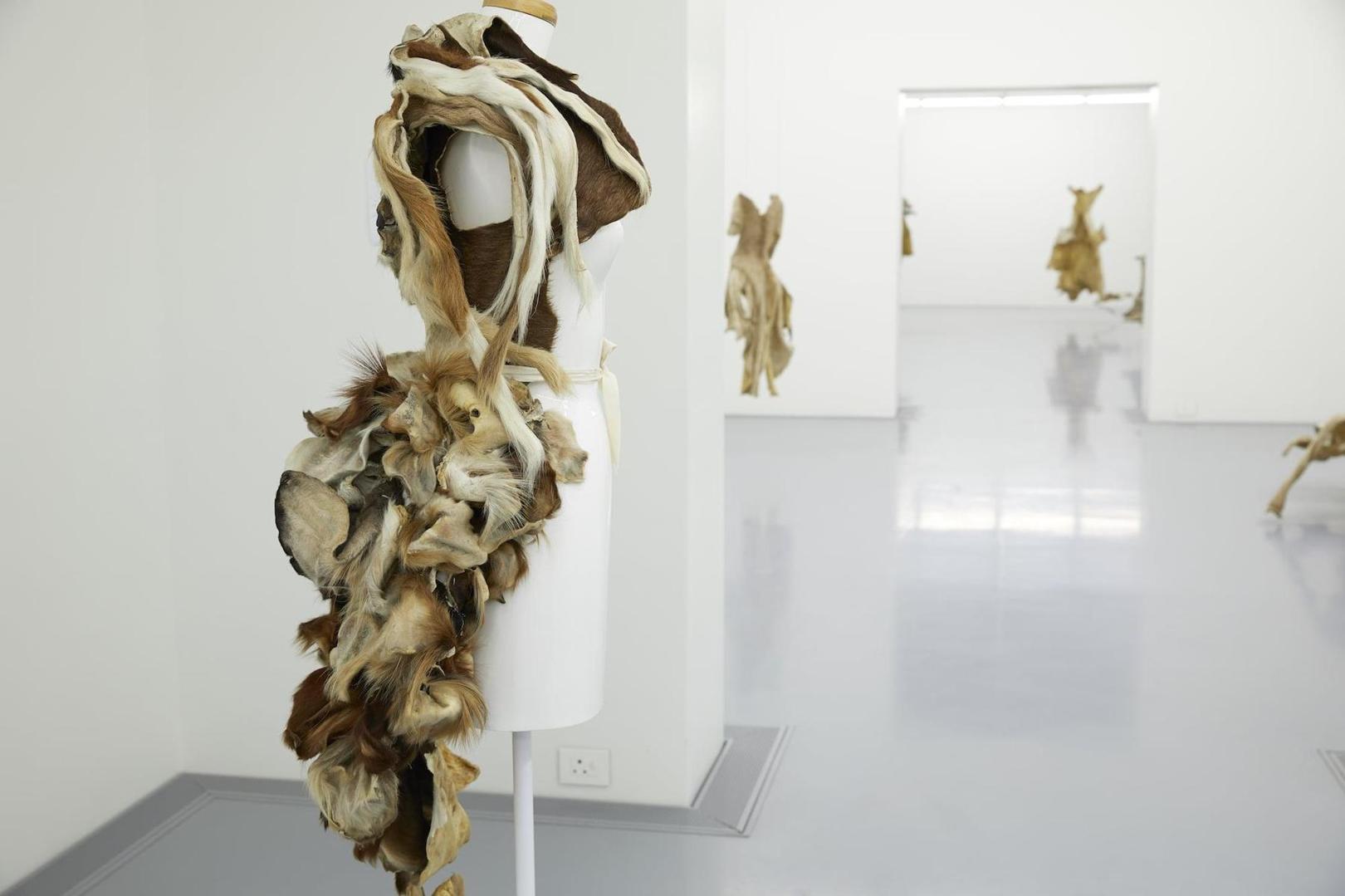
“I am best known for my cowhide sculptures that connect the human form to nature and explore the binaries of attraction/repulsion, animal/human as well as myth and reality.
I’ve been a working commercial artist for the past 20 years; the space of Visual Culture has become second nature to me and so, over time, I have immersed myself into this space through lived experience,” she relays.
Mntambo initially had an interest in Forensic Pathology before taking a leap into the world of fine art.
She explains that her passion for Forensic Pathology was a result of her fascination with organic material and the chemical process.
With a touch of philosophical reflection, she highlights the universality of the experience of life and death whilst expanding that her work with taxidermy helped her understand the chemistry behind preserving cowhides – a skill she frequently used in her artistry.
“I was very good at Biology, Science and Maths at school so the path into the field of science was an expected one. I became interested in forensics because of my fascination with organic material and chemical processes.
“How one can use chemicals to manipulate, preserve and accelerate organic material was of great interest to me. I suppose the space of life and death is the most shared universal experience that planets, plants, animals and humans have in common.
“Part of my journey involved working with a Taxidermist that helped me understand the art of using chemicals to preserve animal hides.
My choice to focus on working with cowhide was cemented because of this experience,”` she
shares.
Being multi-disciplinary is a part of the artist’s creative expression. As such, it is only natural to ponder if she sees a marriage between the various forms of artistic expression that she practices or if these creative endeavours feel like wearing different hats for her.
Mntambo clarifies that, for her, different mediums evoke different effects on the subject. In her own way, she explores her own creative voice and language through each unique medium.
“I feel that different modes of expression are experienced in different ways and answer different questions.
“Different mediums have particular looks, smells, emotions that they evoke and ways in which one access them. A photograph explores and exposes a different point of view to a painting, for instance.
“Ink on paper and oil paint on canvas are very different. It’s always been important to me to uncover and explore the space of each medium because I’m seeking to find my own ‘voice’ and ‘language’ within these age-old ways of working,” she states.
Having shared and exhibited work all around the world from Europe to America, Mntambo reflects on how her work has been received in all these different environments. She explains that the success of her work stems from the universality of her themes – in particular, how the relationship between animals and humans has manifested itself.
“I think what has made my work successful is that I’m exploring the universal and complex space of how animals and humans intersect. Many religions, ethnicities, civilisations have stories related to the complex and intertwined interdependence of animals and humans. Regardless of where my work has been exhibited this complex relationship exists so my work resonates,” she states.
Recently, the artist announced a ‘creative haven’ known as Mntambo Portfolio. She used her social media platforms to clarify that the objective was ‘not just about art’.
Elaborating more on this new endeavour, Mntambo highlights that educating other artists and people in general has always been a big part of her vison and hope for her legacy. She clarifies that she has had the privilege of teaching at various Universities, schools, as well as workshopping with many different art practitioners.
With Mntambo Portfolio, she continues that work and views it as an umbrella under which her thoughts on how to continue in the space of education could work.
“Under the portfolio, I will be launching The LAB, which is a multi-disciplinary workshopping and incubation space for Emerging Creatives.
Within The LAB, selected Emerging Creatives will be mentored by experts from various disciplines in the hope of expanding their creative exploration and fostering the culture of collaborative engagement.
The Mentors, some of who are composers, architects, artists, film makers, curators and gallerists will be sharing their expertise and experience with selected Mentees. The Creatives that will graduate from The LAB will be skilled in both the creative and intellectual expertise they need to propel their individual careers as well as a clear understanding of how to work in a collaborative and effective way,” she explains.
As a Swazi born artist, Mntambo sympathizes with the struggle creatives have in converting their art into lucrative ventures.
She explains that this is a universal struggle that all artists face. As such, she views her new project, The LAB as an important antidote to those struggles. She shares that what has greatly aided her work is aligning with different creatives from different disciplines who have enriched her own skills.
“The reality is that all artists have a difficult time balancing the challenge of converting expression into lucrative ventures.
This is why The LAB is so important to me. As an artist, you may have raw talent but may be lacking in business skills or in the skill of how to present your work to potential clients. What has helped me in my career is surrounding myself with people from different disciplines, who inevitably bring different experiences and skills that have enriched my own.
The LAB seeks to bridge this gap by making those skills accessible through the space of education,” she articulates.
When asked about how she ensures that she remains true to her process, creative voice and artistry when navigating the pressures of working with Corporate entities and facing deadlines – her response is simple: “I don’t take on projects that compromise my thoughts or ideas.”
This ‘value-driven’ mentality permeates through her other creative endeavours as well. Recently, she collaborated with Kate Otten to build her own studio.
The space, however, has a complex history as it was built in 1935 during the Apartheid Regime in South Africa. Taking that history into consideration, Mntambo used the space as an opportunity to reflect on the history of black labour in South Africa. Additionally, she expressed the importance of not erasing history but building on it for the creation of the future.
“I’ve always wanted to have my own studio. I think it’s important to be able to work in a purpose-built space. Kate Otten was the perfect collaborator in building my studio because of her love for collaboration and preservation of history while moving forward.
The house I bought was built in 1935 and has a particular history within the space of South Africa, Apartheid, and how labour is understood within the country.
What I liked about working with Kate Otten Architects is our common understanding of not wanting to erase history but rather building on it to create a new and interesting future language and engagement with space,” she shares.
She states that the history of labour in South Africa delegated certain spaces for certain types of workers – maids, gardeners, and workers lived outside of the main house.
This uncomfortable history may force many to repress and erase the past. For her, however, it is only once one understands the past that they avoid repeating the same mistakes. As such, the studio serves as her contemporary space of labour and she specifically chose not to demolish two ‘outbuildings’ but used them as a foundation for a new structure.
“The house is in a previously exclusively white neighbourhood of Johannesburg. The history of labour dictated that the ‘maid, gardener, worker’ lived outside in a small room with an adjoining toilet.
I feel that, in the hope of building a new or reimagined future, people feel the need to erase the past.
The past, in my view, is important so that one doesn’t repeat the same mistakes. I decided to create my studio, which is my contemporary space of labour, around this historic space of labour by choosing not to demolish the two outbuildings and rather using them as the foundation for a new structure,” Mntambo informs.
The future is filled with interesting opportunities and prospects for the artist as she shares that she will be launching ‘The LAB’ at the end of this month. The programme will commence in March 2024 and will result in exhibition and residency opportunities within the continent.
“I will be launching The LAB at the end of November with the ‘Open Call’ for Emerging Creatives from all parts of the world to apply for mentorship and participation in the program in March 2024. After which the first iteration of the programme will run for 9 months – resulting in exhibition and residency opportunities within Africa for the Top 3 Mentees,” she concludes.
For More News And Analysis About Eswatini Follow Africa-Press