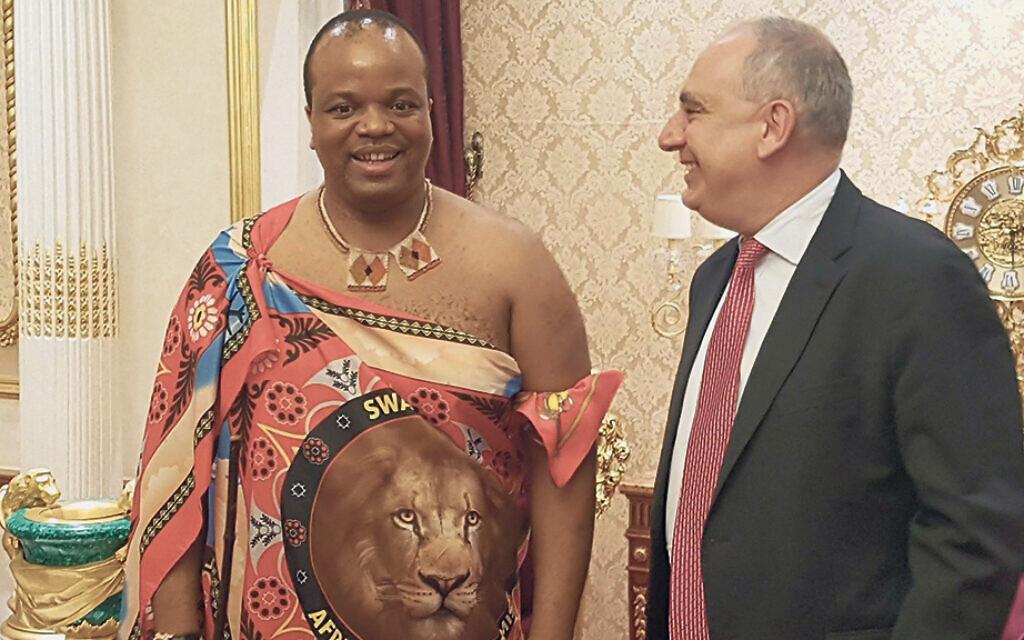
Africa-Press – Eswatini. Israel and Eswatini maintain good diplomatic relations even though Israel no longer has an embassy in Mbabane.
Instead, relations are now handled through the Israeli Embassy in South Africa. For many years, the Israeli Embassy was situated in Mbabane next to the city council. I remember distinctly because my father, Dr Sishayi Nxumalo, would visit the embassy frequently as he had many Jewish friends, including Dr Natie Kirsh, Mr Friedlander and Guy Bertram just to mention a few. He became very good friends with most of the local Jewish community dating back from his old political party days before he joined the Imbokodvo National Movement and it was so touching to see a few of them at his funeral. As recently as August 2022, His Majesty King Mswati III received letters of credence from the ambassador of Israel and the ambassador expressed his commitment to strengthening the relations between the kingdom and the State of Israel.
Formation of Israel
As Christians who read the Bible, we just assume that the State of Israel has always been there. However, for more than 2 000 years Jews were stateless; wondering around the world surviving through their highly resourceful culture and unity; emphasising education for their children, particularly in finance, banking and trade. They soon controlled several key economic sectors internationally. They were hated and discriminated against everywhere they went, but almost always managed to get on top. On May 14, 1948, in Tel Aviv, Jewish Agency Chairman David Ben-Gurion proclaimed the State of Israel, establishing the first Jewish State in 2 000 years. Ben-Gurion became Israel’s first premier. The birthplace of the Jewish people is the Land of Israel (Eretz Yisrael), as recorded in the Bible dating back thousands of years, which finally became a reality but at what cost?
What about Palestinians?
As stated earlier, the children of Israel had been scattered across the world with no home of their own for more than 2 000 years. Numerous Bible verses mention the scattering of the children of Israel. Their original home where Jerusalem stood now belonged to the Arabs and was called Palestine. Ninety per cent of the population of Palestine was of Arab descent and as little as 10 per cent of Jewish descent. The British had made it part of its empire, ruling it as one of its territories.
Balfour Declaration
On November 2, 1917, Britain’s then Foreign Secretary, Arthur Balfour, wrote a 67-word letter addressed to Lionel Walter Rothschild, a figurehead of the British Jewish community. It committed the British Government to ‘the establishment, in Palestine, of a national home for the Jewish people’ and to facilitate ‘the achievement of this object’. The letter is known as the Balfour Declaration. In essence, a European power promised the Zionist movement a country, where Palestinian Arab natives made up more than 90 per cent of the population. A British mandate was created in 1923 and lasted until 1948. During that period, the British facilitated mass Jewish immigration – many of the new residents were fleeing Nazism in Europe – and they also faced protests and strikes. Palestinians were alarmed by their country’s changing demographics and the British’s confiscation of their lands to be handed over to Jewish settlers. This was the beginning of the conflict we see today.
UN partition plan
By 1947, the Jewish population had ballooned to 33 per cent of Palestine, but they owned only six per cent of the land. The United Nations (UN) adopted Resolution 181, which called for the partition of Palestine into Arab and Jewish States. The Palestinians rejected the plan in vain because the UN still allotted about 55 per cent of Palestine to the Jewish State, including most of the fertile coastal region. At the time, Palestinians owned 94 per cent of historic Palestine and comprised 67 per cent of its population. 1948 Nakba, or ethnic cleansing of Palestine. Even before the British mandate expired on May 14, 1948, Israeli paramilitaries were already embarking on a military operation to destroy Palestinian towns and villages to expand the borders of the State of Israel that was to be born. In April 1948, more than 100 Palestinian men, women and children were killed in the village of Deir Yassin on the outskirts of Jerusalem.
That set the tone for the rest of the operation, and from 1947 to 1949, more than 500 Palestinian villages, towns and cities were destroyed in what Palestinians refer to as the Nakba, or ‘catastrophe’ in Arabic. It is alleged that an estimated 15 000 Palestinians were killed in dozens of massacres. The Zionist movement captured 78 per cent of historic Palestine. The remaining 22 per cent was divided into what are now the occupied West Bank and the besieged Gaza Strip. An estimated 750 000 Palestinians were forced out of their homes back then, and now millions are displaced.
Six-Day War
Fast forward to June 5, 1967, Israel occupied the rest of historic Palestine, including the Gaza Strip, West Bank, East Jerusalem, Syrian Golan Heights and the Egyptian Sinai Peninsula during what has been called the Six-Day War against a coalition of all Arab armies supporting Palestinians. A remarkable war that saw Israeli forces defeat all Arab armies in six days and in time to rest for Sabbath Saturday. The Palestine Liberation Organisation (PLO), formed in 1964, was an umbrella political organisation claiming to represent the world’s Palestinians – the Arabs, and their descendants. It came into prominence only after the Six-Day War of June 1967. PLO engaged in a protracted guerrilla war against Israel during the 1960s, 70s, and 80s before entering into peace negotiations in the 1990s. It was only in 1993 when PLO Chairman Yasser Arafat recognised the State of Israel in an official letter to its Prime Minister, Yitzhak Rabin.
Israel settlement construction continued in the occupied West Bank and Gaza Strip despite international condemnation. A two-tier system was created with Jewish settlers afforded all the rights and privileges of being Israeli citizens whereas Palestinians had to live under a military occupation that discriminated against them and barred any form of political or civic expression. Israel continues to stake its claim and its rights to exist and defend itself. We will look at the rest of the conflict and Hamas terror next week.
Source: times
For More News And Analysis About Eswatini Follow Africa-Press