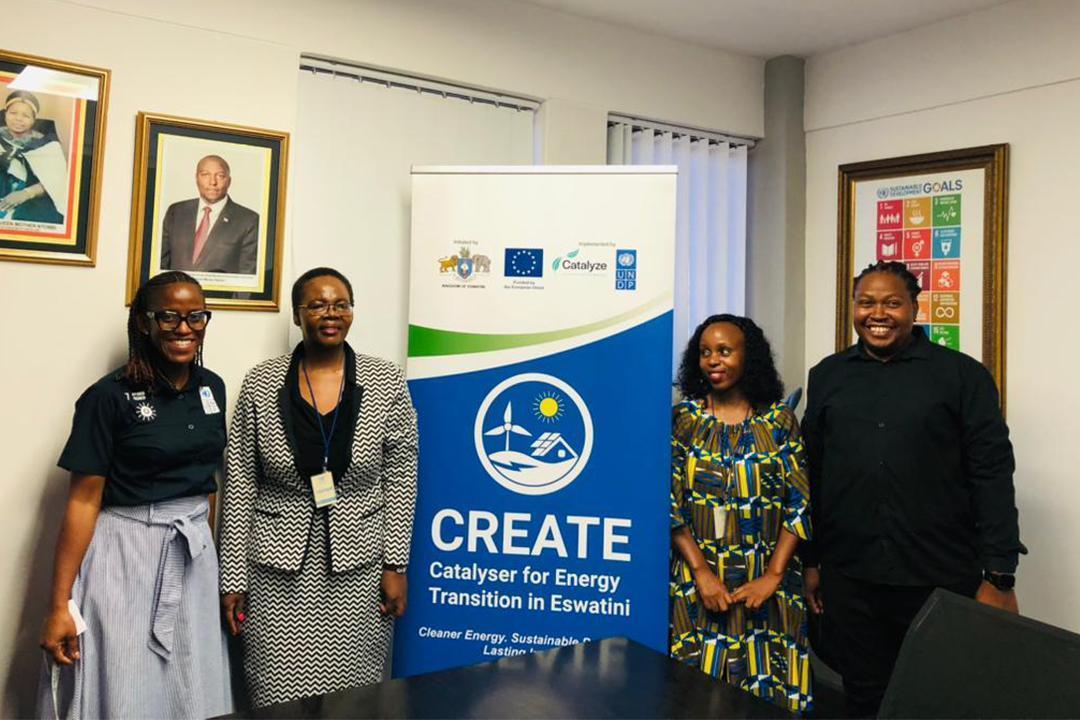
Africa-Press – Eswatini. The Government of Eswatini has set an ambitious target to guide at least 250 Micro, Small, and Medium Enterprises (MSMEs) toward renewable energy adoption through the newly launched Catalyser for Renewable Energy Transition in Eswatini (CREATE) programme.
The initiative was officially unveiled on April 9, 2026, at the UN House Mbabane through a strategic partnership led by the Ministry of Natural Resources and Energy, with support from the European Union and the United Nations Development Programme (UNDP).
CREATE is designed to provide both the technical and financial bridge that small businesses need to escape the burden of rising electricity costs and transition to clean, reliable, and cost-effective energy solutions.
While the programme anticipates receiving more than 1,000 applications from across the country, the focus is firmly on the “final 250” MSMEs that will be supported to access a share of the E100 million (€5 million) in blended finance unlocked for this transition.
Undersecretary in the Ministry and CREATE Steering Committee Chairperson, Gabsile Mabuza, emphasized that the approach prioritizes quality, bankability, and long-term sustainability.
“We aim to receive 1 000 applications, from which 320 bankable business plans will be developed, ultimately leading to 250 MSMEs accessing blended finance from local financial institutions,” Mabuza said. “Rising energy costs continue to affect business competitiveness—CREATE directly responds to this challenge.”
Financial backing for the initiative is channelled through the Ministry of Economic Planning and Development with support from the EU.
EU Project Manager Bhekani Magongo said the initiative builds on years of investment in Eswatini’s key productive sectors.
“We have invested many times in agriculture and this initiative aims to directly benefit emaSwati businesses. Our collaboration with UNDP will ease electricity cost pressures for MSMEs and strengthen national value chains,” Magongo said.
UNDP Sustainable Development Specialist Mangaliso Mohammed echoed this commitment, assuring stakeholders that the programme will be delivered with accountability and measurable impact.
“We are grateful for the trust placed in us. We will ensure this project delivers real benefits for MSMEs,” he said.
The agricultural sector, which depends heavily on energy for irrigation and production, stands to be among the biggest beneficiaries.
Irrigation Engineer Kholiwe Mdluli from the Ministry of Agriculture said the initiative will significantly reduce production costs for farmers.
“Agriculture uses a lot of energy, especially for irrigation. This transition will lower operational costs and improve profit margins for our farmers,” Mdluli said.
To ensure the targeted MSMEs successfully secure funding and implement renewable solutions, CREATE offers a comprehensive support package that includes renewable energy assessments, development of 320 bankable business plans, and technical coaching and advisory support throughout implementation.
For More News And Analysis About Eswatini Follow Africa-Press