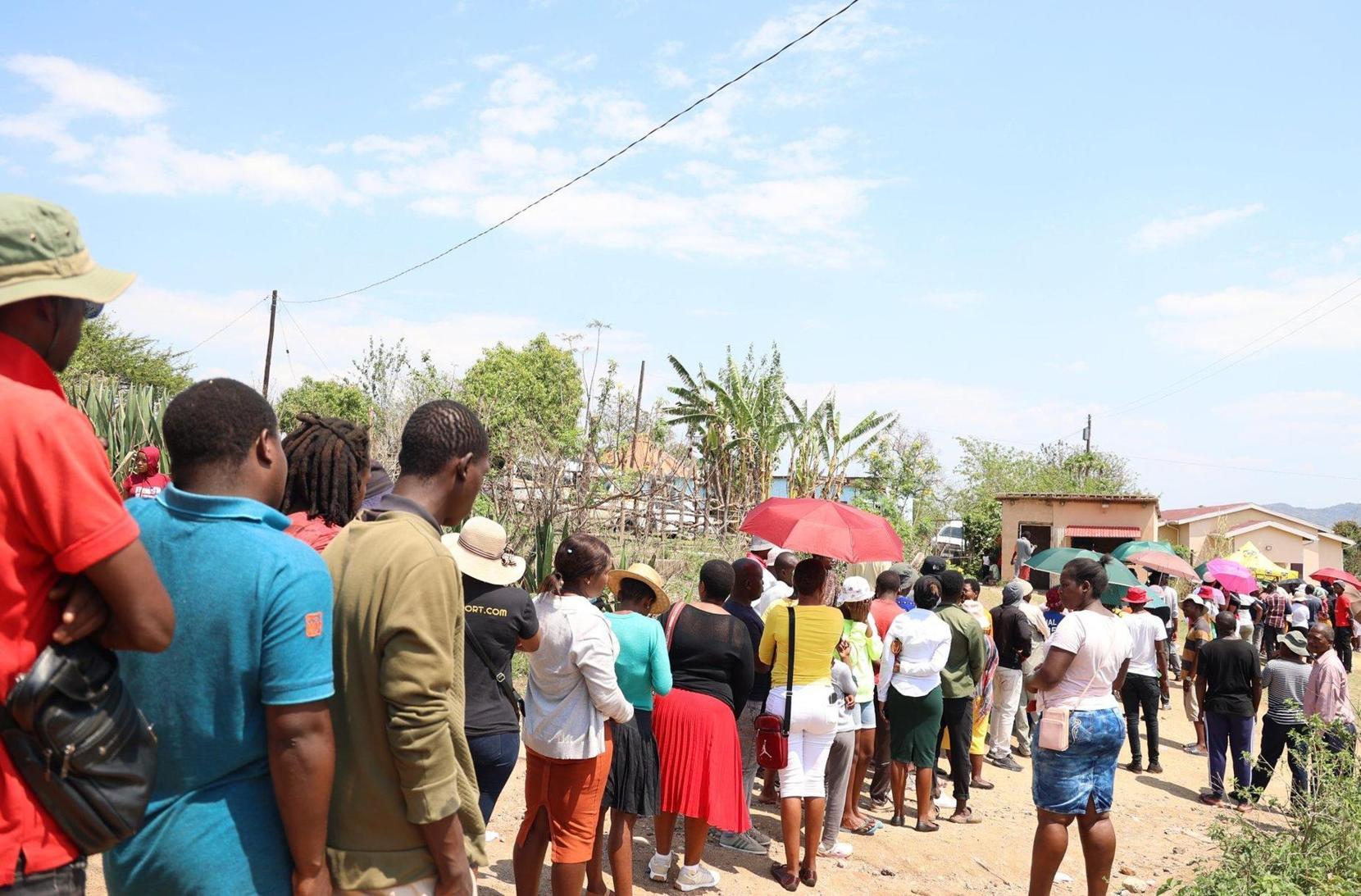
Africa-Press – Eswatini. MP Nomalungelo Simelane and MP Sifiso Mabuza’ successes in the general election say a lot about the free and fair elections of the 2023 parliamentary elections.
Let us talk about free and fair elections under the current system of government – Tinkhundla. MP Simelane, popularly as LaZwide, is wife to Mduduzi ‘Gaw’zela’ Simelane who is presently in exile and on police wanted list. MP Mabuza is a brother to Mduduzi Bacede Mabuza who is in jail awaiting sentencing. I am happy that Gawzela and Bacede’ families were not denied their constitutional right to contest the general election. This can be defined as political maturity. I presume that there was a temptation to frustrate their campaign trail but sanity returned to prevail supreme in those who hold the power to directly or indirectly influence the thinking of the electorate.
On the side of the State, one would expect it to deal with Nomalungelo and Sifiso, but they didn’t. In other authoritarian regimes, the duo, including Mthandeni Dube’s wife, would have been harassed or their rights grossly violated in desperate avenge of iniquities they actually did not commit, if ever there were. I hope Hazel Baxter, the wife to Dube, does not have qualms with the way the election was managed at Ngwemphisi where she wanted to succeed her husband. Her husband is awaiting sentencing alongside Bacede. I believe I will find sufficient time and space after their sentencing to address their predicament from a political perspective.
However, I am “politically” happy that LaZwide and Sifiso were sworn-in as MPs for Siphofaneni and Hosea respectively. Pertaining to free and fair elections, I am ecstatic. I hope this is what we can witness in other political systems. The most interesting benefit from a political system is what it does right for the populace. It’s not enough that Tinkhundla System of Government is in place or a multiparty system of government is operating, it is, on the opposite, what the systems do or have for me as a citizen. That is why the strength of a political system is in its programmes in strengthening and preserving of institutions that are responsible for relevant and quality service delivery.
A failed system doesn’t care about its people. As long as they are in office, it’s fine with political systems that do not care about people. I like a system that cares about the nation’s happiness index. However, the one that makes us angry and insane is unworkable and undemocratic. When we see MP Nomalungelo and MP Sifiso securing their seats without any intimidation, we are, therefore, confident that some candidates lost the elections unfairly and there were no State-sponsored machinations to cause their failures. The Civics Academy helps us understand that elections are a central feature of democracy. For elections to express the will of the electorate, they must be ‘free and fair’.
According to the Academy, free means that all those entitled to vote have the right to be registered and to vote and must be free to make their choice.
In Eswatini, every citizen who has attained the age of 18 is entitled to vote. Experts say an election is considered ‘free’ when a citizen can decide whether or not to vote and vote freely for the candidate or party of his or her choice without fear or intimidation. It is often said that a “free” election is also one where a person is confident that who he votes for remains his secret.
What is fair election?
The Academy, in the context of South African politics, says fair means that all registered political parties have an equal right to contest the elections, campaign for voter support and hold meetings and rallies. I don’t want to dwell on what was happening during the campaign period in the country. I have not been made aware of any complaint that certain candidates were denied the right to hold meetings and rallies. I saw a political bonanza at Msunduza Sportsground. When candidates are free to sell their ideas freely, it gives them a fair chance to convince voters to vote for them. The Academy points to the fact that a fair election is also one in which all voters have an equal opportunity to register, where all votes are counted, and where the announced results reflect the actual vote totals.
I was happy to see the Elections and Boundaries Commission (EBC) counting and announcing results before the election candidates. Transparency is a feature for democracy; a very important one that prevents election rigging that has in many countries culminated in civil war. In a statement on the country’s elections held on September 29, 2023, the SADC Electoral Observation Mission (SEOM) observed that the political and security environment during the pre-election, special voting and election period was “calm and peaceful.” The statement was signed by Enock Kavindele, the former vice President of Zambia who was here in the country to observe the elections.
“The Mission observed that the political and security environment during the Pre-election, Special Voting period and election period was calm and peaceful,” reads the SEOM’s statement. “This was also the general view of a diverse range of stakeholders that we consulted, though some were mindful of what they referred to as the undercurrents arising from the unfortunate civil unrest that took place in June 2021.” What was reported to have transpired at Matsapha Maximum Prison, if it’s true, is uncharacteristic of buSwati. I will leave it to the courts to adjudicate on this matter. This is a serious concern because it reduces the country’s scores for democracy. It puts the country on a graph for countries that violate human rights. Potential investors are uncomfortable with countries that violate human rights.
I advise emaSwati that they must not exhibit conduct that scares investor confidence. On another note, I observed Thursday’s election of 10 candidates to Senate. The candidates seated at the public gallery where they were afforded to the opportunity to observe the counting and announcing of results.
In fact, I was personally thrilled with the manner in which the returning officer and his team conducted the elections. In my notebook, the returning officer conducted the election with aplomb, particularly where transparency was a factor.The smooth running of the elections can be traced back to 2018 when the SEOM made a recommendation on amendments of laws to promote transparency.
The leader of the SEOM, Enock Kavindele, applauded Eswatini for implementing those recommendations, which included the recent amendments to the legislation governing elections in the country – the amendment of the Voter registration Act 4/2013 and Elections Act 6/2013. The amendments were passed before the dissolution of Parliament. Kavindele said the amendments were aimed at promoting transparency, integrity and credibility of the elections. The Voter’s Registration Amendment Act of 2023 provides for continuous voter registration to be done annually to allow time to ensure accuracy of the Voter Register during elections, create uniformity in respect of registration at urban and rural areas, as well as placing the burden of proof on the person objecting to the inclusion of the voter in the voter’s register.
The Elections Amendment Act No.8 of 2023 defines ‘after elections’, ‘before elections’ and ‘election’ campaign for clarity, and extends the time for appointment of candidate agents and messengers. It also extends categories for Special Voting. The Amendment further provides for the counting of ballots at polling stations instead of counting at a central place. This ensures secrecy of the vote by the calling out of the voter and entering the voter ID number on the counterfoil, as well as strengthening electoral offences to ensure implementation of sanctions. There is room for improvement as there was a concern by SEOM that the amendments were gazetted just over a month before voting day, thus giving the electorate and candidates limited time to internalise and understand the changes to the two important laws.
Of course, some stakeholders noted that the amendments created some confusion regarding new requirements for nomination of candidates in the employment of the civil service. The amendments also created the need for public awareness in advance of the elections in the context of a comprehensive civic and voter education programme. I hope the EBC noted these concerns to ensure that the 2028 general elections are much better in terms of transparency.
Otherwise, I can only say “salute” to the Head of State, 11th Parliament, government and EBC for having a much improved election, which was not only free and fair but refreshed the mind to realise greater things for us in future, as a united and determined people. The ball is now in the coat of MP LaZwide, MP Sifiso Mabuza and the entire 12th Parliament to strengthen and implementing programmes on job creation, poverty alleviation, improving maternal health and public health and making education relevant, productive and enjoyable.
Source: TIMES
For More News And Analysis About Eswatini Follow Africa-Press