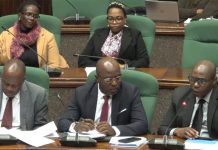
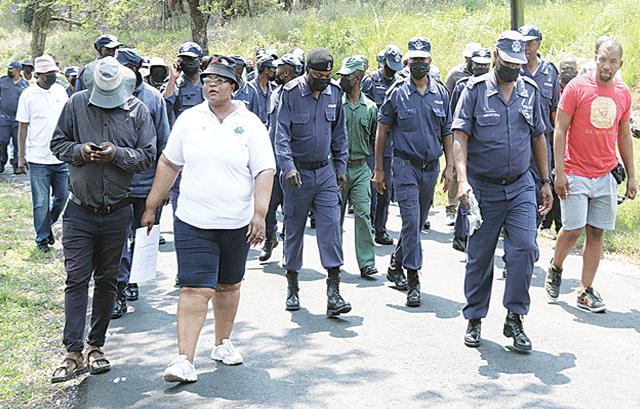
Africa-Press – Eswatini. In its own way, the protest action by junior officers marching to Cabinet to deliver a petition has had such an impact it has rattled the national commissioner of police in the same manner that Members of Parliament have been knocked off their perch by comments made by the Elections and Boundaries Commission Chairman Prince Mhlabuhlangene who this week ripped into politicians for failing this country in its time of need.
It is undisputed that both junior police and the police head-honcho need each other in more ways than one.
The political unrest of the past year has had an emotional impact on both sides, with police being targeted by some elements as a matter of a political statement, during which the police have found the need to stand as a solid unit against such criminality.
In the face of this attack, amid the arson attacks countrywide, the police have stood firm behind the unity of their pledge and oath to protect and serve – until they could be separated and divided by conditions of service that junior officers want addressed as a matter of urgency.
Junior officers decided to march this week after weeks of agonising over the handling of their demand for a salary review, which they want to be restructured according to the policy decision of 2014.
The officers feel government is dragging its feet on this issue, and that comments by the minister of public service have given them little or no option but to protest and march to demand that this issue be addressed as a matter of attention.
The public service minister had called on the officers to wait for at least 12 months to know their fate on the outcome of the review process, which the officers made clear was not acceptable. That at least is the background to how the officers resolved to march to Cabinet, in what clearly took everyone by surprise.
As security services, both police and warders are the last to resort to this kind of protest action – no matter the situation. This decision therefore represents a complete departure from the way such disputes within the security services can be resolved. It also is quite frankly a fresh headache for the police and correctional services heads, in that they now have to deal with what may be seen as ill-discipline if not, as they both said in a statement, defiance.
Yet, the reality is that this is not the time for the police to be caught in such internal turmoil. It is not the time either for the natcom and the commissioner general to be using their show of force to get the officers in line. It is not also, unfortunately, the time for the officers to show the public that they are prepared to do whatever it takes to get what they want. This country needs a happy police and a good environment to thrive. We are just exhausted. We are all desperate to find peace and calmness.
Ultimately, what it comes down to is that this is so ill-timed it has left many of us gripped in fear of what happens next. Police have already had to deal with a lot since last year’s unfortunate unprecedented unrest, leading to the targeting of police officers who have been shot and killed in broad daylight.
Action
While the national commissioner of police has offered the rock solid support of the police during this difficult and emotionally draining period for the officers in the ranks, his handling of this demand by the junior officers has been to read the riot act and threaten to deal with every one of the officers who took part in the first of its kingprotest action.
That is all entirely fine, because we all understand that the security services must operate from a different rule book, but the response by the NatCom and the Commissioner General has to be honest, left us questioning if this could not have been handled differently.
Certainly, it has opened another debate on political leadership and especially how we seem to know how to shoot ourselves in the foot as a country. There is an argument, for instance, that the issue does not require the police to take the firm hard-line on the junior officers, rather to quietly sit down around the table to find compromise, that the protest action should be seen through the prism of how delicate the situation is than disobedience and defiance by the officers.
That the junior officers took this risk to march knowing fully well the consequence should inform us of how far the officers are willing to risk their own jobs and lives than the risks involved. In this case, there is a view that the NatCom should embrace the officers and find alternatives to resolving this matter than to deal with it as a show of force for the consequences could of course be much more worse.
Tsitsibala should be reminded of course that last year’s unrest started off with a simple protest action that was mishandled and that soon gave birth to numerous other delivery of petitions across the length and breadth of the country. It is these little things and how we handle or respond to them that seems to be important.
It is from when we contextualise the events of last year that we can agree with the comments made by the Elections and Boundaries Commission chairman that events of last year could have been prevented from exploding right in our faces had Members of Parliament not been clueless.
The EBC chair gave an impressive presentation to traditional authorities in the Hhohho region in which he tore into the role of parliamentarians that led to the unrest last year and perhaps led to the misconception on the role of the prime minister and the executive arm of government, which principally led to calls for an elected PM.
System
The presentation by Prince Mhlaba was frankly very refreshing, and perhaps is what this country needed to hear last year. It reminded me of how this country is often caught out on such issues, because there is no one to stand up and explain – if not defend – the system.
When this is needed, people duck and dive, while opportunists parading as MPs bang their fists and speak till they froth about their role in the discourse, when it actually turns out they are misdirecting themselves. Put simply Prince Mhlaba has told us that MPs know nothing about their roles and instead start criticising the Monarch when this was outside their scope.
He also reminded this country that removing a country’s status quo is a criminal offence and should be treated as such, adding that if there are people who are going to commit criminal activities in the name of democracy, they will need to be dealt with as criminals.
“They should not hide under the umbrella of being pro-democracy because who is not pro-democratic? We have got evidence that we are also pro-democratic,” said the prince.
Much more importantly, the EBC chair dealt with the issue of parliamentarians using privilege to commit crime in their call for monarchies to fall, saying this was odd and very wrong.
Much more tellingly, the chairman addressed this issue of the call for an elected prime minister within Parliament as an example of how Parliament did not know their job, and also failing to appreciate their scope within the system.
When you consider the chairman’s comments you realise what Parliament has done in contributing to the political negativity in this country, more especially how the very same MPs stood up to make such demands, lying to us all that they were within their right to do so.
This is the essence of what has contributed to the situation this country has found itself in, where the same Parliament has failed to steady the conversation or at least introspect on its own position and the role it is expected to play.
It is why some MPs are mumbling things about how the comments by the chairman are badly timed or something about their being de-campaigned by the EBC.
It is also why not many of them can disagree with the chairman, except to reluctantly agree that they have failed the nation.
These groans about these comments coming at the wrong time with the national election on the horizon make us realise how our system has been made to fail, for it exposes how parliamentarians only see their role as being a job and not how they should add to the efficiency of the system.
All they care about is the ticket to the job, and nothing more.
Of course, just as the National Commissioner of police has seemingly been rattled by the junior officers marching to his bosses, the EBC has given the MPs, who have aspirations of a return to the lucrative job, a reality check about what lies ahead.
For More News And Analysis About Eswatini Follow Africa-Press