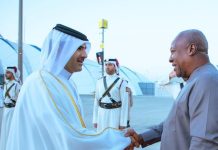

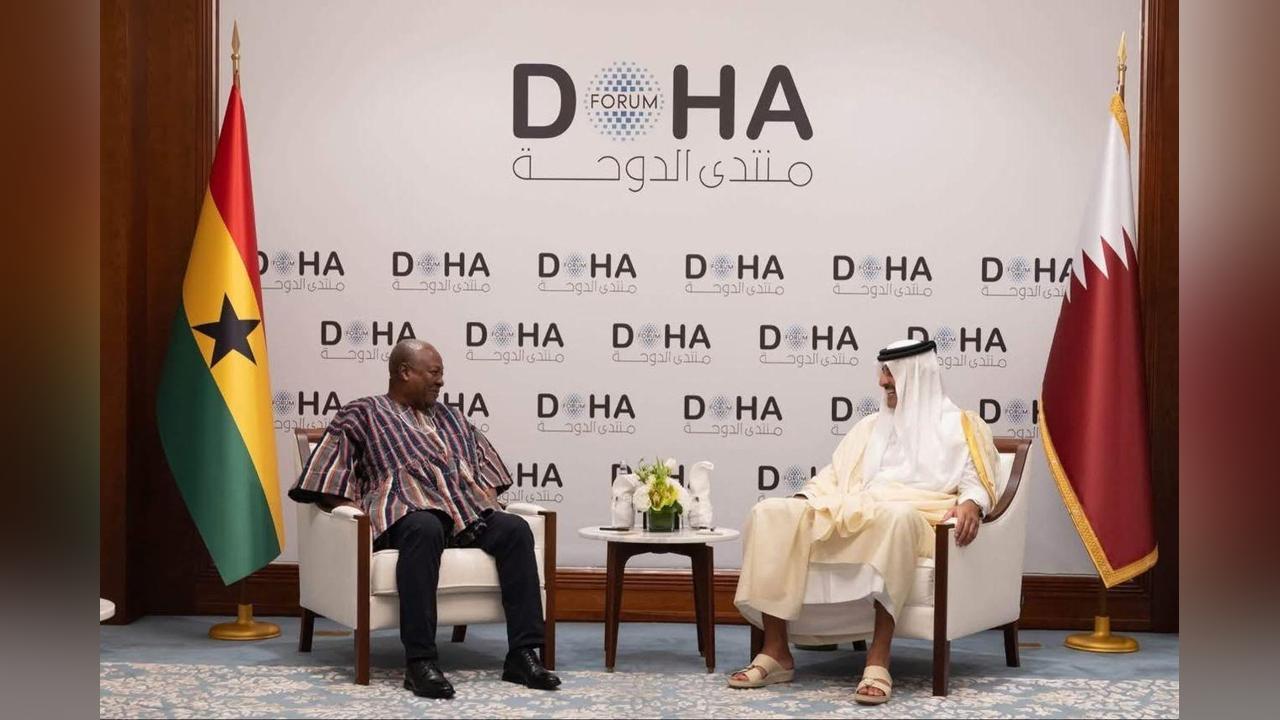
Africa-Press – Ghana. President John Dramani Mahama has reiterated that education is a fundamental enabler for achieving all Sustainable Development Goals (SDGs).
The President said this in an address at the 2025 Doha Forum on the theme: “Justice in Action: Beyond Promises to Progress”.
The SDGs are 17 global goals adopted by the United Nations in 2015 as a universal call to action to end poverty, protect the planet, and ensure peace and prosperity for all by 2030, integrating economic, social, and environmental dimensions.
“Education is not the only focus of SDG 4, quality education, but also the enabler of all the other sustainable goals. Because without education, we cannot end poverty, which is SDG 1,” he said.
“Without education, we cannot achieve good health and well-being, which is SDG 3. Without education, we cannot attain gender equality, which is SDG 5.”
He said without education, nations of the world could not build decent work and economic growth, which was SDG 8. “Without education, we cannot strengthen climate adaptation, which is SDG 13. And without education, we cannot secure peace, justice and strong institutions, which is SDG 16.”
He said education illuminated the path to every other goal and that it empowered individuals, strengthened institutions and transformed nations.
“If we want a just, peaceful and prosperous world, we must start by ensuring just, equitable and resilient education systems,” he said.
The President noted that the theme of the 2025 Doha Forum reminded the world that justice was not confined to domestic laws and that it was a global concern.
“Education is a global public good, and when children in one region are denied the opportunity to learn due to conflict or poverty, the entire world loses talent, innovation and potential,” President Mahama said.
He underscored that if education was to serve nations justice in times of crisis, the global community must commit to certain key elements.
First, protecting education budgets in times of crisis, and that economic austerity should not begin in the classroom.
He also mentioned integrating education into humanitarian response plans, ensuring safety of schools and the learning environment, accelerating digital inclusion and investing in digital infrastructure, devices and teacher training.
The President also called for supporting teachers as agents of stability and strengthening global partnerships.
“Our world is changing fast. Our thinking about education must evolve just as rapidly,” he said.
President Mahama said education today must prepare young people to adapt to climate shocks, navigate digital disruptions, participate in democracy and governance, contribute to peaceful societies, and compete in a global economy that was increasingly driven by technology and innovation.
“Education must be transformational, not transactional. It must be equitable, not exclusive. It must be forward-looking and not outdated. This is the justice we owe our children,” he stated.
“Justice is not only delivered in the courtrooms. Justice lives in the classrooms. It is found in the moment a child learns to read. In the moment a young woman discovers her talent for science. In the moment a displaced child finds safety and hope in a school. In the moment, a teacher inspires courage in a new generation.”
President Mahama said if world leaders were to create a more peaceful, equitable and resilient world, then education must be their most significant investment and their boldest commitment.
This, President Mahama said, resonated with the saying that “knowledge is like a garden. If it is not cultivated, it cannot be harvested”.
“Let us cultivate the seeds of justice through education, especially in times of crisis, so that the harvest may be peace, prosperity and a shared humanity,” the President said.
For More News And Analysis About Ghana Follow Africa-Press