
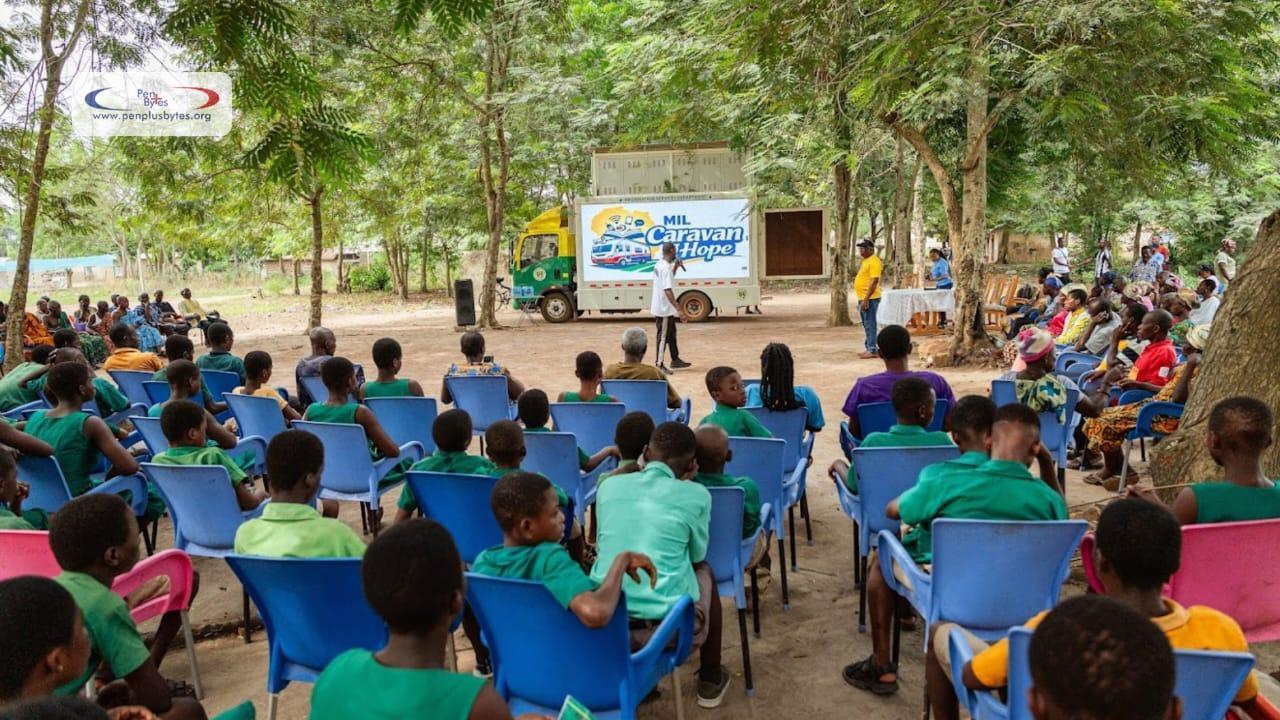
Africa-Press – Ghana. There is something magical about arriving in a community square with a colourful van, jingles blaring, and a team full of energy ready to talk about mis/disinformation.
At first glance, it probably looked like we were about to host a festival. In many ways, it was. From behind market stalls, school walls, and doorways, people peeked out with curiosity shining in their eyes, wondering what all the noise was about. But instead of music concerts or political rallies, the Caravan of Hope carried something less visible yet far more powerful: media and information literacy (MIL).
Across five districts—Shai Osudoku, Afram Plains South, Ho West, Jasikan and Tolon—the Caravan of Hope team from Penplusbytes, in partnership with DW Akademie and with support from the Federal Ministry for Economic Cooperation and Development (BMZ), engaged communities in conversations about fake news, rumours and hate speech.
The idea was simple: meet people where they are, speak their language, and help them develop habits that enable them to question the information they receive daily.
In practice, this approach became far richer, livelier and more revealing about how information travels in rural Ghana.
The Rumour Economy
In today’s world, trust feels fragile. The sources people once relied on sometimes become the very channels producing falsehoods, propaganda or misleading messages. And the confusion is not limited to online spaces. Offline, rumours travel just as quickly—carried along by familiar expressions like “Ak33 ak33” and “Yɛ seɛ yɛ seɛ,” loosely translated as “I heard that” or “They said.”
In many rural communities, information spreads faster than any 4G network. A story shared in Kpoeta Ashanti described rumours about ghosts visiting homes at night. By the time the tale reached the market, it had grown into a dramatic, fear‐filled discussion punctuated with laughter.
Another participant captured a widespread concern: “Sometimes the voice notes received on WhatsApp sound so confident that you cannot help but believe them.”
Such comments highlight a key truth: misinformation does not spread because people are careless. It spreads because it is crafted to sound believable.
For many rural residents—especially those with limited literacy—verifying information online is difficult. Fact‐checking platforms, lengthy articles and digital verification tools are often impractical. This is why the Caravan approach was essential: instead of asking people to travel to cities or sit through long lectures, the team took the learning directly to village centres, markets and faith gatherings.
Learning through Laughter
A guiding principle of the roadshow was: less lecture, more interaction. Rather than PowerPoint slides, the team used drama, storytelling, short videos in local languages, pictorial flipbooks, radio conversations and lively audience participation.
In Koranteng (Afram Plains South District), a simple role‐play was used. Community members participated in a “telephone game,” passing a message from one person to another. By the time it reached the last person, it had completely changed—prompting laughter and underscoring an important lesson: information is easily distorted as it moves from person to person.
Such moments opened space for reflection on the need for questioning and critical thinking. Participants were encouraged to ask: Who said it? What happened? Where and when did it happen? Why and how did it happen?
The Wisdom in the Crowd
Another insight from the roadshow was that rural communities are not passive recipients of information. They already use their own methods to interrogate rumours.
In Kpoeta Ashanti, an elderly man explained his technique: “If a message says ‘forward to everyone immediately,’ I know something is wrong.” His comment drew applause. It was an example of how lived experience often equips people with instincts similar to those taught in formal media literacy training. The Caravan’s role was not to introduce new ideas but to strengthen existing ones.
Women at the Centre
One of the most rewarding aspects of the roadshow was the strong participation of rural women. Across several communities, women were among the most vocal contributors, recounting experiences with scams, misleading health information and fake opportunities shared on messaging apps.
Some highlighted challenges in accessing digital devices. Many rely on shared phones, receive information second‐hand, or depend on others to read messages—making them especially vulnerable. To address this, the Caravan used low‐text and audio formats, videos in local languages, illustrations and community radio discussions. These methods not only made the sessions accessible but also enjoyable.
Information Inequality as a Digital Rights Issue
These experiences raise a broader question: who gets to participate fully in today’s information society? Access to accurate, trustworthy information is becoming recognised as part of a wider set of digital rights. Without the ability to access, understand and evaluate information, individuals are left open to manipulation, exclusion and exploitation.
Information inequality often reflects existing social inequalities. Rural communities, women with limited personal devices and people with lower formal education encounter greater barriers in verifying online information. Thus, media and information literacy is not merely an educational programme—it is an equity and rights issue.
Interventions like the Caravan of Hope help narrow this gap by offering community‐centred learning that reflects people’s lived realities. The fight against misinformation is ultimately a fight for information fairness—ensuring that everyone has the tools to understand the stories shaping their world.
The Road Ahead
The five‐district pilot is only the beginning. Beyond the roadshow, the project established local channels through community radio and partnerships with the Information Services Department to continue educating rural communities.
More importantly, the initiative generated insights into what works, what resonates and how inclusive approaches can reach those often left out of digital literacy efforts.
The journey revealed that combating mis‐/disinformation is not solely about technology or fact‐checking tools. Sometimes, it begins with a simple conversation in a community square—preferably one filled with laughter, because when people laugh, they listen, and when you speak their language, they learn.
Five regions. Five districts. Thirteen communities. Over 3,000 direct beneficiaries. A true example of borderless media and information literacy education.
Source: Ghana News Agency