
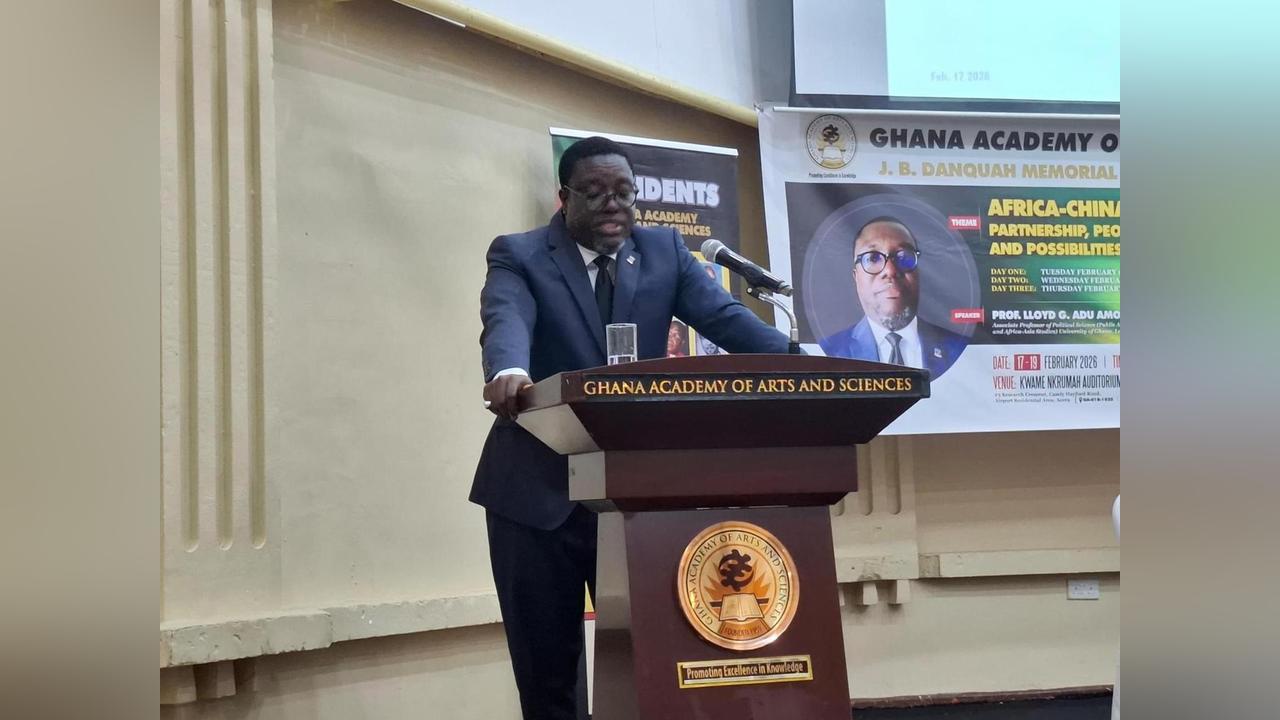
Africa-Press – Ghana. Professor Lloyd G. Adu Amoah of the University of Ghana has urged African countries to be wary of what he described as “digital imperialism.”
Delivering the second lecture in the 2026 J.B. Danquah Memorial Lectures organised by the Ghana Academy of Arts and Sciences (GAAS) in Accra, he cautioned that the continent risked becoming a pawn in the evolving technological rivalry between global powers, particularly China.
“In Africa‐China relations, a classical example of Africa being a pawn is in the realm of digital technology,” he said.
Prof. Amoah explained that he had coined the term “digital imperialism” to describe “the contemporary instantiation of imperialism afforded by the Internet and wider globe‐spanning telecommunications infrastructure.”
“In a digital imperialism age, Africa is simply a consumer of digital technologies,” he said, adding that China, through its Digital Silk Road Initiative, was reinforcing that status “as it powers its way towards global digital supremacy.”
Prof. Amoah noted that “powerful states” and corporations that invent and control digital technologies hold proprietary rights that enable them to dominate production, distribution, consumption and control in the digital age.
Citing research data, he said components produced by Chinese technology giant Huawei constituted about 70 per cent of Africa’s 4G networks and were leading the rollout of 5G infrastructure on the continent.
Prof Amoah emphasised that Chinese smartphone manufacturers controlled more than 70 per cent of Africa’s handset market, underscoring what he described as an “increasingly one‐sided dependence” across the digital technology stack, including cloud computing, data centres, cables and service applications.
“Africa’s digitalisation heart… is controlled by China, which therefore possesses the power to stop the digital life of Africa if it so chooses.
“This is a digital conquest hidden in plain sight,” he said.
Prof. Amoah warned that control over the “stack” – the layered infrastructure underpinning digital systems – would define technological power in the coming decades.
Beyond digital technology, he pointed to what he termed the “diplomacy of architecture,” arguing that China’s extensive construction of public facilities and landmark buildings across Africa symbolised a projection of soft power.
“What has Africa built in China? Not even a statue,” he said, questioning the reciprocity of the relationship.
The week‐long lecture series, themed “Africa‐China Relations: Partnership, Peonage, Pawnage, and Possibilities?” began on Tuesday.
The J.B. Danquah Memorial Lectures are held annually in honour of Dr Joseph Boakye Danquah, a scholar, lawyer and leading figure in Ghana’s independence movement, to provide a platform for reflection on major national and international issues.