

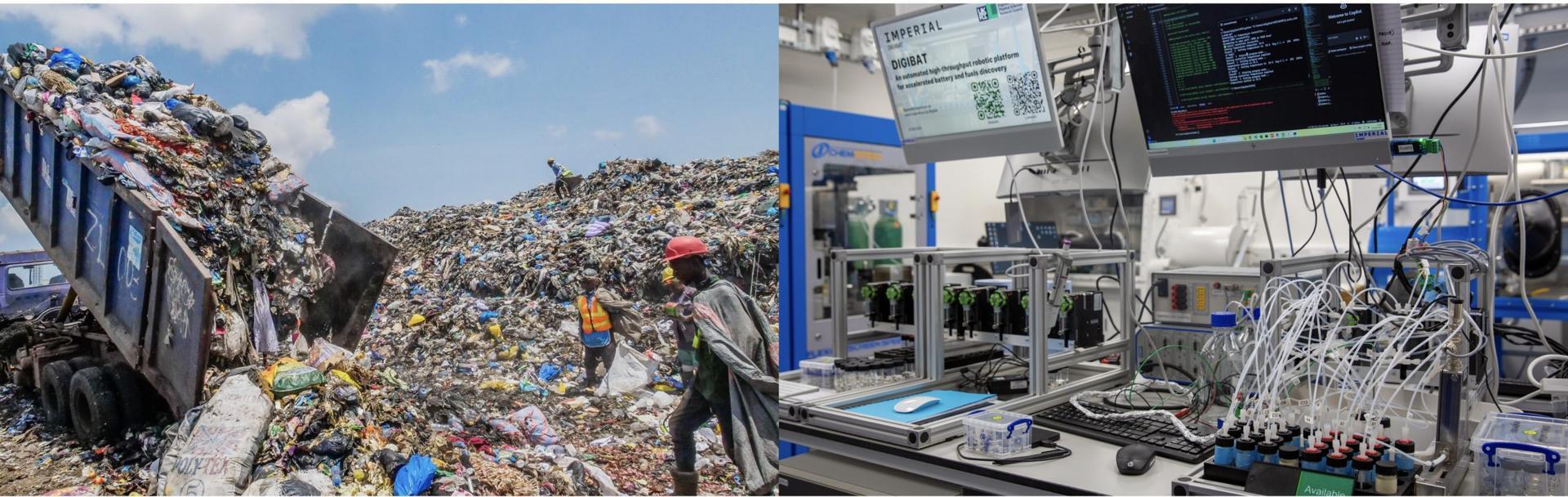
Africa-Press – Ghana. At dawn, trucks rumble into sprawling, unapproved landfill sites in Accra, offloading tonnes of waste; plastic, organic matter, and agricultural residue, into growing heaps along the coast, a stark and defining feature of urban life.
Tricycles also make the trip, littering their path to these cursed dumps.
Among the waste are coconut shells from roadside vendors, remnants of oil palm processing and organic refuse that, in another context, could serve a far more valuable purpose.
In Accra, the story of waste is visible, immediate and unresolved. Smoke curls from burning piles, scavengers sift through debris, and the sheer volume of discarded material tells a story of a system under strain.
Yet, hidden within these heaps is a different story, one not of neglect, but of possibility; a quiet, untold narrative of value waiting to be unlocked.
Discarded coconut shells, cocoa husks and organic residue hold the potential to become the very materials that can fuel a cleaner and more sustainable future.
A quiet revolution in the lab
Thousands of kilometres away, inside a quiet, highly controlled laboratory at Imperial College London, machines hum with precision, robotic arms glide methodically across workstations, and screens flicker with streams of data.
There are no overflowing bins or smouldering waste piles here. Instead, there is order, automation and a quiet revolution.
In this space, materials not unlike those discarded daily in Accra; biomass, agricultural residues and indigenous plant matter, are being transformed into the building blocks of next-generation batteries.
The facility, known as DIGIBAT, represents a fundamental shift in how science approaches one of the world’s most urgent challenges: how to store clean energy sustainably and at scale, Prof. Magda Titirici, Chair in Sustainable Energy Material, Imperial College, London, explains.
Unlike traditional laboratories, where scientists manually test one material at a time, DIGIBAT operates as a self-driving system. Robots mix chemical compositions, fabricate electrodes and assemble miniature batteries.
These are immediately tested, generating streams of data that artificial intelligence analyses in real time, recommending new combinations and improvements.
What would take years in a conventional lab can now happen in months, or even days, Prof Titirici notes.
From biomass to battery
At the centre of this innovation is a deceptively simple idea: that waste, particularly biomass, can be turned into energy.
Biomass includes organic materials such as coconut shells, sawdust, cocoa husks and other plant-based residues. In many parts of Ghana, these materials are abundant but underutilised, often burnt or left to decay.
In the laboratory, however, they are treated as valuable raw materials.
Dr. Kamogelo Modisane, a Postdoctoral Research Associate, explains that the research focuses on materials and renewable resources for energy storage technologies.
“We design and develop sustainable materials for batteries,” she says, and adds that while lithium-ion batteries currently dominate the market, they come with environmental and ethical challenges.
Lithium-ion batteries power mobile phones, tablets and many everyday devices because their chemistry is well understood and materials are relatively accessible.
However, sourcing lithium is fraught with concerns, including environmental degradation and reports of child labour in mining regions such as the Congo.
These challenges are driving the search for alternative energy storage solutions, with sodium emerging as a promising complement to lithium.
Abundant, cost-effective and widely accessible, sodium offers a more sustainable pathway for battery development.
According to Dr. Modisane, the aim is not to replace lithium-ion technology entirely, but to complement it with more sustainable and widely accessible solutions.
Sodium is abundant and widely available in nature, making it significantly cheaper and more environmentally friendly than many conventional battery materials.
Turning food waste into energy materials
A key innovation in this research lies in the use of biomass derived from agricultural and food waste.
These include everyday materials that people discard without a second thought; starch residues, plant fibres and organic by-products from food processing.
“In South Africa, we use waste from pap starch. In countries like Ghana and Nigeria, similar materials can be obtained from cassava-based foods.” Dr. Modisane explains.
The process begins by collecting these materials and grinding them into fine particles. They are then subjected to controlled heating processes, transforming them into what scientists call hard carbon.
Hard carbon is a critical component in battery technology, serving as the anode; the part of the battery that stores and releases energy during charging and discharging cycles.
Its porous structure makes it particularly suitable for sodium-ion batteries, allowing ions to move efficiently and improving performance.
In the lab, researchers work with different battery formats, including pouch cells used in mobile phones and coin cells commonly found in watches. Each format helps scientists to test performance under different conditions.
Precision meets automation
Another dimension of the research is the integration of automation into battery development.
Advanced robotic systems are used to assemble and test batteries with remarkable precision, reducing human error and ensuring consistency.
While robots can produce more uniform results, manual assembly is not essential, as the system is fully capable of carrying out the process. However, it allows researchers to better understand the materials and refine techniques.
This balance between human expertise and machine efficiency is central to accelerating innovation.
Performance, durability and real-world use
The progress in sodium-ion battery research is already showing promising results.
Researchers have developed batteries capable of lasting more than 11,000 charge cycles, with some maintaining stability for over two years.
In countries like China, sodium-ion batteries have already been commercialised, particularly for large-scale applications.
However, sodium batteries are heavier than lithium batteries, making them less suitable for small devices like mobile phones.
Instead, they are better suited for electric vehicles, off-grid energy systems and household power storage.
This distinction highlights their complementary role in the global energy landscape.
Rather than replacing lithium entirely, sodium batteries can reduce dependence on it, easing supply pressures and mitigating geopolitical risks associated with mining.
AI and race against Climate Change
What makes the DIGIBAT facility particularly transformative is the role of artificial intelligence.
AI analyses vast datasets generated from hundreds of experiments, identifying patterns and predicting optimal material combinations.
This approach significantly accelerates the discovery process, enabling scientists to develop more efficient and sustainable batteries in a fraction of the time required by traditional methods.
As renewable energy sources such as solar and wind become more widespread, efficient energy storage is becoming increasingly critical.
Without reliable batteries, the full potential of clean energy cannot be realised.
Biomass-based sodium-ion batteries offer a pathway that aligns with climate goals, reducing reliance on mining, lowering emissions and promoting a circular economy.
Ghana’s opportunity: From waste to industry
For Ghana, the implications of this research are profound. The same coconut shells, cocoa husks and agricultural residues that currently contribute to waste management challenges could become valuable inputs for a new energy industry.
By transforming waste into battery materials, Ghana could address environmental concerns while creating economic opportunities.
A new value chain could emerge, spanning waste collection, material processing and battery production. This could generate jobs, particularly in rural areas where agricultural waste is abundant.
It could also reduce dependence on imported lithium-ion batteries, strengthening energy security and easing pressure on foreign exchange.
For off-grid communities, locally produced battery systems could provide reliable and affordable electricity, supporting development and improving livelihoods.
However, achieving this vision will require investment in research, infrastructure and skills development. Partnerships with international institutions like Imperial College and strong policy support will be essential.
From concept to reality
Looking ahead, the research team is advancing beyond laboratory experimentation to develop a prototype battery pack made entirely from locally sourced, sustainable materials.
This proof of concept is designed to demonstrate not only the technical viability of biomass-based sodium-ion batteries, but also their potential for real-world deployment.
Planned applications include powering public infrastructure such as traffic lights, street lighting systems and other critical urban utilities, particularly in areas where reliable electricity supply remains a challenge.
Such demonstrations are a crucial step in translating scientific innovation into practical solutions. They bridge the gap between controlled laboratory success and everyday use, providing tangible evidence that the technology can perform under real conditions.
Beyond validation, the prototype also serves as a model for scalability. It shows how locally available resources can be harnessed to produce energy storage systems that are not only cost-effective but also environmentally sustainable.
Conclusion: A new story on waste
Back in the laboratory, the work continues; quiet, precise and relentless. Robots assemble and test, artificial intelligence learns and refines, and new possibilities emerge with each cycle.
It is a world away from the dumping grounds of Accra, yet deeply connected to them. Because in both places, the same materials exist; one as waste, the other as opportunity. The difference lies in perspective.
For Ghana and many developing nations, the future of energy may not lie solely in mined resources, but in the intelligent use of what is already available. In farms, markets and everyday life.
In the quiet transformation of biomass into battery power lies a powerful idea: Waste is not the end of a story. It is the beginning of one.
Source: Ghana News Agency