
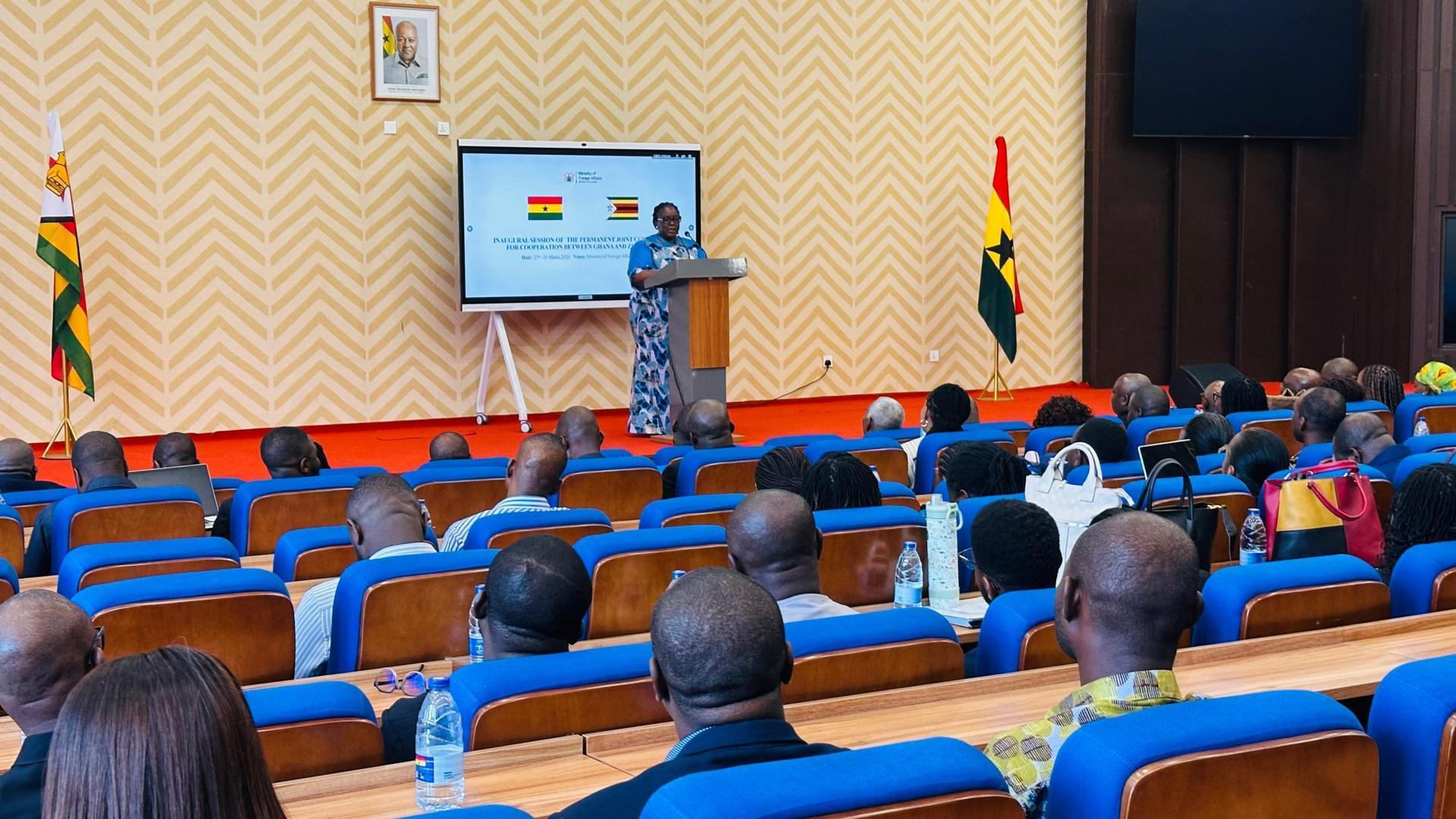
Africa-Press – Ghana. Ghana and Zimbabwe on Friday inaugurated the Technical and Ministerial Meetings of the Permanent Joint Commission for Cooperation in Accra to revitalise bilateral relations and translate longstanding political ties into concrete economic and developmental outcomes.
It marks a renewed push to transform decades of political solidarity into concrete economic and developmental outcomes.
The opening ceremony, held at the Ministry of Foreign Affairs, brought together senior officials, diplomats, and sector experts from both countries, with a shared commitment to reposition bilateral relations through structured collaboration across key sectors.
The PJCC, which has taken nearly three years to convene, follows the signing of a General Framework Agreement in 2023 and is expected to culminate in multiple Memoranda of Understanding covering over 20 priority areas, including trade, agriculture, mining, energy, health, tourism, and education
In addition to trade, Ghana and Zimbabwe will explore collaboration in mining, particularly in addressing challenges such as illegal mining and mineral beneficiation, as well as partnerships in energy, including oil and gas development and renewable initiatives.
Tourism and cultural exchange also featured prominently, with both countries considering twinning arrangements between heritage sites such as Cape Coast and Victoria Falls to promote joint destination marketing.
The Technical Meeting will lay the groundwork for the Ministerial Session, where agreements reached will be reviewed and adopted, setting the stage for a new phase of strategic cooperation between Ghana and Zimbabwe.
Ambassador Khadija Iddrisu, Chief Director of Ghana’s Ministry of Foreign Affairs described the meeting as “both historic and symbolic,” noting that it signalled a decisive shift from longstanding goodwill to actionable partnerships.
“This meeting marks not only the formal institutionalisation of cooperation between our two countries, but also a conscious effort to revitalise a relationship whose foundations were laid many decades ago,” she said.
She recalled Ghana’s pivotal role in Africa’s liberation struggles under Osagyefo Dr Kwame Nkrumah, including support for Zimbabwe’s independence movement and that the enduring ties between the two nations must now translate into measurable development gains.
Despite strong historical and political bonds, Ambassador Iddrisu acknowledged that economic engagement between Ghana and Zimbabwe had remained below expectations, with limited trade volumes and underutilised opportunities.
Ambassador Iddrisu stressed that the success of the PJCC would ultimately depend on implementation, urging participants to move beyond agreements to deliver real impact.
“Our task is to ensure that this engagement marks a turning point in Ghana-Zimbabwe relations, one that shifts us from potential to performance and from goodwill to concrete results,” she said.
“Our two Presidents are determined to change the narrative. This PJCC must not be a mere consultative forum. We must leave here with clear priorities, measurable outcomes, and a plan of sustainable actions,” she said.
Ambassador Albert Ranganai Chimbindi, Permanent Secretary in Zimbabwe’s Ministry of Foreign Affairs and International Trade, leading the Zimbabwean delegation, underscored the deep historical ties between the two countries, rooted in shared struggles for independence and Pan-African unity.
“Ghana was among the first countries with which Zimbabwe established diplomatic relations at independence in 1980. That support remains a powerful symbol of Pan-African solidarity,” he said.
He highlighted Ghana’s contributions to Zimbabwe’s post-independence development, particularly through education and diplomatic training, describing the relations as one of “enduring brotherhood and shared identity.”
Ambassador Chimbindi, however, expressed concern over the slow pace of structured engagement between the two countries, noting that the inaugural PJCC meeting had come decades after diplomatic relations were established.
“It is a serious indictment for all of us that we are only meeting in this structured format now. Our responsibility is to translate political will into tangible programmes that benefit our peoples,” he said.
Both sides emphasised the need to remove barriers to trade and investment, including tariff and non-tariff obstacles, while promoting the free movement of people, goods, and services in line with the African Continental Free Trade Area (AfCFTA).
The Zimbabwean delegation commended Ghana for hosting the AfCFTA Secretariat in Accra, describing it as a demonstration of leadership in advancing Africa’s economic integration agenda.
Ambassador Chimbindi pointed to opportunities for expanding trade between the two countries, noting that Zimbabwe could supply agricultural products such as maize, beef, and sugar, while Ghana could leverage its strengths in cocoa-based products, textiles, and shea butter.
He proposed the establishment of trade facilitation mechanisms, including warehouses, to ease access to goods and enhance bilateral commerce.
The PJCC framework aligns with broader continental efforts to deepen intra-African trade and integration, while reinforcing the vision of an Africa driven by its own resources, partnerships, and shared aspirations.