
Africa-Press – Ghana. At its core, the campaign carries a deeper message about stewardship. Beyond enforcement and regulation, officials say the task is fundamentally about responsibility — caring for the land rather than exhausting it.
The principle echoes an old biblical injunction in Genesis that humanity was placed on the earth “to work it and keep it,” while Psalm 24 reminds that “the earth is the Lord’s and the fullness thereof.” For policymakers, the meaning is practical rather than poetic: Ghana’s mineral wealth is not a resource to plunder, but a trust to manage wisely for future generations.
Gold’s record surge on global markets is reshaping Ghana’s economy at a critical moment. Higher prices have boosted export receipts and government revenues, but they have also intensified pressure on regulators to contain illegal mining — the environmental and fiscal leak that has long undermined the sector.
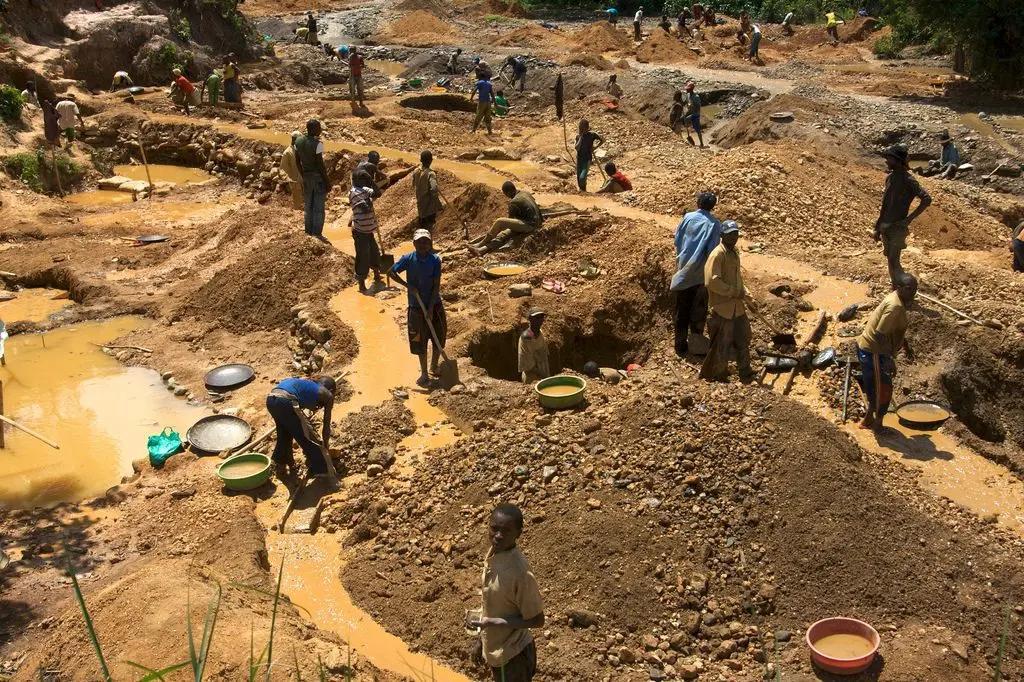
For years, successive administrations announced taskforces and emergency operations to tackle galamsey. Yet rivers continued to brown and forest belts shrank.
Under the new NDC administration, Ghana’s Ministry of Lands and Natural Resources has intensified efforts to curb illegal mining, rolling out a five-pronged strategy aimed at tackling galamsey while restoring degraded ecosystems.
Led by Sector Minister Emmanuel Armah-Kofi Buah, the approach blends enforcement, land restoration, and alternative livelihoods, signalling a shift from episodic crackdowns to a more structured and preventive framework.
At the heart of the strategy is an ambitious reclamation drive to restore lands and water bodies ravaged by illegal mining, backed by initiatives such as the Tree for Life reforestation programme.
The Minister recently inspected the successful restoration of 320 hectares of degraded land at Manso Nyankomanse in the Ashanti Region — comprising 240 hectares at Nyankomanse and 80 hectares at nearby Asare — describing the project as evidence that damaged landscapes can be returned to productive use. He said the government would intensify similar efforts nationwide as part of the broader fight against galamsey.
Early environmental indicators suggest the push is beginning to yield results. Ministry data show turbidity levels in several major rivers have declined markedly.
The River Tano at Sefwi recorded an 89 per cent drop, from 139 NTU in 2024 to 14 in 2025, while Barekese fell by half. The Ankobra at Domenase improved by 32 per cent, with similar gains at the Densu at Mangoase and the Ankobra at Ampasie. Cleaner water not only signals ecological recovery but also lowers treatment costs for utilities and reduces risks to farming and public health.
Beyond land restoration, the Ministry is expanding alternative livelihood programmes, notably through the Responsible Cooperative Mining and Skills Development Programme (rCOMSDEP), to create sustainable income opportunities for communities long dependent on illegal mining.
Enforcement has also been tightened through the National Anti-Illegal Mining Operations Secretariat (NAIMOS), with military and police deployments protecting forest reserves and water bodies now designated as security zones. At the same time, reforms to the licensing regime aim to formalise small-scale mining and strengthen regulatory compliance.
The strategy is supported by broader stakeholder engagement — working with traditional authorities, local assemblies, civil society, and the media — alongside the use of AI-powered satellite monitoring and remote sensing to detect illegal activity in real time.
Taken together, the measures reflect a more coordinated national response, pairing environmental repair with regulation, technology, and community inclusion, as Ghana seeks to reverse years of ecological damage while safeguarding livelihoods and long-term economic stability.
Mr Emmanuel Armah-Kofi Buah also told Parliament that a total of 500 excavators have been seized from illegal mining sites across the country since he assumed office, as part of the intensified efforts to clamp down on galamsey operations.
At the heart of these strategies is one key government agency — the Minerals Commission, responsible for regulating and managing the utilization of mineral resources, implementing policy, and promoting the mining sector. Its CEO, Isaac Andrews Tandoh, and his able Deputy, Emmanuel Anyimah, are keen to make a mark during their tenure.
Their strategy has changed. Less spectacle. More systems.
At the centre of that shift is Emmanuel Anyimah, Deputy Chief Executive in charge of Support Services, whose portfolio — estates, finance, logistics, and human resources — has quietly become one of the operational engines of the government’s anti-illegal mining campaign.
Mr Anyimah oversees spending, recruitment, and deployment for the Commission’s field operations, including the Blue Water Guard, now the most visible enforcement arm of the state.
“The President and the Minister of Lands were clear that enforcement must work this time,” he says. “My responsibility is to make sure we build structures that stay — not exercises that come and go.”
Building enforcement that stays on the ground
Launched last year, the Blue Water Guard was designed as a permanent, community-based force to protect rivers, concessions, and forest belts from illegal activity. Unlike periodic military-style swoops, the model relies on trained local recruits embedded within affected districts, providing daily surveillance and intelligence.
Mr Anyimah supervises the entire chain — recruitment, vetting, training, and deployment.
“We didn’t want a symbolic programme,” he explains. “We wanted something structured and accountable, with people permanently assigned to the communities they protect.”
The numbers reflect that intent. More than 1,600 personnel have already been deployed nationwide, with a target of over 2,000. The initiative has been backed with about GH¢4 million in funding, including about GH¢3.2 million in monthly wages, effectively turning enforcement into a standing budget line rather than an ad hoc intervention.
Deployments span mining hotspots across the Western, Western North, Eastern, Ashanti, Central, Volta, Northern, and Savannah zones, including communities along the Black Volta and Pra basins. The guards are unarmed. Their mandate is surveillance, reporting, and environmental protection.
“They are the eyes and ears.” Mr Anyimah says. “When something happens, we know immediately. Then NAIMOS and the security agencies move in.”
That coordination with the National Anti-Illegal Mining Operations Secretariat (NAIMOS) is central to the model.
“Illegal mining thrives in gaps,” he adds. “If enforcement disappears for two weeks, they return. So we are making sure there is always someone on the ground.”
Beyond gold: widening the net
While public debate focuses largely on gold, Mr Anyimah argues the damage runs deeper. Illegal sand winning, particularly along the Volta Basin, has destabilised riverbanks and farmland, often with little scrutiny.
“People think it is only about gold,” he says. “But sand winning can be just as destructive. Our responsibility covers all minerals.”
For the Commission, protecting licensed operators is equally important.
“When we issue a licence, we must protect it. Otherwise, the entire regulatory framework loses credibility.”
Embracing Technology
Alongside manpower, the Commission is leaning heavily on technology. Historically, excavators and earth-moving machines could be moved from legal concessions to illegal sites with little oversight. That loophole is being closed.
More than 2,000 heavy-duty machines are now being tracked through a digital monitoring system, with 3,000 additional trackers being procured. Under proposed amendments to the Minerals and Mining Act 703, excavators must be registered and geofenced to specific concessions. Once equipment moves outside authorised boundaries, alerts are triggered, and operations can be halted.
“If an excavator leaves its permitted site, we know immediately.” Mr Anyimah says. “That is usually the first sign of illegal activity.”
Explosives trucks are also being monitored — a measure shaped partly by lessons from the Appiatse disaster.
For Mr Anyimah, the shift is simple: “We are moving from reacting after the damage is done to preventing it in real time.”
Making mining more investible
Enforcement is only half the story. The government is also trying to make Ghana more attractive to responsible investors by reducing geological uncertainty.
The Ghana Geological Survey Department — a key agency the Minister of Lands is dedicated to assisting as he is bent on getting funding for them, so it can be supported to undertake nationwide mapping and prospecting, producing credible data on ore bodies that can shorten exploration timelines — Mr. Anyimah pointed out.
“The gold is there.” Mr Anyimah says. “But investors need reliable data. When you have that, you lower risk and attract serious capital.”
He adds that even in the small-scale sector, there is commitment from government to support:
“As I speak to you, GoldBod has come to Minerals Commission and we have given them a block out area and we have given to the Ghana Geological Survey Department to do prospecting for them. You also need traceability of where the gold is coming from, so it is a whole coordinated effort and the Minister remains serious about this to know where the data is. The vision of the President and the Minister will ensure a lot of investors come in.”
For Mr. Anyimah, the government, through the Lands Minister alongside his CEO, Mr Isaac Andrews Tandoh, at the Minerals Commission, is keen on traceability.
He reckons that traceability will enhance investor confidence via Environment Social Governance compliance. It will help reduce risk, as it will identify and mitigate risks associated with child labour, human rights abuses, and environmental damage. Investors seeking to avoid reputational and legal risks prefer jurisdictions where they can trace the gold and verify it was mined responsibly.
Further, there is Alignment with Global Standards: By enabling compliance with international standards (e.g., OECD Due Diligence Guidance, Responsible Jewellery Council), traceable supply chains assure international buyers that the gold is ethically sourced.
Officials believe better geological intelligence, coupled with stricter enforcement, could help formalise production and raise state revenues at a time when gold is central to the country.
Source: Ghana News Agency