
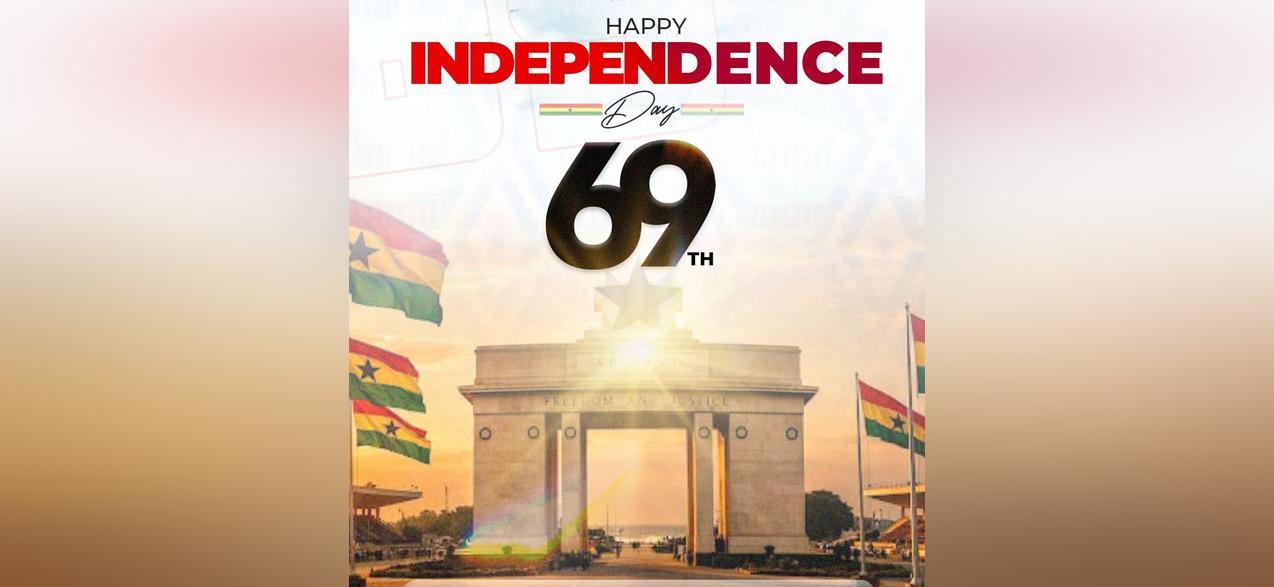
Africa-Press – Ghana. As Ghana marks its 69th Independence Anniversary, the occasion offers an opportunity to reflect on the country’s constitutional journey, the democratic gains made over the decades, and the challenges that remain in strengthening governance.
On March 6, 1957, Ghana became the first sub-Saharan African nation to gain independence from Britain, setting a historic example for other African countries seeking self-determination.
Under the leadership of Dr Kwame Nkrumah, the nation embarked on a path of nation-building, political transformation, and constitutional experimentation aimed at shaping a stable system of governance.
Ghana’s first major constitutional milestone came in 1960 when the country adopted its first Republican Constitution, transforming it into a republic with Dr Nkrumah as Executive President.
The 1960 Constitution strengthened presidential authority and ended the role of the British monarch as Head of State.
However, political tensions and economic challenges culminated in the overthrow of the Nkrumah government in the 1966 Ghanaian coup d’état.
The coup marked the beginning of a turbulent period in Ghana’s political history, characterised by alternating civilian and military administrations.
In 1969, constitutional governance returned with the establishment of the Second Republic under Dr Kofi Abrefa Busia.
The new constitution introduced a parliamentary system designed to reduce the concentration of power in the presidency.
Nevertheless, the civilian government was overthrown in the 1972 coup d’état, once again suspending constitutional rule.
Another attempt at constitutional governance emerged in 1979 with the formation of the Third Republic led by Dr Hilla Limann.
The Third Republic, however, lasted only a short period before it was overthrown in the 1981 Ghanaian coup d’état.
The subsequent years under the Provisional National Defence Council, led by Flt. Lt.
Jerry John Rawlings, marked another era of military rule.
A major turning point in Ghana’s democratic journey came in 1992 with the adoption of the current Constitution, ushering in the Fourth Republic.
The 1992 Constitution established a multi-party democratic system and provided the legal framework for governance in modern Ghana.
The constitution sought to cure the ills of previous constitutions by the introduction of many clauses, including those which abolish the one party state, retroactive legistion, protection for anyone who defends the constitution and even the role of the Media in the protection of the constitution and the holding of government and public institutions accountable to the people.
It also entrenched a hybrid separation of powers among the executive, legislature and judiciary.
Independent institutions such as the Electoral Commission of Ghana were strengthened to promote credible elections and democratic accountability.
Over the past three decades, the Fourth Republic has delivered relative political stability and democratic continuity.
Ghana has conducted multiple competitive elections and experienced peaceful transfers of power between political parties.
These developments have enhanced the country’s democratic credentials both within Africa and internationally.
However, as the country celebrates 69 years of independence, debates continue about the need to reform aspects of the constitution.
Critics often point to the concentration of powers in the executive arm of government and the influence of political authority over public institutions.
Others advocate stronger decentralisation to empower local government structures and deepen grassroots participation in governance.
In response to these concerns, the government established the Constitutional Review Commission (CRC) in 2010 to gather public views on possible reforms to the Constitution.
The Commission received thousands of submissions from citizens and institutions across the country.
Its recommendations covered governance reforms, electoral processes, and measures to strengthen institutional independence.
Yet, many of the proposed reforms are still awaiting implementation.
In 2025, another committee, this time an advisory one, was formed by President John Mahama to present proposals for the review of the constitution.
The group’s report is out and the President has vowed to implement these proposals. It is mainly on political and civil rights with no talk about economic rights, which form a solid ground for political and civil rights to flourish.
Voting buying is rampant and even more apparent during elections because many Ghanaians struggle to meet their economic needs. The political class will take advantage of it to seek power and keep it.
It also encourages clientalism where state resources are used by the political class to purchase loyalty with the view to hold on to power.
As Ghana marks its 69th Independence Anniversary, the country stands at an important moment in its constitutional journey.
The progress achieved in sustaining democratic governance provides a strong foundation for future development.
However, strengthening institutions, promoting accountability, and ensuring inclusive governance remain critical priorities.
Ultimately, the success of Ghana’s Constitutional system will depend on the commitment of leaders and citizens alike to uphold democratic principles.
The celebration of independence therefore serves not only as a reminder of the nation’s historic achievements but also as a call to deepen democracy and secure a more prosperous future for generations to come.
Source: Ghana News Agency