
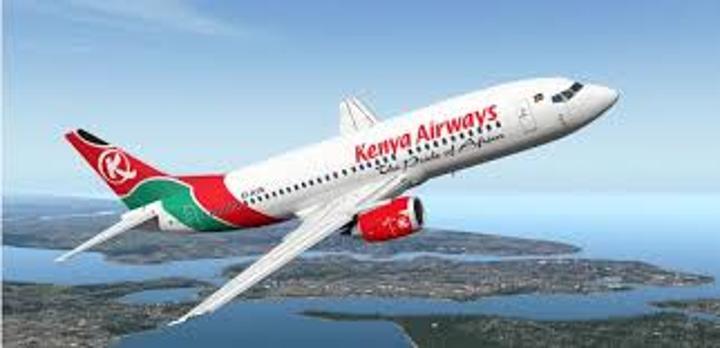
Africa-Press – Kenya. Kenya Airways slipped back into the red, posting a net loss of Sh17.2 billion for the year ended December 2025, a sharp reversal from the Sh5.2 billion profit recorded in 2024.
The situation was aggravated by a global shortage of aircraft spare parts that grounded key planes and disrupted operations.
The latest financial results paint a picture of an industry still grappling with deep-rooted supply chain constraints, even as demand for air travel remains resilient.
The loss was mainly occasioned by the temporary grounding of three Boeing 787-8 Dreamliner aircraft, which significantly cut the airline’s capacity, triggering a ripple effect across its network.
Available seat kilometres (ASKs), a key measure of airline capacity, dropped by 18 per cent to 13.3 billion, reflecting the operational strain.
This capacity crunch translated into a 13 per cent decline in passenger numbers, pushing total revenue down by 14 per cent, or Sh27 billion, to close the year at Sh161 billion.
Despite efforts to rein in expenses, including scaling down operations, total operating costs only fell marginally by 3 per cent to Sh167 billion.
The mismatch between shrinking revenues and relatively sticky costs resulted in an operating loss of Sh5.6 billion, ultimately widening to the Sh17.2 billion net loss.
The airline’s chairman, Kiprono Kittony, attributed the downturn largely to external shocks rather than weak market demand, insisting that the airline’s fundamentals remain intact.
“While our financial performance reflects a challenging year, it is important to recognise that this was driven primarily by global supply chain disruptions and not a lack of demand,” he said, noting that appetite for travel remains strong.
Acting Group managing director and CEO George Kamal echoed this view, situating the airline’s struggles within a broader global aviation context marked by aircraft delivery delays, engine shortages and logistical bottlenecks.
According to the International Air Transport Association, the aviation sector continued its recovery trajectory in 2025, buoyed by robust international passenger demand.
However, persistent supply chain disruptions and rising input costs—particularly fuel and labor—have continued to erode profitability across airlines.
For Kenya Airways, the aviation lobby said that these global pressures were compounded by regional structural challenges, including high operating costs and infrastructure limitations within Africa. Cargo operations also weakened amid slower global trade and shifting tariff regimes, further denting revenue streams.
The macroeconomic environment offered little relief. While the Kenyan shilling remained relatively stable compared to the volatility seen in 2024, geopolitical tensions, particularly in the Middle East, posed fresh risks through potential fuel price spikes and airspace restrictions, which could force airlines into longer, costlier flight paths.
Looking ahead, the airline has outlined a recovery plan anchored on restoring grounded aircraft to service, tightening cost controls and pursuing fresh capital to strengthen its balance sheet.
“Fleet restoration is seen as the most immediate lever for recovery. Bringing back the grounded Dreamliners is expected to unlock capacity, stabilise schedules and recapture lost revenue. At the same time, management is pushing for stricter cost discipline and cash conservation to navigate ongoing uncertainties,” Kamal said.
The airline is also advancing plans to raise capital, a move aimed at improving liquidity, supporting fleet expansion and diversifying revenue streams in an increasingly competitive and volatile aviation landscape.
The future performance is, however, dependent on how the ongoing war in the Middle East between Israel and the US against Iran will pan out.
On Monday, KQ told journalists that although the war is both a blessing and a curse to the airline, indicating that 90 per cent of seats are occupied daily, as it benefits from spilled seats from other carriers for passengers heading to West Africa, Europe, Asia and America.
Even so, the crisis has sparked a fuel crisis, with the price of Jet A-1 having surged by 60 per cent. The airline is also losing at least Sh2.6 million per flight due to reroutes as most airspaces in the Middle East remains shut.