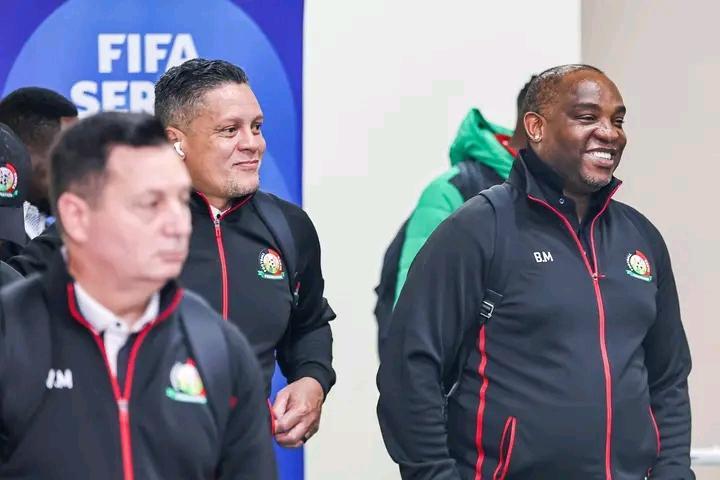
Africa-Press – Kenya. Harambee Stars have arrived in Kigali, Rwanda, for the 2026 FIFA Series without their captain and leading striker, Michael Olunga, whose omission headlines a significantly reshaped squad named by head coach Benni McCarthy.
The decision to leave out Olunga, Kenya’s second-highest scorer with 34 international goals, marks one of the most consequential selections of McCarthy’s tenure. The forward, who plays for Al-Arabi SC, is one goal shy of equaling the national record held by William Ouma, making his absence all the more notable.
According to McCarthy, the final squad was shaped by a combination of injuries, unavailability and technical considerations. Several regulars have been left out, including Byrne Omondi, Erick Ouma, Joseph Okumu, Collins Sichenje and Jonah Ayunga. At the same time, Daniel Anyembe and Zak Vyner were ruled unavailable for the international window.
Within that wider context, McCarthy’s selections suggest a willingness to experiment, assess depth and potentially reshape the team’s identity.
One of the most closely watched returns is that of Mohammed Bajaber, the forward whose international career had stalled amid persistent injury setbacks. His inclusion offers both an opportunity for personal redemption and a test of McCarthy’s faith in players seeking to reestablish themselves.
“It means a lot to be back,” Bajaber said. “I haven’t been playing regularly, so I see this as a chance to rebuild myself—physically and mentally—and show what I can still offer.”
The 23-year-old forward, who now plays for Simba SC, acknowledged the challenges that have interrupted his progress over the past year.
“Football can change quickly,” he said. “At one point, you feel like everything is going your way, and then suddenly you’re working just to get back to your level. That’s what I’ve been dealing with.”
Despite those setbacks, Bajaber framed his return as both a responsibility and an opportunity. “When you’re given another chance, especially to represent your country, you don’t take it for granted,” he said. “I’m grateful for the trust, and I want to repay it with my performances.”
He added, “This is not just about being in the squad. I want to contribute, to make an impact, and to help the team move forward.”
Bajaber also credited his club environment for supporting his recovery and helping him regain confidence. “The setup has helped me a lot,” he said. “They’ve given me time to recover properly and get back into shape, and that has made a big difference.”
For McCarthy, Bajaber’s recall reflects a calculated decision rather than a sentimental one. “He’s a player who offers something different in attack,” the coach said. “Even when he hasn’t been playing regularly, you can still see his qualities.”
McCarthy emphasised that selection was based on readiness and commitment rather than reputation. “We’ve been monitoring him, and he’s working hard to get back to full fitness,” he said. “What matters is that he’s ready to compete.”
At the same time, the coach made clear that no player is assured of a place. “In this squad, everyone has to earn their position,” he said. “There are no guarantees. You prove yourself in training and in matches.”
Still, McCarthy acknowledged the potential impact Bajaber could have if he regains form. “When he’s at his best, he brings movement and unpredictability,” he said. “Those are important qualities for us.”
The coach also framed the tournament as part of a longer-term process. “This is an opportunity for players to show what they can do,” he said. “We are building toward bigger objectives, and every player has to align with that.”
Olunga’s absence inevitably shifts attention toward a younger attacking group that includes Zech Obiero, Ryan Ogam and Clarke Oduor. Without the team’s established focal point in attack, responsibility will be more widely distributed.
McCarthy, however, downplayed concerns about the missing captain. “Football is always about the collective,” he said. “When one player is not there, others have to step up and take responsibility.”
The squad otherwise features a blend of experience and emerging talent. Goalkeepers Faruk Shikhalo, Brian Bwire and Ian Otieno provide depth, while the defensive unit includes Aboud Omar, Daniel Sakari and Rooney Onyango. In midfield, Richard Odada and Duke Abuya are expected to play central roles alongside Austine Odhiambo.
Kenya will remain in Kigali for the duration of the tournament, with matches scheduled on March 27 and March 30. For Bajaber, the immediate focus is simpler than the broader narratives surrounding the squad. “I just want to get back to feeling like myself on the pitch,” he said. “Once that happens, everything else will come.”
For Kenya, the coming days will offer early indications of whether a reconfigured squad can deliver results—and whether the absence of its captain signals a temporary adjustment or the beginning of a more lasting transition.
Kenya will open their campaign against the Estonian national football team on March 27 at Amahoro Stadium. Their second fixture will depend on the outcome of the opening match between the Rwanda national football team and the Grenada national football team, under a format that pairs winners and losers in subsequent matches.
The tournament, now in its second edition, is designed to offer national teams competitive matches across confederations. For Kenya, it serves a broader purpose: preparation for the Africa Cup of Nations 2027, which the country will co-host alongside Uganda and Tanzania.
Final 23-man Kenya squad for FIFA Series
Goalkeepers: Faruk Shikhalo, Brian Bwire, Ian Otieno; Defenders: Manzur Okwaro, Aboud Omar, Alphonce Omija, Mike Kibwage, Frank Odhiambo, Rooney Onyango, Daniel Sakari; Midfielders: Alpha Onyango, Duke Abuya, Richard Odada, Chrispine Erambo, Austine Odhiambo, Will Lenkupae, Mohammed Bajaber; Forwards: Job Ochieng, Zech Obiero, Clarke Oduor, Ryan Ogam, Lawrence Okoth, Ben Stanley.
Kenya fixtures in Rwanda
Kenya vs Estonia (6 pm) March 27
Winner M1 vs Winner M2 (6 pm) March 30
Loser M1 vs Loser M2 (6pm) March 30