By
Tridivesh Singh Maini
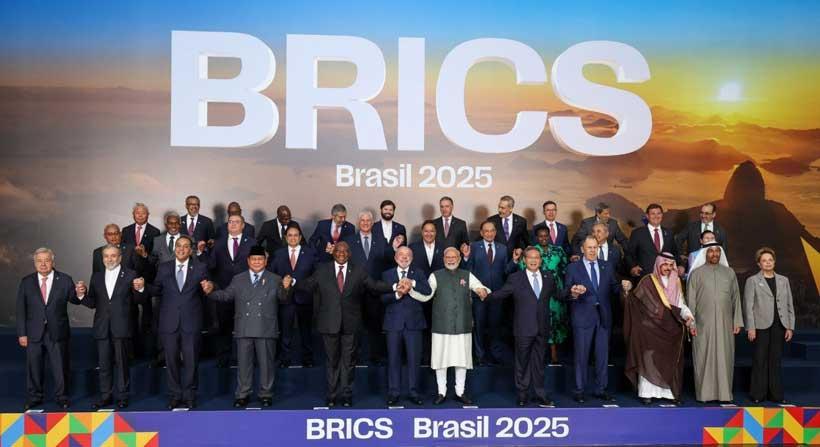
Africa-Press – Kenya. Brazil handed over the BRICS Presidency to India on December 12, 2025, though India will formally take over on January 1, 2026. Brazil handed a gavel—made of recycled wood from the Amazon forest—to India. While handing over the gavel, Brazil’s BRICS Sherpa Mauricio Lyrio said:
‘Through this gesture, confidence in India’s upcoming presidency is reaffirmed, along with the commitment to support its efforts to advance the BRICS agenda.’
As India prepares to take over the mantle of BRICS, it is tough to ignore two important issues.
The first is the discussion regarding what has been referred to as the proposed BRICS+ Unit. The BRICS+ unit is a payment instrument that seeks to facilitate trade in local currencies between BRICS+ member states (it is currently in the testing phase). The BRICS+ unit would consist of a basket of gold (40%) and currencies (60% BRICS+ currencies). The aim of the BRICS unit is to reduce dependence upon SWIFT and the US dollar. While the unit could lead to weakening of the US dollar, it cannot be classified as a currency per se.
Second, the Advisor on International Affairs to the Brazilian President reiterated the point that the BRICS+ grouping in no way wanted to challenge the dollar. Said Celso Amorim, international affairs advisor to Brazil’s president:
‘Many wonder if the US dollar will be abandoned. No one is planning to do that. The United States is a big country whose economy is crucial for the entire world. However, there still needs to be an alternative.’
This is important because US President Donald Trump has repeatedly threatened imposition of sanctions on BRICS member states if they seek to challenge the US dollar in any way. The latest such threat to BRICS countries was after the BRICS Summit held in Rio de Janeiro (Brazil) in July 2025.
Celso Amorim’s statement comes days after Russian President Vladimir Putin’s remarks during his India visit that BRICS countries needed to be realistic with regard to the idea of a common currency and not act in ‘haste.’
Trade in local currencies: The challenges
Several BRICS countries—members and partners—are reducing dependence upon the US dollar. It is important to understand that trade in local currencies is very different from a common BRICS currency. India, which will be chairing BRICS, has supported trade in local currencies while distancing itself from the idea of a BRICS common currency on more than one occasion. During its presidency, India is likely to promote the United Payments Interface (UPI). BRICS Pay seeks to link UPI with UPI, Russia’s SPFS, China’s CIPS, and Brazil’s Pix for promoting trade in local currencies.
It is important, however, to bear in mind a few facts regarding the likely obstacles that trade in local currencies faces. A JP Morgan Report, published in July 2025, titled “The Evolving BRICS+ Payments System: A Primer,” makes an important point:
‘The reluctance of countries to hold large quantities of foreign currencies other than the dollar and euro leads to a more intractable issue—the absence of a universally accepted settlement and reserve asset.’
The challenges pertaining to rupee-ruble payments were flagged by Putin during his India visit. In an interview Putin said:
‘… It’s not about rupees; it’s about what those rupees can buy, respectively, for our companies. We’re also thinking about this, not only the Indian government. And we agree that this disparity must be addressed, but not through bans, rather by finding areas beneficial for both sides’.
Why countries may be cautious vis-à-vis full membership of BRICS+
Another interesting aspect is that of countries entering BRICS as partner countries rather than full members. One such example is Malaysia, which has entered BRICS as a partner country. While the Southeast Asian nation’s trade with BRICS member states has risen, it has adopted a cautious approach vis-à-vis full membership of the organization. Several other countries may seek to play it safe vis-à-vis BRICS, lest they annoy the Trump administration.
Conclusion
In conclusion, recent developments highlight the fact that BRICS member states are seeking to realign their policies with the changing global order but do not necessarily view the global economic landscape from a zero-sum perspective and simplistic binaries. The BRICS organization does have convergence on many issues, but there will be issues where finding consensus may be tough. Finally, several countries may follow an approach similar to that of Malaysia regarding full membership of BRICS and prefer remaining partner countries.
moderndiplomacy