
What You Need to Know
The Directorate of Criminal Investigations (DCI) has uncovered serious irregularities in body tagging at Nyamira Teaching and Referral Hospital. Investigators found that 39 remains, including infants and amputated body parts, were mishandled and buried without proper identification. The DCI is conducting forensic identification and tracing parents of the deceased while ensuring accountability in a
Africa-Press – Kenya. The Directorate of Criminal Investigations (DCI), Amin has unearthed a mortuary tagging irregularities at Nyamira Teaching and Referral Hospital, exposing grave lapses in documentation, oversight, and burial protocols.
Investigators revealed that dozens of remains, including infants and amputated body parts, were mishandled and buried without proper identification, raising serious accountability concerns.
Speaking today, March 31, 2026, during a live briefing aired on NTV, the DCI confirmed that 39 remains — 33 bodies and six body parts — lacked official hospital tags.
Only a few had informal handwritten wrist or foot tags, but none had proper hospital identification.
The vast majority of the 39 remains, that is, the 33 bodies and six parts, lacked the standard official mortuary tags. Only a few had eligible hospital tags or informal handwritten wrist or foot tags. However, none of the bodies had proper hospital identification and documentation,” Amin said.
“Whereas the hospital records indicate that 46 infants died in the wards and were taken to the morgue, the mortuary records do not account for the discharge of the 46 infants or foetuses whose remains may have left the morgue under unclear circumstances,” he added.
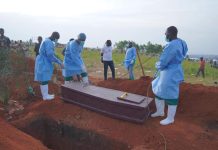
According to Amin, investigations established that all remains recovered from a mass grave at the NCCK Makaburini cemetery originated from Nyamira Teaching and Referral Hospital mortuary.
DCI said footage from March 19, 2026, showed four bags being loaded into a white Toyota Land Cruiser by a mortician at the morgue under the supervision of another officer from the facility.
The vehicle has since been impounded and is under police custody.
To ensure accountability and transparency, the DCI said forensic identification of the deceased is underway, with DNA and toxicology samples submitted to the government chemist.
“The investigations team has embarked on tracing the parents of the deceased infants and foetuses, and reference DNA samples from patients whose limbs were amputated at the hospital for comparison purposes,” he said.
Second, Amin said forensic document analysis is being conducted on hospital records, mortuary logs, court orders, and administrative documents from the National Council of Churches of Kenya (NCCK) Kericho branch.
Investigators are also verifying land registration details of the cemetery to establish whether it is a gazetted public burial site.
So far, six suspects have been arrested, with three released after interrogation. The remaining three are in custody pursuant to court orders.
Their case is scheduled for mention on April 23, 2026.
According to Amin, the probe has also exposed possible irregular payment processes.
He said a sum of Sh130,000 was reportedly paid to the NCCK Makaburini cemetery management, but investigators say due process was not followed.
The DCI stressed that the matter is not about mass murder but negligence and accountability.
“Currently, we are talking about undocumented dead bodies. People are talking about mass murder. It’s nothing about murder here. We are just talking about negligence and accountability, and we will take appropriate action,” the DCI said.
The Nyamira Teaching and Referral Hospital has faced scrutiny in the past regarding its handling of remains. This recent investigation by the DCI highlights ongoing issues of accountability and proper documentation in mortuary practices. The mishandling of remains raises significant ethical and legal concerns, particularly regarding the treatment of deceased infants and the protocols followed by healthcare facilities in Kenya.
Historically, the management of mortuaries in Kenya has been challenged by inadequate oversight and lack of adherence to established protocols. The DCI’s findings may prompt a broader examination of mortuary practices across the country, emphasizing the need for more