
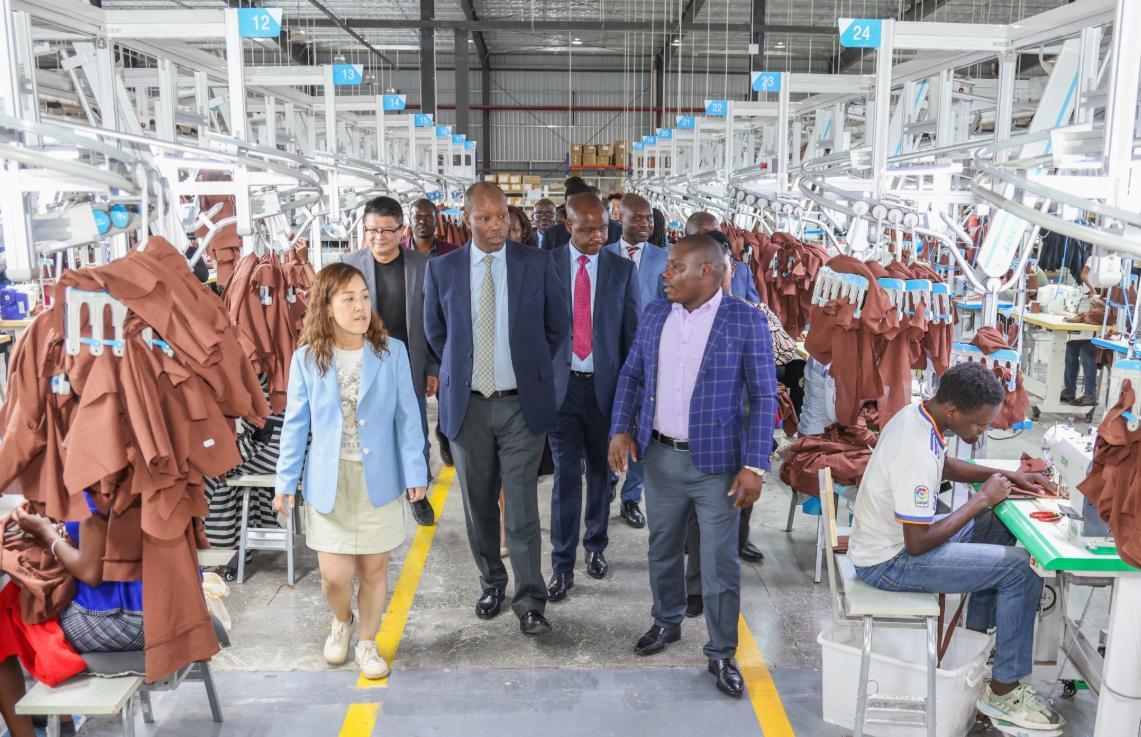
Africa-Press – Kenya. INVESTMENTS in the country’s Export Processing Zones (EPZs) have hit Sh181.5 billion, Investments, Trade and Industry Ministry says.
This is on 116 gazetted zones and 207 licensed enterprises across the country, with textile and apparel businesses accounting for the lion’s share of these investments whose main focus is production for international markets.
According to Investments CS Lee Kinyanjui, the operating EPZs have so far created about 95,364 direct jobs, with over 300,000 indirect jobs supported through value.
Export earnings from EPZs reached approximately Sh135.7 billion last year, up from Sh129 billion in 2024, driven mainly by growth in apparel and agro-processing.
Earnings were Sh105.5 billion in 2023, which was a slight dip from Sh106.6 billion in 2022, before recovering to the recent numbers.
The sector is dominated by apparel producers with exports under the African Growth and Opportunity Act (Agoa), which has since been extended by one year, remaining key.
Data by EPZ Authority indicates apparel exports under Agoa has averaged over 90 per cent of national apparel exports over the years.
“With the extension of Agoa, investors now have greater certainty of continued market access, even as Kenya begins bilateral engagement with the United States to unlock further opportunities for our products,” CS Kinyanjui said during a visit of the Athi River EPZA on Tuesday.
He said his ministry is also exploring diversification into other markets in Europe and parts of Asia, and most importantly across Africa through the African Continental Free Trade Area (AfCFTA).
Apart from textile and apparel, Kenya’s EPZs also churn out agro-processed goods (tea, coffee, fruits) and pharmaceuticals.
Major export markets include the US (via Agoa), Europe ( now under the Economic Partnership Agreement), the UK and African countries, with exports driven mainly by firms in Athi River and Mombasa.
As of 2025, the Athi River area had 106 licensed and operational enterprises with Sh66.5 billion in cumulative investments (37 per cent of total investments in the country) and export earnings of Sh50.1 billion for the year.
These entities created 38,560 direct jobs with within the region.
CS Kinyanjui said the government has enacted a raft of incentives, including tax holidays to attract investors into industrial zones.
EPZs in Kenya are offered a 10-year corporate tax holiday followed by a 25 per cent rate for 10 years, 100 per cent investment deductions on buildings, machinery, and perpetual exemption from VAT and customs duties on inputs.
These incentives, managed by the EPZ Authority also feature a 10-year withholding tax holidays on dividends, no exchange controls and rapid, one-stop licensing to foster export-oriented manufacturing.
Major companies shaping Kenya’s manufacturing narrative on the global stage include Nador (global sports goods producer specifically specialising in the production of bristle dartboards) and Antex (manufacturing and export of garments).
Another major player is MAS Intimates Kenya (EPZ), a subsidiary of the Sri Lankan-based MAS Holdings, a major manufacturer and exporter specialising in apparel and textile production, specifically focusing on lingerie, intimate wear and garments for global brands.
Meanwhile, Kenya has received the backing of World Bank’s investment arm—International Finance Corporation (IFC), in developing structures that will allow more investments in its Special Economic Zones.
While EPZs are primarily restricted to manufacturing goods for export with limited local sales, Speacial Economic Zones (SEZs) are broader, accommodating diverse sectors (services, tech, tourism) and allowing significant domestic market sales.
SEZs act as comprehensive integrated industrial ecosystems,while EPZs function as narrowly focused export-promotion enclaves.
“In addition to the enabling environment, the cooperation agreement (with IFC) will also focus on green special economic zones and performance based incentives,” Investment PS Abubakar Hassan said.