Africa-Press – Kenya. Gulf Energy, a local petroleum exploration and production firm, has pledged to maintain international best practice in the production of crude oil resources in Turkana County.
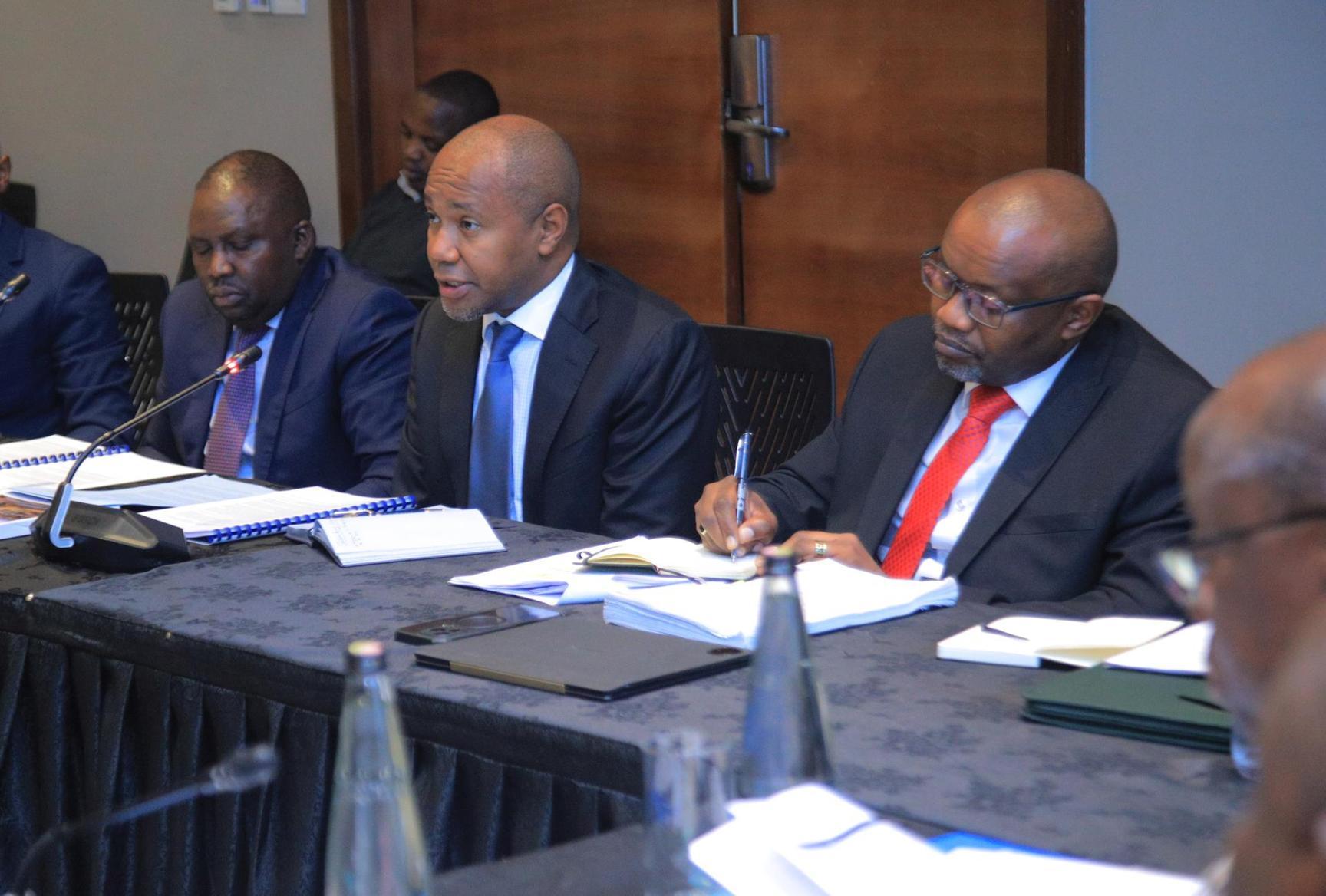
Appearing at a Joint Parliamentary Committee of Energy meeting, Gulf Energy E&P BV chairman, Francis Njogu, while describing the project as the single most significant private-sector-driven upstream petroleum investment in Kenya’s history, said the firm will maintain world-class standards with a target to produce crude oil by 1st December this year.
He said this during a public participation exercise ahead of the project’s Field Development Plan (FDP) ratification, where it is expected to pump nearly $6 billion into the project.
Both the Gulf Energy E&P BV (GEBV) Field Development Plan (FDP) and the Production Sharing Agreements, he said, place strong emphasis on local content, community engagement, and alignment of mutual benefits.
Flanked by the firm’s Group CEO, Paul Limoh, and Country Manager, Franklin Juma, said that these commitments are reinforced through social investments and strict adherence to a robust, ring-fenced Local Content Strategy, with the overarching goal of delivering long-term socio-economic benefits for Turkana County and Kenya as a whole.
“At Gulf Energy, we are approaching this FDP as Kenyans with a view to creating as many jobs and business opportunities for Kenyans, starting with our Turkana host community, as are committed to positioning Kenya as an oil-producing country. We are very ready, and we have set December 1, 2026, as a target to produce oil, and we hope to expeditiously secure the FDP ratification,” Njogu said.
He added that the firm is an indigenously owned firm with strong financial resources to support capital-intensive projects, such as the South Lokichar Oil Project.
According to him, the firm has established robust financial partnerships and active lines of credit with leading local and international banking and financial institutions.
“The South Lokichar project and the FDP we have presented to the Government present a technically mature pathway to unlock Kenya’s largest onshore petroleum development in a shared prosperity model,” he said.
“While the plan demonstrates a clear scheduling, phased risk reduction and strong economic rationale, Gulf Energy also reaffirms its commitment to operate transparently, safely and in full compliance with Kenyan legislation and international best practices.”
Kenya stands to gain significant fiscal and economic benefits, with the Government of Kenya projecting potential earnings between $1.05 billion (at $60 per barrel) and $2.9 billion (at $70 per barrel), which translates to Sh136 billion to Sh371 billion over the life of the project.
While commenting on the project’s cost recovery proposal contained in the FDP that was approved by the Cabinet Secretary, Ministry of Petroleum and Energy, Opiyo Wandayi, last November, Njogu explained that the project-specific fiscal measures outlined in the FDP are essential to meeting the investment and bankability thresholds required for a Final Investment Decision (FID).
“The South Lokichar Development presents a strategic and time-sensitive opportunity for Kenya to convert a well-understood petroleum resource into long-term economic value.”
Under the Petroleum Sharing Contract (PSC) framework, the State, he explained, retains full ownership and stewardship of the resource, while the Contractor (Gulf Energy) provides the technical capability and risk capital needed to bring it to production.
He petitioned the Parliament to recommend the project’s ratification, saying that the current opportunity exists against the backdrop of a rapidly evolving global energy landscape, where the window for financing new upstream oil projects is narrowing.
He revealed that international lenders are progressively tightening investment criteria for hydrocarbons in line with global climate commitments, and capital is increasingly being redirected toward lower-carbon energy systems.
“As a result, frontier oil projects such as South Lokichar must demonstrate strong economics, robust fiscal stability, and timely decision-making to remain competitive for capital. Any prolonged uncertainty risks placing Kenya at a disadvantage relative to other emerging oil provinces that are actively adjusting their fiscal terms to secure investment before this window closes,” he explained.
Parliament is expected to deliberate on the FDP and PSCs before deciding on ratification in the coming weeks.