
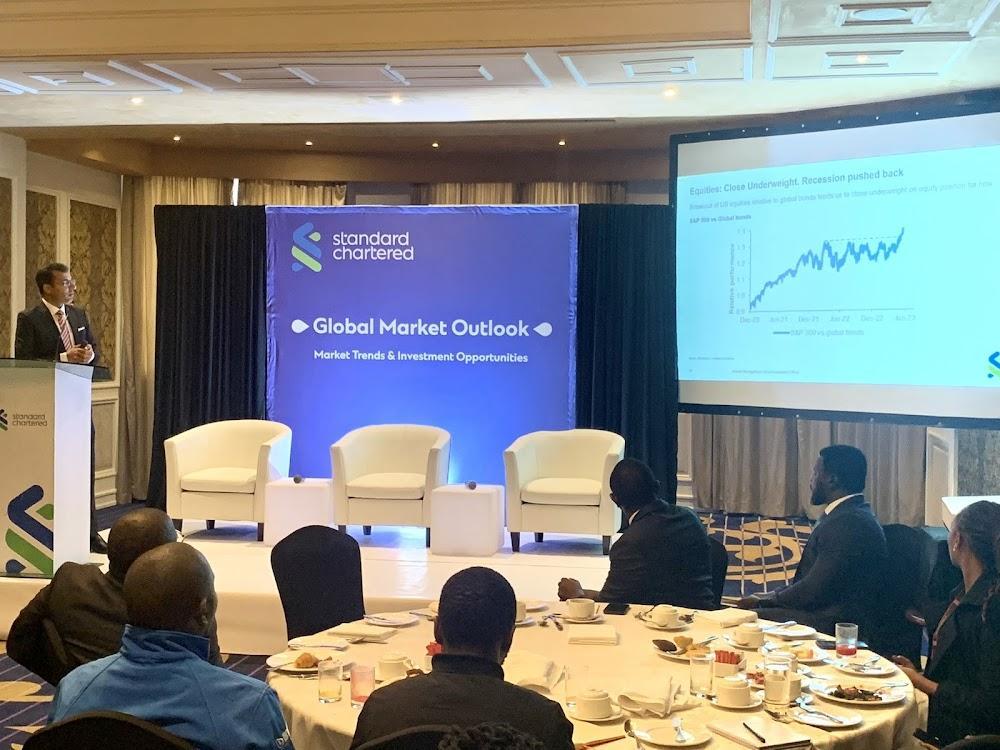
Africa-Press – Kenya. Standard Chartered Bank says those who invest in high-security bonds are likely to reap big even as the world slides into a recession.
Speaking during the launch of the bank’s market outlook for the six months to June 30, chief investment officer for Africa & Middle East, Manpreet Gill said that investors who capitalise on the capital market opportunities will record good returns on their investments.
Manpreet points out that diversification of capital and the management of their volatile investment will also cushion them from the adverse effects of the recession.
“There are always opportunities in the capital markets, in this scenario high quality bonds continue to offer extremely attractive yields. Longer tenure quality bonds offer potentially better total returns compared to cash as we approach the end of a hiking cycle,” said Manpreet.
He added that the bonds are at their highest returning assets during economic recessions which presents an opportunity to really lock these investments.
Equity markets on the other hand have recorded quite an impressive run this year majorly driven by a small number of stocks that have driven the index higher.
“That’s that optimism that the equities will continue performing the same way indefinitely and we are worried that it may go on longer than it is sensible,” added Manpreet.
The H2 Market Outlook warns that the monetary tightening regulations by central banks across the world risk hastening the global recession.
It says that if the federate rate hike continues it will further slow economic activity as the high cost of credit slows down uptake while also discouraging some investors from borrowing to expand their investments.
The report points out that as businesses entered Half two 2023, financial markets are presenting a challenge to investors. Equity markets have surged, at least at a headline index level and our view is that they may rise further, at least in the short term.
“However, leading indicators of economic growth (particularly in the US) continue to paint a less optimistic picture and most major central banks remain much more concerned about elevated inflation than about weak growth indicators.”
The fed rate increase has led to a rise in the cost of living due to an increase in the price of basic commodities, leaving a large proportion of the vulnerable population at the edge of a precipice.
Additionally, the rising cost of credit has on the hand, affected individuals and corporate persons alike.
The world bank had already warned that should the economic strain continue, there could be a string of financial crises in emerging markets and developing economies that would do lasting harm.
Over the recent years we have witnessed most of the investment being concentrated in high-growth sectors such as tech and green energy as increasingly impact-oriented investors look for sustainable solutions to the various challenges like the climate crisis.
Standard Chartered Head of Affluent Banking and Wealth Management for Kenya & East Africa Paul Njoki said that In 2020, over half of all PE investments in the region were in the tech sector while African start-ups raised over $1 billion for the first time in 2021.
“Africa remains an exciting investment destination with positive demographics, rising adoption of technology and rising consumer and business spending. With Africa set to account for 25percent of the global population by 2050 – and with robust growth in key sectors, the continent offers an attractive investment proposition for international capital,” said Njoki
Already, the economic situation in Kenya remains fragile owing to various constraints such as rising inflation, surging fuel costs and drought which has affected agricultural activities and overall productivity.
According to the IMF, this has been attributed to weakened activity in key economies such as the US, China and Europe and is likely to affect one-third of the world with ripple effects reaching regions that may not experience a recession.
For More News And Analysis About Kenya Follow Africa-Press