
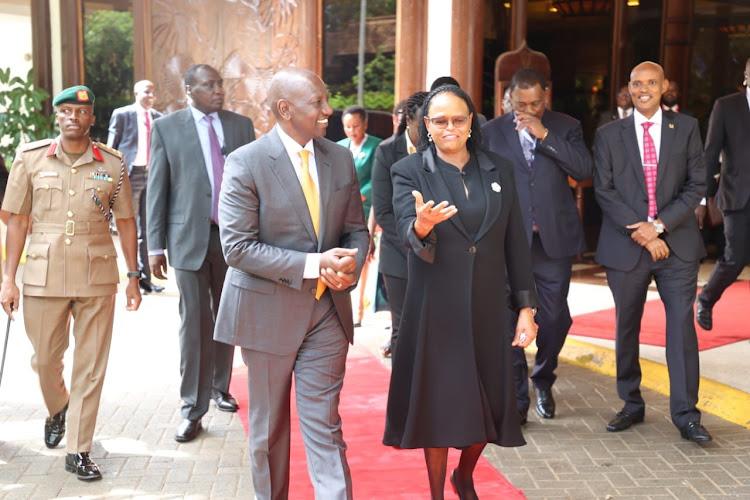
Africa-Press – Kenya. The Judiciary has pledged to continue playing a proactive role in the fight against climate change.
Chief Justice Martha Koome said the institution must be unyielding in its pursuit of environmental justice, ensuring their decisions and judgments contribute to the realisation of a greener, more resilient and more sustainable Africa. Koome said the move will protect the most vulnerable in society.
“Judiciaries have a role to play in ensuring environmental stewardship, justice, and sustainability for the African continent and our people,” she said.
The CJ said hosting the symposium speaks to the country’s commitment to championing environmental justice and fostering regional judicial dialogues.
“As we face the unprecedented challenges posed by climate change, it is crucial that we unite as one continent, and speak with one voice to protect and preserve the very foundation upon which our societies are built – our environment.”
Koome said judiciaries should not be left behind in the fight for a sustainable future, adding that the country expects to gain massive benefits from the ongoing symposium.
The Kenya Judiciary is hosting the third Regional Symposium on Greening Judiciaries in Africa that started on Monday and is expected to end on Wednesday at Safari Park Hotel in Nairobi.
The theme of the symposium bringing together 27 chief justices from Africa is “Strengthening the Role of Judiciaries in Addressing Climate Change in Africa.”
It seeks to strengthen the Judiciary in the wake of the devastating impacts of climate change in Africa.
Close to five million Kenyans are in dire need of humanitarian assistance as a result of the ongoing drought.
Further, about three million livestock and hundreds of wildlife have also succumbed.
Koome said the adaptation and mitigation measures required for the continent to respond optimally to climate change require comprehensive, collaborative solutions.
The CJ said cross-national judicial dialogue is one such collaborative measure.
“As we share our experiences, best practices and jurisprudence, we are forging a collective path towards a more sustainable future,” the CJ said.
President William Ruto said although climate change is a universal existential threat, there is good reason for Africa’s institutions and leadership to drive the agenda of mitigating its effects and eliminating the human activity driving it.
He said Africa is, by far, the least polluting continent, yet it is by far, the most adversely affected by climate change, adding that it was paying for the sins it did not commit.
“The entirety of industrial and economic activity from all of the continent’s economies contributes less than five per cent of the global greenhouse gas emissions,” the President said.
“These emissions are the cause of a steady and dangerous rise in global temperatures, which have resulted in the extinction of plant and animal species, rise in sea levels, disruption in climatic patterns, drought and desertification.”
Ruto said the brunt of the adverse impacts have been borne by vulnerable African populations residing in the less developed parts of the world.
He said water stress caused by climate change has been devastating, both directly and as a driver of conflicts over water and pastures.
“Droughts are more frequent and more severe; our region has undergone a five-season long drought, which has decimated domestic and wild animal populations, wiped out food crops, disrupting and threatening the lives of millions of people.
“Poverty has been exacerbated by the loss of livestock, which forms the mainstay of pastoralist economic livelihoods and massive crop failure, which weakened the foundations of the farming economies,” he said.
The President said in addition to droughts, African populations are experiencing floods, heatwaves and the outbreak of climate-change-related diseases.
Ruto said greening judiciaries will be inevitably multi-sectoral and inter-disciplinary.
“Beyond local and international human rights, constitutional, environmental, trade and economic law, our judiciaries must be exposed to diverse fields such as ecology, economics, agriculture, food systems, trade and finance, carbon markets, energy and infrastructure,” he said.
Ruto added that judiciaries must fully play their part in arbitrating and auditing Africa’s aspiration to lead a new industrial revolution.
This means they have to collaborate across the length and breadth of the continent, engage with diverse knowledge domains and interact with numerous sectors.
The President said those attending the symposium should also formulate a unified understanding of sustainability, as the guarantor of prosperity, peace and security, ecological integrity and human well-being.
“Your decisions will matter a great deal. They will shape climate governance and enhance environmental justice, by promoting accountability for environmental harm and facilitating collective action by stakeholders,” he said.
A few days ago, the UN General Assembly passed a resolution that the International Court of Justice renders an opinion obligating the world’s biggest emitters to take responsibility for their actions.
Ruto challenged the Judiciary to be creative and imaginative and develop jurisprudence that will enhance climate action based on the polluter-pays principle.
For More News And Analysis About Kenya Follow Africa-Press