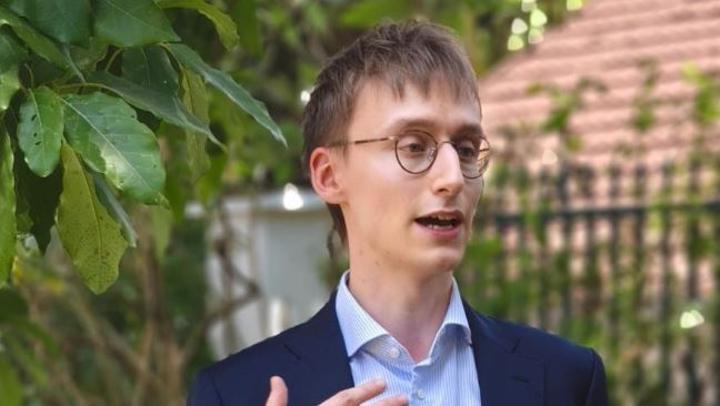
Africa-Press – Kenya. Head of Programmes at the Westerwelle Foundation, Sebastian Gentry. Kenya has emerged as the leading destination for German investment in the continent’s startup ecosystem.
A new study by Africa Investment Bridge shows that founders across 19 African countries secured a combined $1.88 billion (Sh242.5 billion) through German-backed syndicates over the past decade, with Kenya claiming the largest share.
Kenya’s dominated the investments, recording 50 German-backed deals, more than any other African nation. Kenya’s 50 deals placed it ahead of Nigeria with 34 transactions, while Tanzania drew 24 indicative of German investors expanding beyond traditional power markets.
South Africa, with 19 deals, and Ghana (17 deals) completed the top investment corridor, collectively accounting for 77 per cent of all German-funded deals.
Fintech and AgTech dominated the investment landscape, securing 51 per cent of transactions, while Health and Education gained momentum between 2020 and 2025 as demographic shifts and development needs reshaped investor priorities.
“The data tells a clear story: African founders are building solutions that work in agriculture, financial services, health, and climate adaptation,” said Head of Programs at the Westerwelle Foundation Sebastian Gentry.
The survey titled “Germany-Africa Investment Report: A Decade of Capital Flows & Ecosystem Growth” (2015–2025) shows that German syndicate exposure peaked at $565.5 million (Sh72.9 billion) in 2023 before dropping, a decline attributed to fewer mega-deals rather than structural weaknesses.
Meanwhile, African startup funding rebounded in 2025, climbing to $3.8 billion (Sh490 billion), a 32 per cent increase in volumes and an eight per cent rise in deal count.
The report recommends stronger communication with partners, improved reporting transparency, and deeper co-investment networks to help African fund managers channel even more international capital toward the continent’s entrepreneurs.
“This report is designed to reduce the information asymmetry that keeps international capital on the sidelines. When investors engage through trusted local partners and proven structures, they access not just returns but participation in one of the most significant economic transformations of our time,” added Gentry.
The report documents how African founders particularly in AgTech, Fintech, and HealthTech have built compelling businesses that attracted 784 per cent growth in
German deal participation between the foundation phase (2015-2019) and scale phase (2020-2025). The report comes at a decisive moment for the continent. Africa is the fastest-growing region globally, with GDP growth projected at around 4 per cent annually.
The African Continental Free Trade Area (AfCFTA) is connecting 1.3 billion people in the world’s largest free trade zone by population, and by 2030, one in five people globally will be African.
Yet African startups received just 0.6 per cent of global venture capital in 2024, a gap that represents both a market inefficiency and an untapped opportunity for international investors willing to engage through structured partnerships with local fund managers and ecosystems.
The initiative was implemented by the Westerwelle Foundation in partnership with GIZ SPARK, commissioned by the German Federal Ministry for Economic Cooperation and Development (BMZ), and co-financed by the European Union.