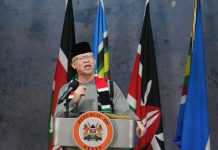

Africa-Press – Kenya. Kenya Chamber of Mines has called for co-existence between large-scale and artisanal miners, as it appeals for calm in Kakamega, where the recent discovery Sh680 billion worth of gold has raised tension.
British mining company Shanta Gold Limited last month reported one of the country’s largest gold deposits, estimated at Sh683 billion, in Ikolomani, Kakamega.
The company estimates it will need around 337 acres of land, primarily privately owned plots, which will see the displacement of roughly 800 households.
It has earmarked six possible resettlement locations spanning about 1,932 acres, giving affected families the option of monetary compensation or relocation within the same region.
The move however, has sparked tension within the community with local politics also playing out, even as the government promises a “win-win” for both the investor, government and locals.
Four people were killed a fortnight ago during a public participation led by the National Environment Management Authority (Nema) and Shanta Gold, as locals protested against the project.
Kenya Chamber of Mines (KCM), the apex body representing Kenya’s mining industry, yesterday said it recognises Shanta Gold as a duly licensed investor operating under valid mineral rights granted in accordance with the Mining Act, 2016.
Equally, it acknowledges the long-standing artisanal and small-scale mining (ASM) communities in Kakamega, many of whom are also members of KCM, and the community, hence investment in the gold project should ensure co-existence.
“The Chamber encourages all stakeholders to maintain constructive communication, avoid actions that may heighten tensions and work collaboratively under the leadership of the State Department for Mining and County Governments,” CEO Brian Simiyu said.
He said all actors, whether licensed mineral right holders or ASM groups, must conduct their activities strictly in line with the law.
“Lawful coexistence requires predictable regulatory processes, transparent community engagement and adherence to environmental, safety and operational standards,” Simiyu said.
Last week, Mining CS Hassan Joho in a joint press release after a consultative meeting with leaders from Kakamega county, affirmed to hold adequate consultation by all stakeholders, to deliver a win–win outcome for the community, the county and the investor.
Meanwhile, Kenya Chamber of Mines is optimistic that reforms will boost the mining sectors contribution to GDP to 10 percent before 2030.
KCM says over the last decade, the mining industry has only managed a meagre average of 0.7 per cent to Kenya’s GDP, despite its latent potential.
Chairman Patrick Kanyoro said the recent decision to lift the moratorium on licensing and have the Mineral Rights Board commence operations, will go a long way in having the applications for the various mineral rights considered, within reasonable time.
“It is the efficient and timely issuance of prospecting and mining licenses and permits that will attract both direct domestic and foreign investors and transform the sector. As an industry, we are certain that we can drive our sector’s contribution to 10 per cent to Kenya’s GDP, more than Sh1.6 trillion well before year 2030,” said Kanyoro.