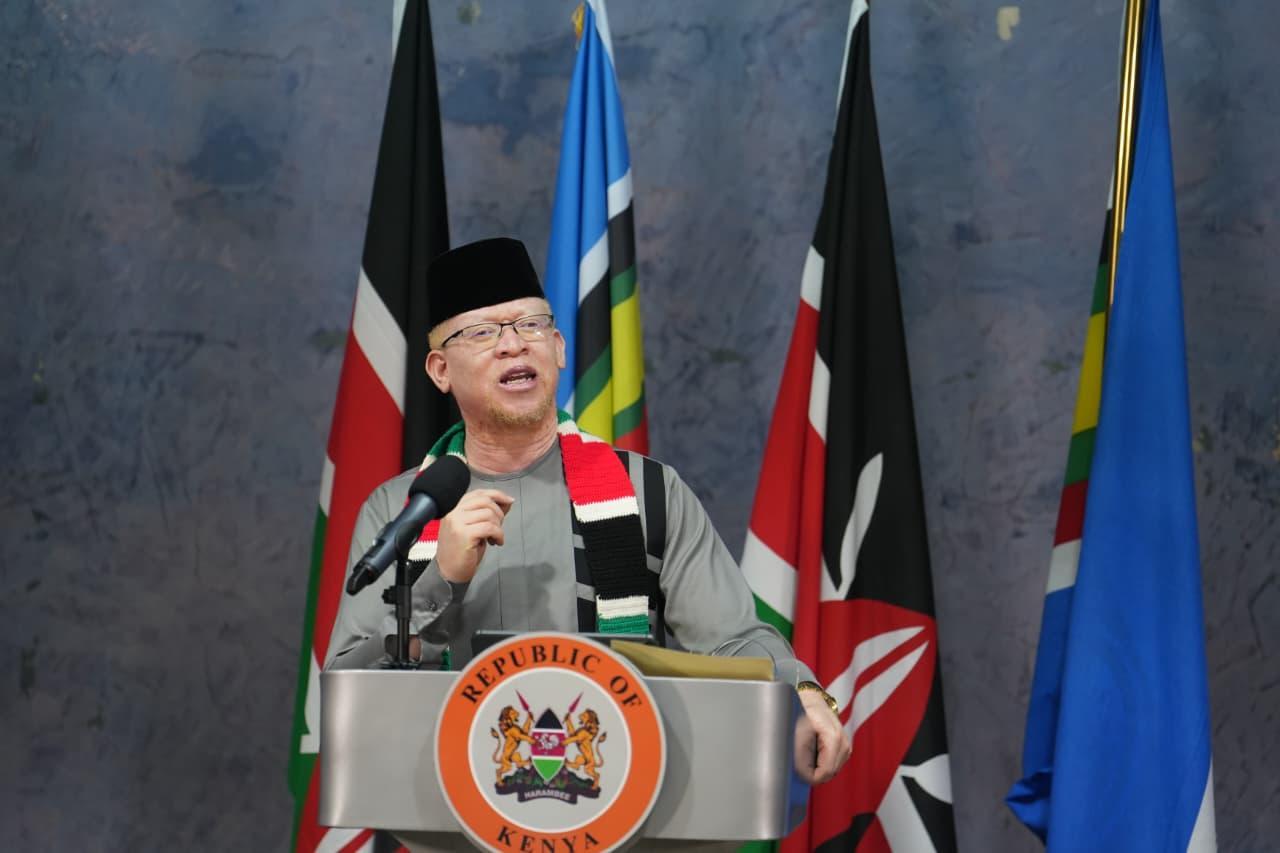
Africa-Press – Kenya. The government has created two million jobs across various sectors over the past year, government Spokesperson Isaac Mwaura has announced.
Mwaura made the announcement at a press briefing while releasing the 2025 Government Scorecard.
According to Mwaura, the country is deliberately transitioning from a Third World economy marked by exclusion to a First World economy anchored on economic freedom, productivity, and shared opportunity.
“Kenya is deliberately transitioning from a Third World economy defined by exclusion, to a First World economy anchored in economic freedom, productivity, and shared opportunity,” Mwaura said.
The last 12 months, he noted, represent a defining turnaround in the implementation of the Bottom-Up Economic Transformation Agenda (BETA), which has prioritised job creation, industrialisation, and empowerment of local communities.
A key driver of employment, Mwaura highlighted, has been the government’s affordable housing programme.
“240,000 housing units are currently under delivery nationwide, supporting 480,000 direct and indirect jobs, with employment projected to peak at up to one million workers,” he stated.
Mwaura explained that after a period of domestic and global economic strain, Kenya has entered a decisive phase of stabilisation and acceleration.
This phase is underpinned by sound macroeconomic management, targeted reforms, and people-centred investments.
Key indicators confirm this recovery: inflation has fallen sharply from a high of 9.6 per cent to 4.6 per cent, restoring purchasing power for households, while the Kenya Shilling has stabilised against the US Dollar, supported by strong exports and record diaspora remittances, which reached Sh660 billion in the last financial year—making remittances the country’s leading source of foreign exchange.
The government has also shifted focus from consumption subsidies to production-led support, achieving tangible gains in food security and farmer incomes.
Over 7.1 million farmers are now digitally registered, eliminating intermediaries in the distribution of farm inputs and improving market access for smallholder producers.
In urban initiatives, programmes such as the Nairobi River Regeneration have combined environmental restoration with employment creation, engaging 44,000 youth.
Meanwhile, digital transformation has expanded rapidly, with more than 300 digital innovation hubs operational, 400 additional hubs planned, and nearly two million youth trained in digital skills.
About 300,000 of these young Kenyans are already earning through online freelancing, e-commerce, and creative industry ventures.
On the international front, Kenya has signed six bilateral labour agreements with countries including the UK, Saudi Arabia, UAE, Qatar, Germany, and Austria.
These agreements have facilitated over 452,000 Kenyans being placed in jobs abroad, a substantial increase from 14,000 in 2022.
Employment opportunities span technical fields, hospitality, and healthcare, with 586 nurses already cleared for overseas work.
Job creation has also been robust within Special Economic Zones (SEZs) and Export Processing Zones (EPZs).
Over the past three years, jobs in EPZs have increased by 14,000, with four new flagship EPZs under construction expected to generate an additional 5,000 jobs. Investments in SEZs have similarly created 11,000 new employment opportunities.
According to Mwaura, these efforts reflect a government strategy focused on inclusive growth, industrialisation, and sustainable job creation, positioning Kenya as a dynamic economy capable of delivering long-term prosperity and opportunity for its citizens.