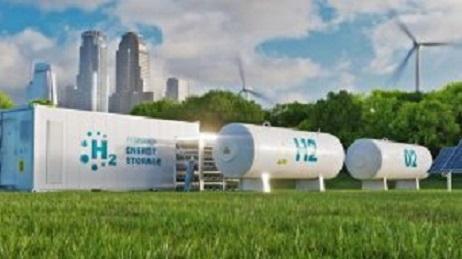
Africa-Press – Lesotho. The hydrogen industry is currently valued about US$243 billion annually and is set to grow to $410 billion by 2030. With more nations coming into the industry we shall see greater returns.
The hydrogen battery industry is expected to grow from $2.7 billion industry to $5.7 billion by 2030. Plus other applications that will grow. Benefits of hydrogen power for Lesotho include most importantly reduced reliance on the oil industry.
We cry every month as prices go up in the oil market because we know it means reduced profits for all businesses and reduced spending power in our pockets. If we produce an energy that is free from other nations’ influence that would be of great benefit in the long term.
We can take farming for example because farming equipment running on hydrogen power would greatly reduce the cost of food production and giving way for farmers to reduce the cost of food.
We are already having problems feeding ourselves. The school feeding programme which was put in place to assist poor families is already failing. Many families are not able to feed their children and some children only get food in schools but that doesn’t always happen.
The problem is the high cost of food and the little tax collected by government. We need our government to teach a man how to catch fish and not hand out fish.
Many farmers buy two bags of fertilizer and mix it with manure on a two acre plot of land and their yield is poor. The fertilizer is too expensive. We have inflation eating away at everywhere and the money cannot go to the fields because many farmers need food now.
Besides, the weather is not always friendly and irrigation systems are needed for farming so as to ensure better harvests but farmers cannot afford such systems.
This problem is one that forces us to deal with bringing the price of fertilizer down and that is possible for us if we have hydrogen power which will make this a possibility that will be in our control.
We will then be able to generate cheap electricity to be used to drive irrigation projects. With hydrogen in this space we will be able to create the means to feed our people, for example.
We will be in a position to generate excess energy because in the first few years we will focus on reducing the cost of living for Basotho and that will lead to reducing the cost of doing business.
The cheap energy will trigger investments in Lesotho. In business the two major challenges to profit are energy and labour costs. If we cut the energy costs then we can improve the pay to the lowest earners and our standard of living will improve quickly for the better.
We then can end the idea of government employment as the destination for all citizens looking for jobs. With excess energy we can for once be energy exporters and change the direction of our country.
Within 10 years of implementation we will be free from all these handouts we get yearly because our government doesn’t collect enough tax so as to pay for its responsibilities but then we will be in a strong position.
We can create a path to independence with hydrogen power in the long run. With hydrogen power we will also reduce our dependence on oil products. We are unhappy that the price of oil goes up meaning petrol prices go up too.
The oil nations use what they have to build their industries to make life for their people better. We have plenty of water and sunlight to generate power from the sun and store it in batteries.
The energy we call electricity from the batteries is then used in a process called electrolysis. That process will separate the water (H2O) into hydrogen gas and oxygen gas.
All that is required for the process is access to a dam because the process separates the molecules and thereafter combine into water again. With hydrogen gas we could have access to creating an industry with a value chain to create many jobs.
We can start using our higher learning institutions to build our human capital to ensure we have people that will be employed in that industry. We could create products that will use the hydrogen we create.
We could export tractors for farming and mining equipment plus car batteries. We could target bringing companies into Lesotho to benefit from cheap energy to create high paying jobs with the government collecting better tax revenues to manage its responsibilities to the nation.
We could also produce ammonia from hydrogen gas. Russia is a leading world supplier of fertilizer because of its hydrogen production industry. We are told that the government has gotten a cheaper price and bought fertilizer and used about M40 million.
That is money that could be better used elsewhere. We are spending about M164 million to buy electricity because hydro power is not generating enough.
We have recently been told that some hydro power generators are not working. This means we need to have an alternative. We cannot grow our economy with the current status quo.
We are heavily dependent on other nations for our survival. The geopolitical consequences of such dependency are too high for us to throw away what can propel our nation into energy independence meaning prosperity for all.
The last time such poor decisions were made led to a collapse of the largest economy in Africa. During President Jacob Zuma’s presidency a plan for building a nuclear power plant was introduced but then rejected.
The so-called intellectuals rubbished the idea so much and said it was because of corruption that Zuma wanted such a project that would cost the nation billions.
They said the South African economy was in a good shape and energy needs will need little improvements by the year 2025 and only then should they start planning to spend huge amounts of money.
The South African economy has collapsed and is now sliding down towards a failed state and we are not in 2025 yet. The South African economy is currently not able to pay its bills.
It is paying about R100 billion per quarter in interest on its debts. There is load-shedding that has cost billions to the economy and has forced many companies to close their doors and move out.
Over 4 500 people who were the wealthiest class in South Africa have left the country. The multitude of problems have created a snowball effect chipping away at the economy that has no end in sight.
The citizens did not participate in the process which was led by mostly scholars who are expected to use logical, evidence-based thinking to help inform the public on what really mattered.
We too have a problem with our scholars who choose not to do their civic duty for the betterment of Basotho’s future and give light to the complexities we face.
We are now having people called scholars from other nations leading the debate because our home-grown scholars feel keeping quiet is the best option but then complain loudly around their close friends and families.
We can also look at the past and not repeat the same mistakes over and over and expect to get different results. Our late leader and Prime Minister (Morena Leabua) had his faults like many others.
The problem once again was with the scholars who kept quiet when all the good which he had brought was thrown away with the bad. We have to separate politicians from our national interests.
Politicians have their role to play but our institutions have academics who are specialists who need to play their part so that citizens can have a voice outside political interests.
The academics must play their part on the hydrogen project so that we can create something special for our nation. Lesotho needs energy independence for its growth.
If we allow history to repeat itself like what happened to Morena Leabua and President Zuma’s nuclear power project we will be doomed as a nation. With energy independence we will be in a position to build the battery industry.
We will manufacture the batteries which could power all machines. Our hydrogen power will be limitless because we have endless supply of water to feed the process.
We will be an attractive investment location in the southern Africa region. Our universities will drive the latest technological advancements to build our human capital.
We can see how Saudi Arabia has managed to have about a US$3 trillion balance sheet because of the cheap oil available to its citizens while exporting the excess.
Hydrogen equipment is expensive but so is buying energy that keeps going up at a pace faster than our ability to cover our current needs and no possibility of building an industry that can give us the means to get out from underneath the cloud of poverty.
We spend about M166 million per year on electricity imports because hydro power is only giving us about 44 percent of the energy we currently need. The LHDA project of Polihali dam is expected to transfer 480 million cubic metres of water per year.
If we were paid fairly at least at a rate of M15.00 per cubic metres (480 million x M15.00 = M7.2 billion) we would be able to reduce the need for government to seek so much from aid.
The cost of doing business in Lesotho is too high right now so we are not able to attract much capital investment. We do not have tax free locations to attract high paying jobs that can enjoy reduced tax areas to increase our export capabilities.
We need to accept the fact that life is about to become even more difficult. We can all see how the South African economy is in trouble and that will affect our way of life here in Lesotho.
Prices will be going up in South Africa because of shortages and we are dependent on South Africa for almost everything for survival. The SACU revenue share will be getting smaller year after year because of the BRICS and Western conflict.
The many privileges South Africa has enjoyed will be cut or greatly reduced. As of 2026, the EU will be adding tariffs on all non-EU imports of fossil fuel products.
These tariffs will be targeted at the steel and coal industry and heavily hitting South African profits. That will affect the SACU revenue. The SA wine industry will get hit as the citrus industry (oranges, lemon, lime) has recently been stopped from entering the EU market.
The conflict will run for years to come and we shall be the casualties of war. We need to make the changes while we still have an opportunity or we shall disappear into oblivion.
The task is to see if those elected into positions of leadership are truly looking to build our nation and economy or are looking to bring us down so that Lesotho becomes part of South Africa.
We need to see who the real patriots are. If there is something wrong then we must fix it but not trash the idea that can drag us out. We need to clean house and end the corruption stopping our growth because time is running out fast.
Our electricity capacity is expected to grow by 200 percent to support our population by 2050. Our electricity transmission and distribution infrastructure is old and needs to be updated before we find ourselves in a position similar to that of South Africa and many other nations.
There are 15 nations working to expand hydrogen power to their national grid. Countries like Australia, Germany, Russia, China, United States, Japan, South Korea, United Kingdom and others.
We do not have much of anything so why not start here and now and at least leave a legacy for our children? Our current economy and direction shows we need to make huge investments and change direction if we are to survive as a nation.
Source: Thepost
For More News And Analysis About Lesotho Follow Africa-Press