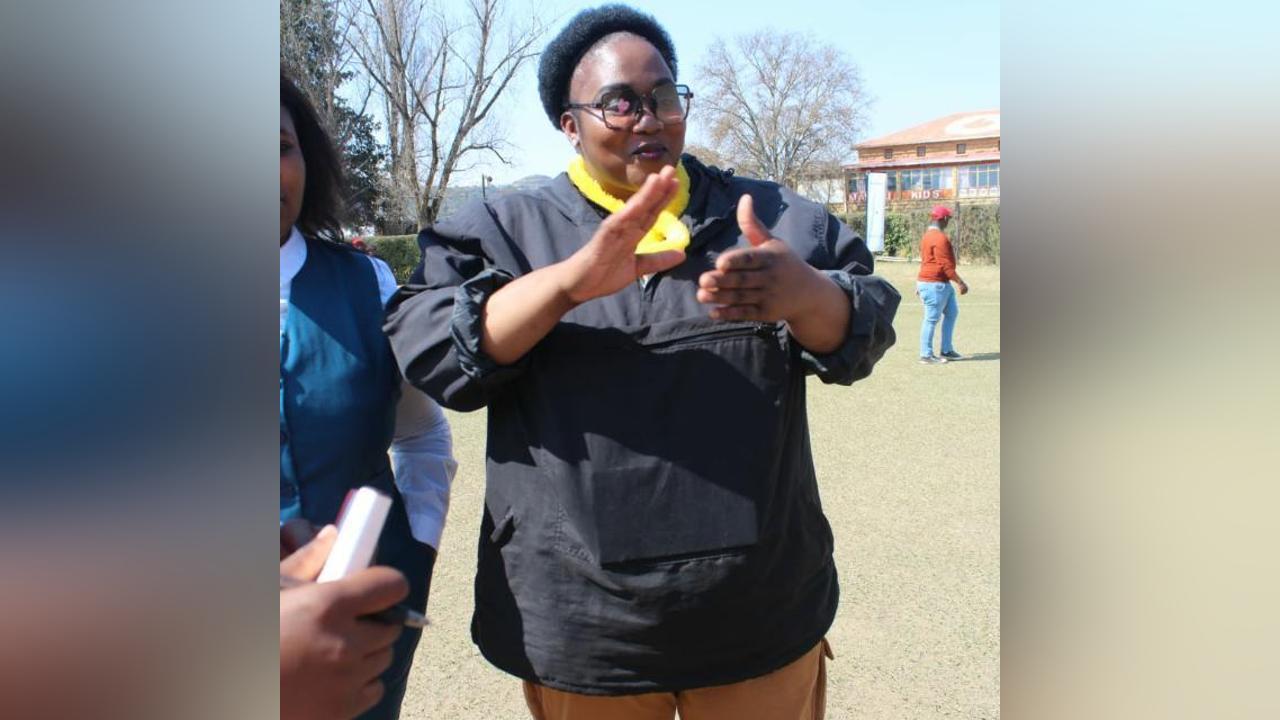
Africa-Press – Lesotho. BONGIWE Buzi was 17 and about to write her Form E examinations when her life was upended. One day she woke up terribly sick. She was admitted to a hospital where doctors delivered the terrible news: she had a type of meningitis that causes loss of hearing, speech and vision permanently.
The next few weeks were unbearable. “I spent a month bedridden at a hospital, unable to talk, to see, to hear or do anything,” Buzi recalls. “Doctors were confused too and they did not know if I would heal or die.
” She was transferred to Pelonomi Hospital in Bloemfontein.
“Doctors then realised that my skull had cracked so maybe it affected my ears, eyes and mouth.
” After weeks of treatment, Buzi partly recovered her vision and speech but her hearing was completely gone.
Buzi had to adjust to a new life without hearing voices she had heard for the first 17 years of her life. She had to learn a new way of communicating with the world.
Her voice is sometimes hoarse, deep or high-pitched and it can change in one sentence, which she says irritates people she communicates with. But Buzi, now 44, did not allow her disability to determine her future.
Born and raised in Quthing, Buzi says she has now made peace with her disability although she sometimes gets irritated when she cannot communicate with people the way she would like.
Thanks to her friend Mamello Lesoetsa, Buzi learnt sign language and enrolled at the National University of Lesotho (NUL) where she graduated with a diploma in counselling.
Buzi says when she enrolled the NUL’s management said it would be difficult to teach her because of her disability. “The school management asked me how I would learn yet I am deaf.
I proposed that I would lip-read lecturers but they refused. ” “My interpreter (Lesoetsa) heard my story and volunteered to apply to do the same course as mine to help me with school work.
” Lesoetsa was her interpreter in the class. The university hired another interpreter for her, ’Malesaoana Mohale.
Despite Lesoetsa and Mohale’s help, it was still a colossal task for Buzi to sail through, especially because losing the sense of hearing was a new thing to her.
She was still learning how to adapt to her new situation and faced dealing with lecturers who, much as they were willing to help her, were not fully equipped to teach deaf students.
Buzi became aware that she needed clear schedules and regular, collaborative meetings with her lecturers as an important part of her academic progress.
Much as Lesoetsa and Mohale were helping, their lives had to be a threesome intertwined as they had to be always available in class to assist her even when they had personal, private reasons to be absent.
They had sacrificed their freedoms to assist her with a complete understanding of what the lecturers had said to ensure that she was on the same page with other students.
She was attending a university that tried hard but was incapable of providing assistive technology such as interactive whiteboards, video remote interpreting, chat rooms, strobe lights, digital pen technology, closed captioning on videos, infra-red systems, hearing aid compatible, computer assisted note taking, ASL videos for testing materials, alert systems such as vibrating systems, and alarms.
All she had were her interpreters in the classroom. “I had a few challenges while at the NUL because the university was very supportive,” she says, however.
“One of the challenges was that I failed the computer skills course for the first time because my lecturer was not aware of how best he could teach me,” she says.
“It was difficult for me to perform the task at the same time looking at my interpreter, meaning it was a very competitive task with hearing students who could grab information easily while focusing on typing instructions given to them by the lecturer.
” Buzi says she is happy that Lesoetsa passed with distinction regardless of how difficult the task was for her.
“Also my family was very supportive during my studies, especially my 76-year-old mother who is the best fashion designer for Xhosa dresses,” she says.
“The importance of sign language should be valued.
” After that, she joined the National Association of the Deaf Lesotho (NADL), where she is now its director.
Later she went to the University of Cape Town (UCT) where she graduated with a degree in Disability Studies, and ultimately went for a Master’s Degree in the same course.
Buzi, a mother of two children, says she admires deaf community’s work. “I struggled and did not lose hope and I graduated,” she says. “Now I am still working and also a part-time lecturer at the National University of Lesotho.
” She says when her children learn basic sign language, they can tell her when other people in the streets are talking to her.
She says, communication is still a barrier. “I want to advocate breaking boundaries but some people do not want to learn how to communicate with us,” she says. She says her passion is to work with the deaf community to motivate them to reach their goals.
For More News And Analysis About Lesotho Follow Africa-Press