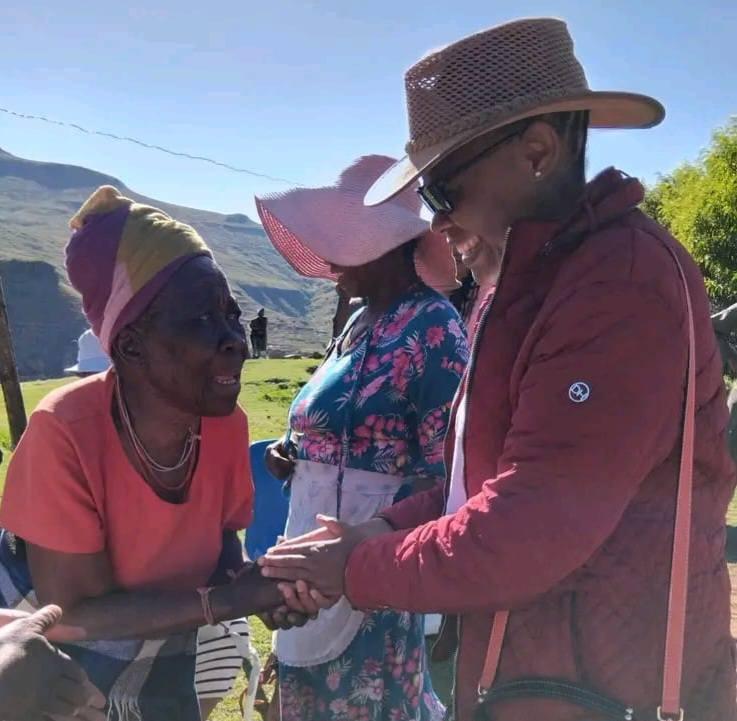
Africa-Press – Lesotho. Lebakeng Development Trust founder and Lesotho’s Ambassador to Ethiopia and Permanent Representative to the African Union, Nts’iuoa Sekete, has led an initiative with the Department of National Identity and Civil Registration (NICR) to deliver essential civil registration services to hard-to-reach villages in Libobeng, Ha Senarile.
This initiative, carried out through the Trust in partnership with NICR, was aimed at bringing services closer to hard-to-reach communities.
The outreach provided birth, death and marriage registration services, as well as Identity Document (ID) renewals, benefiting over 100 Basotho from the villages of Mats’ekhoaneng, Ha Senarile and Nkoeng.
Speaking to the Agency, Sekete of Ha Mapote, Tebellong said the initiative was part of a broader effort to ensure continuous service delivery in Lebakeng constituency, where many villages remain difficult to access due to rugged terrain and remoteness.
“As a native of Qacha’s Nek, I felt compelled to advocate for my people because I understand the pain of not accessing basic services,” she said.
“Recently, I received a report of an elderly woman who fell and was badly injured while travelling long distances to access services. Although I had already planned this campaign, that incident touched me deeply. Such situations should not be happening, especially to the elderly.”
She emphasised that bringing services closer to these hard-to-reach communities is not only fair but essential, particularly for the elderly and those unable to afford long travel.
Sekete further noted that many residents are unemployed and financially strained, making it difficult to afford transport to town or even service fees.
“My aim was to ease the burden and meet halfway those who no longer had the strength or opportunity to walk long distances,” she said, adding that the initiative remains ongoing and will be extended to other inaccessible areas within the constituency.
She expressed optimism about government efforts to improve road infrastructure and bridge construction, saying these developments would transform lives in the coming years.
Expressing concern over burial challenges in remote villages such as Libobeng, Sekete highlighted the absence of nearby mortuary services.
“In some cases, a person dies and is buried the next day because mortuaries are not easily accessible. Even when bodies are taken to a mortuary and kept for some time, men are forced to break the knees and joints to soften the body so it can be carried on horseback. We really want to put an end to this.”
“We are hopeful that within the next two years, such situations will no longer be happening. Our campaign does not end here, we will continue helping people,” she said.
Sekete added that she has instructed her assistants to continue working closely with the Home Affairs department, even in her absence.
“Civil servants themselves are expected to walk long distances to reach these areas. It is hard, but we are encouraged by the government’s commitment to addressing the needs of people in mountainous and hard-to-reach areas.”
Ha Senarile Chief Motloang Motloang expressed gratitude for what he described as a “noble gesture”, noting that access to services remains a major challenge.
“We are very happy and wish for this initiative to be continuous. Access to essential services is critical,” he said.
One 55-year-old beneficiary described the outreach as a “miracle”.
“Nts’iuoa performed a miracle by meeting us halfway. What she did is something we have never seen before,” she said. “Because of financial constraints, I only managed to apply for an ID now. I don’t have the M240 required to travel to town. I am not alone, there are still elders here without birth certificates.”
Meanwhile, during a Ministry of Local Government, Chieftainship, Home Affairs and Police Heads of Departments meeting held in September 2025, NICR Qacha’s Nek Manager Tumaki Mahao cautioned that decentralisation efforts cannot succeed without adequate transport.
“The ministry decentralised services such as birth, marriage, ID and death certificates to councils, which is a good strategy. But without transport to move applications back and forth, the system fails. People lose confidence and travel long distances to the district office instead. If transport was available, we could make this decentralisation work,” he said.
The Libobeng outreach underscores both the impact of community-driven leadership and the urgent need for logistical support to sustain decentralised services.
As government infrastructure projects take shape, initiatives like Sekete’s offer a glimpse of how bringing services closer to the people can restore dignity, confidence and access especially for the most vulnerable in Lesotho’s mountain communities.