Africa-Press – Liberia. The Legislative Monitoring Coalition of Liberia (LEMCOL) has raised serious concerns about transparency, inclusion, and citizen participation at the National Legislature, despite noting adherence to basic democratic procedures during plenary sessions.
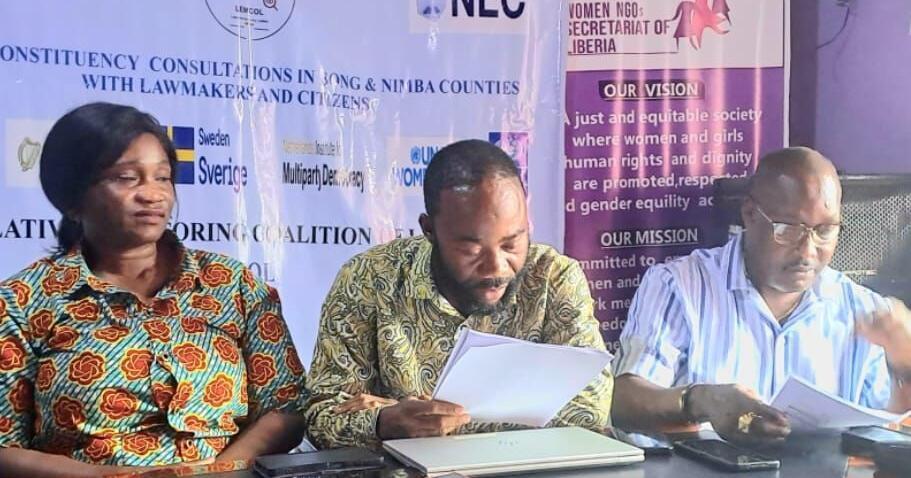
Presenting LEMCOL’s Legislative Monitoring Report for November–December 2025, a press conference held at WONGOSOL’s office on Monday, December 15, 2025, Joseph Cheayan, Executive Director of the Institute for Democratic Action & Development (IDAD), said the findings reflect a Legislature that is procedurally functional but structurally constrained by secrecy, weak oversight, and limited public engagement.
The monitoring, conducted between November 4 and December 11, 2025, covered nine plenary sessions of both the Senate and the House of Representatives. It was carried out under the Liberia Electoral Support Project Plus (LESP+), co-funded by the European Union and the Embassies of Ireland and Sweden, and implemented by UNDP, UN Women, and the Netherlands Institute for Multi-party Democracy (NIMD).
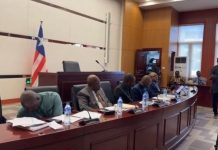
According to Cheayan, lawmakers consistently respected parliamentary rules during sessions, including orderly debate, recognition by presiding officers, and the reading of daily journals. Motions were routinely seconded and debated, and legislative attention centered on key national priorities such as finance, public sector governance, infrastructure, education, and youth development.
However, the report identifies chronic delays as a systemic weakness. None of the nine sessions observed began at the official 10:00 a.m. start time. House sittings commenced between 10:30 and 11:00 a.m., while Senate sessions were delayed until as late as 2:00 p.m., raising concerns about efficiency and discipline.
Transparency, though partially demonstrated through open galleries and live-streamed sessions, was undermined by several critical gaps. LEMCOL found that individual voting records are not published, with lawmakers preferring secret ballots, making it nearly impossible for citizens to hold their representatives accountable. The House of Representatives records only vote totals, while the Legislature’s bill tracking system remains inaccessible to the public.
The report also highlights the near absence of functional digital transparency. The Senate website, the only official legislative platform, was found to be offline and outdated, lacking real-time information on bills, voting records, session reports, and deliberations.
Oversight emerged as one of the weakest functions of the Legislature during the monitoring period. Only one instance of executive action review was recorded, while government agencies failed to submit budget performance reports. Follow-ups on prior resolutions and audits were largely nonexistent, with only three of the nine sessions producing any oversight-related recommendations.
Cheayan further criticized the routine use of closed “executive sessions” to deliberate on matters of public interest, as well as the failure of lawmakers who attended ECOWAS and other international parliamentary meetings to submit reports to plenary. Budget transparency was also questioned, as revenue hearings were conducted behind closed doors, in contrast to the publicly accessible expenditure hearings.
Gender inclusion was identified as a major deficiency. Although female lawmakers were present particularly in the Senate, where women recorded 100 percent attendance their participation in debates was minimal.
Women contributed to discussions in only three of the nine sessions, with five sessions recording no female participation at all. Legislative sponsorship was overwhelmingly male-dominated, with only two bills independently sponsored by women and just one bill reflecting male-female.
The newly established legislative monitoring body urged the public and constituents to continuously engage their lawmakers for proper accountability, something the monitoring CSO believe will help push the houses to be more transparent in doing the people’s business.
For More News And Analysis About Liberia Follow Africa-Press