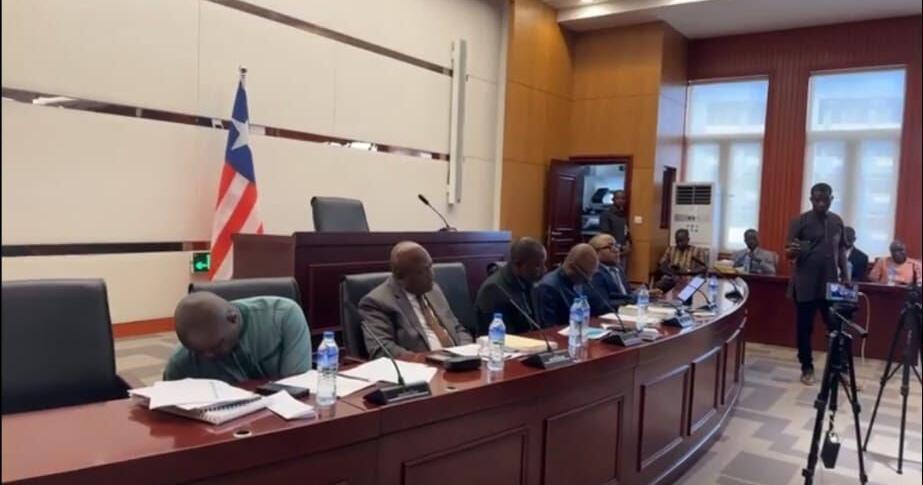
Africa-Press – Liberia. The Senate Joint Committee on Transport, Concessions, and Judiciary on Monday held a high-level public hearing on the proposed Ivanhoe/HPX Concession and Access Agreement, an arrangement that would allow Guinean iron ore to be transported through Liberia’s rail and port infrastructure, amid growing legislative scrutiny over foreign consent, fiscal benefits, and the protection of national assets.
The hearing, held at the Capitol Building, was conducted by the Senate Joint Committee on Transport, Concessions, and Judiciary. It was chaired by Senator Saah Joseph, Chair of the Senate Committee on Transport, and co-chaired by Senator Numene T. Bartekwa of Grand Kru County, who also chairs the Senate Committee on Concessions.
The agreement under review would grant Ivanhoe Liberia Limited access to the Yekepa–Buchanan railway and port facilities to transport Guinean iron ore through Liberia, drawing wide public interest because it involves cross-border mineral evacuation, long-term use of national assets, and the transition of Liberia’s rail system to a multi-user framework.
Opening the hearing, Minister of Transport Sirleaf R. Tyler told the Joint Committee that the agreement is fundamentally an access-based arrangement designed to ensure Liberia derives structured and predictable benefits from the use of its rail infrastructure.
“For example, US$3 million upon the establishment of the National Rail Authority, US$3 million upon the creation of an independent operator, and US$3 million on the first anniversary of the independent operator,” Tyler said, explaining that the agreement contains three distinct regimes governing asset payments.
He disclosed that under the initial regime, covering shipment volumes from one million to five million metric tons, the Government of Liberia would receive an access fee of US$2.05 per metric ton.
Addressing skepticism over why Guinea would choose Liberia as its export corridor, Minister Tyler emphasized geography and cost efficiency.
“From Nimba Mountain to Simandou is about 200 kilometers, and from Simandu to the Port of Conakry is around 700 kilometers,” he said. “But from the Nimba Mountains to the Port of Buchanan, to Tokadé, is only 243 kilometers. This is a shorter distance and it is feasible.”
He further noted the existence of a dedicated cross-border haul road measuring approximately 43 to 45 kilometers, with 18 kilometers on the Guinean side and 25 kilometers on the Liberian side, making mineral transport operationally viable.
Minister Tyler told senators that Liberia’s position is anchored in decades-old bilateral agreements with Guinea that permit transshipment and transit of Guinean natural resources.
He cited a transshipment agreement signed on July 14, 1973, a protocol on the application of transit agreements signed in 1983, and a 2013 protocol aimed at facilitating transportation of natural resources between the two countries. According to him, all of these agreements were ratified by the Liberian Legislature and their Guinean counterparts and remain legally valid.
“There have been all kinds of stories going around,” Tyler said. “But these agreements exist, they were ratified, and copies of those documents are before you.”
Members of the Joint Committee present during the hearing included Senator Emmanuel J. Nuquay of Margibi County, Senator Abraham Darius Dillon of Montserrado County, Senator Amara Konneh of Gbarpolu County, Senator Thomas Yaya Nimley, and Senator Numene Bartekwa, co-chair of the Joint Committee.
Government representatives explained that the Ivanhoe Concession and Access Agreement flows directly from the Implementation Agreement signed between Liberia and Guinea on October 11, 2019. That agreement, they said, was designed to allow Guinea-based mining operators to use Liberian infrastructure while enabling Liberia to extract greater value from its rail assets.
The arrangement initially relies on the third-party access provisions of ArcelorMittal Liberia’s Mineral Development Agreement, while paving the way for a transition to an independent rail operator by September 2030, when AML’s existing agreement expires or is amended.
To prepare for that transition, the Executive Branch issued several executive orders, including Executive Order No. 112 of October 11, 2022, Executive Order No. 136 of October 10, 2024, and Executive Order No. 153 of October 14, 2025. These orders seek to establish the National Railway Authority and ensure that Liberia’s rail infrastructure is regulated and utilized on a multi-user basis.
Under Phase One of the agreement, Ivanhoe would initially be allocated capacity of up to five million tons per annum on the existing Nimba–Buchanan rail line. The company would be permitted to apply for increased capacity only after submitting satisfactory railroad capacity studies, port engineering reports, and feasibility assessments.
The agreement also sets out conditions precedent, including the construction of a haul road from the Guinea border to Tokadé, development of loading and storage facilities in Tokadé, construction of loading and unloading facilities near the commercial pier in Buchanan, and execution of operational agreements with the National Port Authority and ArcelorMittal Liberia.
Phase Two envisions a major expansion, including increasing rail capacity to handle up to 30 million tons and constructing a new multi-user port in Buchanan.
“Though we did not get everything that we wanted, which is usually the case during negotiations, we believe that we have done our best to ensure that this agreement brings benefit to the Republic of Liberia,” government officials told the committee.
Speaking on behalf of the Minister of Justice, Deputy Minister for Economic Affairs Cllr. Charles D.F. Karmo II said the agreement grants long-term access rights to Ivanhoe while preserving Liberia’s sovereign control over its assets.
“The parties undertook and executed the Concession and Access Agreement to grant long-term access rights relating to the Yekepa to Buchanan rail and to enable Ivanhoe to evacuate Guinean iron ore using existing infrastructure,” Karmo said.
He explained that the framework is a two-tier arrangement in which Guinea determines eligibility for its mining operators, while Liberia independently manages access to and compensation for its assets.
“Guinea handles the eligibility requirement. Liberia handles the access part of the arrangement,” he emphasized, adding that the agreement is not a free-access regime but a commercial transaction governed by law.
Representing the Ministry of Finance and Development Planning, Assistant Minister for Revenue and Tax Policy Andrew Ngollie provided a breakdown of the fiscal terms, noting that Liberia would collect a transit fee of ten cents per ton for every shipment.
He explained that access fees would be assessed annually on a sliding scale, starting at US$1.95 per ton for shipments up to 5 million tons and gradually declining to US$1.55 per ton for volumes exceeding 20 million tons.
Ngollie also disclosed that Ivanhoe would pay US$500,000 in customs user fees within 30 days of shipment. Income tax obligations, he said, would be assessed under Liberia’s general revenue laws.
A tense exchange unfolded when senators questioned whether the current Guinean administration has formally reaffirmed its consent to the arrangement.
National Investment Commission Executive Director Melvin Sherrif confirmed that the consent documents submitted to the committee were dated 2020 and originated from Guinea’s previous government.
“There has been no response from the Guinean government,” Sherrif said, acknowledging that repeated follow-ups through diplomatic channels had yielded no formal reply.
Senator Abraham Darius Dillon, speaking in his capacity as Chair on Foreign Affairs, cautioned that communications with foreign governments must be routed through Liberia’s Ministry of Foreign Affairs, suggesting procedural gaps may explain the lack of response.
Responding to concerns, Deputy Minister for Operations at the Ministry of Mines and Energy William S. Hines insisted that Guinea has no objection to the agreement.
“The Guinean government owns fifteen percent of SMFG (Société des Mines de Fer de Guinée,” Hines told the committee. “They receive asset fees, customs user fees, and will benefit from a steel facility to be constructed in Guinea.”
He added that Guinean transport officials recently held discussions with Liberian authorities in Margibi County during last week’s Roberts Flight Information Region (RFIR) conference and stressed that no formal opposition has been communicated.
As the hearing concluded, the Joint Committee reiterated its request for updated documentation, particularly formal communication from Guinea’s current leadership, as part of its ongoing review.
Lawmakers said the agreement, which touches on Liberia’s most strategic transport assets, must be examined with utmost care before any recommendation is made to the full Senate.
The hearing underscored the broader national debate over how Liberia balances regional cooperation and foreign investment against sovereignty, transparency, and long-term economic value, as the Legislature weighs whether the Ivanhoe Concession and Access Agreement truly serves the national interest.
The House of Representatives has already passed the Agreement and transmitted it to the Senate for concurrence. Yesterday’s hearing marked the Senate Joint Committee’s first substantive session since it was mandated nearly two months ago to review the instrument. Two earlier hearings were abruptly shut down or postponed by the Joint Committee Chair, Montserrado County Senator Saah Joseph, who has since been cited for a conflict of interest arising from his business dealings with ArcelorMittal Liberia—the company most directly opposed to the Ivanhoe Agreement.
As of today, December 16, the Senate plenary is expected to receive the Joint Committee’s report and determine whether it will concur with the House of Representatives’ version of the Ivanhoe Concession and Access Agreement, a decision that could bring the long-delayed legislative process to a close.
For More News And Analysis About Liberia Follow Africa-Press