Africa-Press – Liberia. The Center for Transparency and Accountability in Liberia (CENTAL) has formally called on the Ministry of Internal Affairs (MIA) and the Ministry of Finance and Development Planning (MFDP) to urgently reform the County Social Development Fund (CSDF) system, warning that persistent weaknesses in funding flows, oversight, and inclusion continue to undermine local development across Liberia’s counties.
The call follows the release of CENTAL’s 2025 research report, titled “Open Expenditure: Examining CSDF Projects in Six Counties,” which documents both visible progress and troubling systemic failures in the implementation of CSDF-funded projects in Nimba, Bong, Grand Bassa, Bomi, Rivercess, and Gbarpolu Counties.
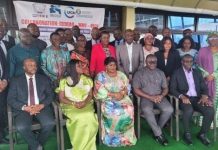
Addressing journalists at a press briefing in Monrovia on Wednesday, CENTAL Executive Director Anderson Miamen, stressed that while the CSDF remains one of Liberia’s most important mechanisms for channeling development resources to communities affected by concession activities, “the system as it is currently structured and managed is falling short of its promise.”
CENTAL reminded the public that the CSDF consists of payments by concession companies for the benefit of host counties—commonly referred to as social development funds—alongside budgetary allocations from the national government, known as county development funds. Together, these resources are intended to finance projects that directly improve the lives of citizens, particularly in communities deprived of schools, health facilities, markets, roads, and other basic infrastructure.
“This financing module has been a consequential pillar upon which people living in communities deprived of schools, medical facilities and other infrastructure reap the benefits of their natural endowment or resources,” CENTAL said.
However, the organization warned that years of engagement with counties have shown that the system is plagued by challenges in appropriation, disbursement, transparency, and implementation, limiting its overall impact.
The findings presented by CENTAL are based on field research conducted in June 2025 under its Open Expenditure Initiative (OEI), a key component of the National Integrity Building and Anti-Corruption Program supported by the Swedish International Development Cooperation Agency (Sida) through the Embassy of Sweden in Liberia.
Through the initiative, CENTAL said it monitors CSDF-funded infrastructure projects, evaluates transparency and inclusiveness in project selection and award processes, tracks disbursement patterns, and assesses the real impact of the funds on citizens, including women, youth, and persons with special needs.
The research team visited more than 30 project sites, including schools, hospitals, markets, bridges, town halls, and administrative buildings, and conducted interviews with county authorities and community representatives across the six counties.
Among the most concerning findings, CENTAL said, is the continued centralization of CSDF spending, with a disproportionate share of resources directed toward government infrastructure in county capitals.
“Despite its goal of promoting local development, CSDF implementation remains highly centralized,” CENTAL stated. “This limits benefits to rural communities, a trend particularly evident in Grand Bassa, Nimba, and Bong Counties, where communities receive little direct impact from CSDF projects.”
The report also exposed serious weaknesses in contract management and oversight. In Bomi County, the Jawajeh Town Hall project was cited as an example of poor scope control, where unauthorized changes to the contract increased costs and left the project incomplete for years.
In Bong County, CENTAL documented violations of the Children’s Law of 2011, after children were observed working at a CSDF-funded school construction site in Gbarnga—an incident that underscored weak contractor supervision until county authorities intervened.
CENTAL further raised concerns about the limited inclusion of vulnerable groups in CSDF project design and implementation. The study found that most facilities lacked accessibility features for persons with disabilities, despite assurances from engineers.
“In Nimba County, disability advocates welcomed limited support but stressed that true inclusion remains absent from project design and implementation,” the report noted.
On value for money, CENTAL said CSDF resources are often spread too thinly across multiple sectors, resulting in under-resourced and low-impact projects. A completed youth center in Bunadin, Nimba County, was cited as an example of infrastructure that lacks basic amenities, reducing its long-term usefulness.
The study also highlighted capacity gaps affecting County Councils, including lack of staff, stipends, and logistics, which weaken their ability to exercise effective oversight as required under the Local Government Act of 2018. While relations between councils and county administrations were generally cordial, tensions were reported in Rivercess County due to resource constraints.
Based on the findings, CENTAL issued a direct appeal to the Ministry of Internal Affairs and the Ministry of Finance and Development Planning, urging them to take decisive action to fix systemic flaws in the CSDF framework.
“Rather than spreading resources thin, counties should prioritize fewer, high-impact projects that can be fully completed and functional,” CENTAL said, emphasizing that accessibility features must be mandatory in all CSDF projects from the design stage.
CENTAL specifically urged the MFDP to prioritize the timely release of CSDF allocations and concession contributions, warning that delays and uncertainty in funding flows disrupt implementation and weaken accountability.
At the same time, the organization called on the MIA to strengthen its coordination role, ensuring closer collaboration among county administrations, county councils, and civil society actors.
“Stronger cooperation is needed between the Ministry of Internal Affairs, County Administrations, County Councils, and civil society actors such as CENTAL,” the organization said. “Regular dialogues and joint planning will help align priorities, address bottlenecks, and sustain accountability.”
CENTAL also recommended institutionalizing structured county-level monitoring mechanisms involving County Councils, civil society organizations, women, youth, and community representatives, to ensure oversight is regular, participatory, and independent.
Despite the challenges identified, CENTAL acknowledged progress in several areas, including the construction of schools, renovation of town halls, and improvements in health facilities, in line with priorities under the ARREST Agenda for Inclusive Development.
However, the organization warned that without urgent reforms led by the MIA and MFDP, the CSDF risks continuing to deliver “infrastructure without impact.”
“The CSDF can and should be a powerful tool for inclusive development,” CENTAL said. “But fixing the system is no longer optional—it is urgent.”
For More News And Analysis About Liberia Follow Africa-Press