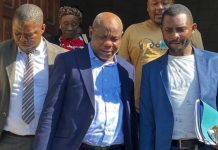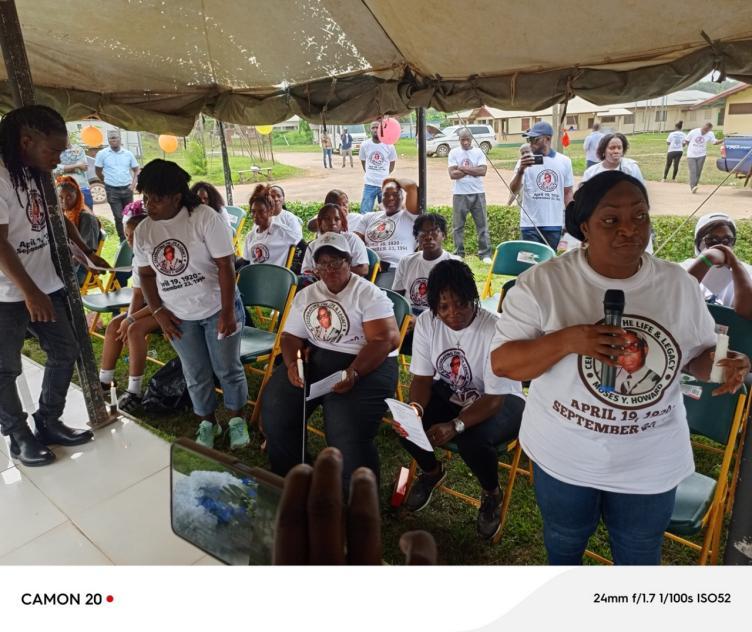
Africa-Press – Liberia. The road to Phebe Hospital is one many Liberians know for its legacy of healing, training, and quiet resilience, but on Saturday, December 20,2025, the compound bore a different kind of weight as generations of the Howard family gathered at the mass grave where their patriarch, the late Dr. Moses Y. Howard, was killed nearly three decades ago during Liberia’s civil war.
The atmosphere was solemn but resolute as memory, grief, faith, and reflection converged at a site that for years remained both sacred and unspoken within the national consciousness.
Children, grandchildren, great grandchildren, nieces, nephews, church leaders, hospital administrators, and community members stood shoulder to shoulder on the same ground where Dr. Howard and several other medical professionals lost their lives in September 1994 while performing their duties.
For the Howard family, it was not simply a memorial, it was a homecoming to a painful chapter that had never been fully closed. This gathering marked the first time in decades that almost the entire extended Howard family assembled at Phebe as a single unit.
Many had traveled from the United States and other parts of Liberia, drawn by a shared need to remember, to reconcile, and to ensure that the story of their father and grandfather is not lost to time. Former Vice President Jewel Howard-Taylor, one of Dr. Howard’s daughters, stood near the grave with quiet composure as she explained why the family chose this moment to return.
She reflected that her father’s resting place is not merely a burial site but a reminder of service cut short by violence. She noted that for years the family carried their grief privately while the nation moved on without fully acknowledging what happened at Phebe.
She explained that bringing the family together was both an act of mourning and an act of truth telling. She said the visit was necessary because the family had never collectively laid her father to rest in spirit and memory, and that many siblings, nieces, and grandchildren were seeing the site for the first time.
Howard-Taylor said the memorial was also about education and continuity, ensuring that younger generations understand where they come from and the values that shaped their lineage. She explained that many of the grandchildren and great grandchildren had grown up hearing fragments of the story but had never stood on the ground where their grandfather made the ultimate sacrifice.
She emphasized that the family did not want Dr. Howard to become a name reduced to footnotes or private recollections but a living part of their shared history.
She also raised a long standing concern that continues to trouble the family, the absence of Phebe Hospital from national conversations about wartime massacres. She explained that while Liberia often recalls atrocities committed in other parts of the country, the killing of doctors and civilians at Phebe has remained largely unacknowledged.
She stressed that this silence diminishes the magnitude of what was lost, especially at a time when trained medical professionals were scarce and desperately needed.
Despite the weight of the past, Howard-Taylor made it clear that the family was not seeking revenge. She said justice for them lies in remembrance, reconciliation, and a commitment to peace. She explained that violence took her father but would not define the family’s future, adding that war destroys more than lives, it fractures generations and sets nations back in ways that take decades to heal.
Among those present was one of Dr. Howard’s grandchildren, Nelson Philip Charles Taylor, who spoke on behalf of a younger generation carrying both the pain and pride of the family legacy. In a reflective statement, he said returning to Phebe was both overwhelming and grounding, describing it as standing at the intersection of loss and purpose.
Taylor said growing up, Dr. Howard’s name was spoken with reverence, but being at the site transformed the story from something inherited to something deeply personal.
Taylor said, “Being here makes his sacrifice real in a way no story ever could. This is where our grandfather chose service over safety, and knowing that changes how we see our own responsibility to this country.” In another moment of reflection, Taylor added, “We are not only mourning him today, we are committing ourselves to the values he lived by, compassion, courage, and service to others no matter the circumstances.”
Also present was Norwu Howard, one of Dr. Howard’s daughters and former Deputy Minister for Administration under President George Weah. In a thoughtful statement, she said the memorial was long overdue and deeply emotional for the family.
She reflected that her father was not just a doctor but a man who believed that service to humanity was a calling, not a convenience. She explained that even in the midst of war, he believed that hospitals should remain places of refuge, not targets of violence.
Norwu Howard said, “Our father taught us that education and service were the greatest gifts we could offer Liberia, and standing here today reminds us that his life, though violently ended, continues to speak through what we choose to do.” She added, “This gathering is painful, but it is also healing because it allows us to reclaim his story and ensure that it is told with dignity and truth.”
Faith leaders also joined the family in reflection and prayer, including Rev. Thomas Z. Paye, Bishop Assistant of the Lutheran Church in Liberia, who represented the church that played a pivotal role in Dr Howard’s professional journey. In a lengthy statement, Rev. Paye said the Lutheran Church considers Dr. Howard not only a medical pioneer but a faithful servant whose life embodied the church’s mission of service to humanity.
He explained that Dr. Howard was among the early Liberian professionals trained abroad through the Lutheran Church in America and who returned home with a commitment to build institutions and save lives.
Rev. Paye said the church views the tragedy at Phebe as both a wound and a calling, a reminder of the cost of war and the sacred duty to protect those who heal others. He emphasized that remembering Dr. Howard is not about reopening old wounds but about ensuring that such violence is never repeated. He noted that hospitals should be sanctuaries of life even in times of conflict.
He said, “Dr Moses Y. Howard lived his faith through service, and his death at this place challenges us as a nation to ask whether we truly honor those who dedicate their lives to saving others.” In another quote, Rev Paye added, “The blood that was shed here calls not for revenge but for repentance, remembrance, and a renewed commitment to peace and reconciliation in Liberia.”
Representing the management of Phebe Hospital was Jonathan L. Pewu, Acting Administrator, who delivered an emotional statement that connected past tragedy to present reality. He recounted that in 1994, he was at Phebe Hospital on the day Dr. Howard was shot because he had gone to visit a relative receiving treatment.
He said at the time, he never imagined that decades later he would return to the same compound to memorialize a man whose death he witnessed indirectly and whose legacy still shapes the hospital.
Pewu said standing at the memorial brought back memories he had long buried, reminding him of the fear and confusion that engulfed the hospital during those dark days.
He explained that for him, the event was a powerful reminder of how fragile life is and how deeply war scars institutions meant to preserve life. He said the hospital management considers it an honor to host the Howard family and to acknowledge the sacrifices made by doctors and staff who paid the ultimate price.
He added that Phebe Hospital remains committed to preserving the memory of those lost and to continuing the mission they started. He explained that remembering Dr. Howard is also about recommitting to excellence, compassion, and service despite challenges.
Dr. Howard’s legacy extends beyond tragedy. He was among the first Liberian medical professionals trained abroad through the Lutheran Church in America, studying anesthesiology in the United States before returning home. He served at the Old Government Hospital, the John F. Kennedy Memorial Hospital, and later became one of the pioneering doctors at Phebe Hospital in the 1960s.
His wife, Laura Howard, was also a trained medical professional, and together they dedicated decades to strengthening Liberia’s health sector.
The family chose to honor his memory not only through words but through action. A granddaughter of Dr. Howard, now a medical doctor based in the United States, led an initiative to bring medical supplies to Liberia. She explained that the effort was planned over a year ago and involved reaching out to hospitals and colleagues across several states to collect drugs, equipment, and basic supplies. She said part of the supplies would support Phebe Hospital, while others would be used for free medical services in Zorzor, Yella, and the Curran Memorial Hospital, areas where her grandfather once served.
As prayers were said and wreaths laid, the gathering closed with a shared understanding that the story of Dr. Howard is not only a family story but a national one.
For More News And Analysis About Liberia Follow Africa-Press