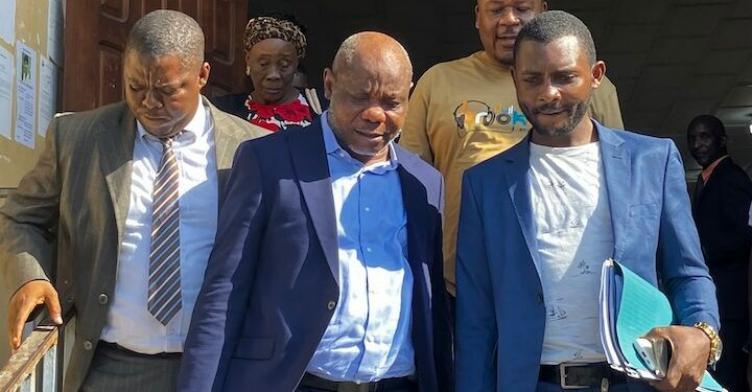
Africa-Press – Liberia. The protracted national security case involving former Finance Minister Samuel D. Tweah, Jr. and several ex-officials of the Weah administration has taken yet another dramatic turn, as the Supreme Court of Liberia has agreed to hear a petition for re-argument—less than 24 hours after denying a writ of prohibition that would have halted proceedings at Criminal Court “C.”
On Friday, December 19, 2025, Associate Justice Yussif D. Kabbeh, one of the three justices who participated in Thursday’s unanimous ruling against the accused, granted the defense’s application for re-argument. The decision allows lawyers for Tweah and his co-defendants to return to the chambers of the Supreme Court, reopening a case already marked by extraordinary legal twists, sharp procedural battles, and high constitutional stakes.
A Case Marked by Early Controversy
Even before reaching the Supreme Court, the case had become one of the most contentious prosecutions involving former senior officials of the Weah era. During pre-trial proceedings at Criminal Court “C,” the prosecution challenged the validity of Tweah’s criminal appearance bond, arguing it was defective and seeking his immediate remand to the Monrovia Central Prison.
Defense lawyers countered that the bond met all legal requirements, emphasizing that its sole purpose was to secure the defendant’s appearance in court. Presiding Judge A. Blamo Dixon agreed with the defense and denied the prosecution’s request for incarceration.
Dissatisfied, state prosecutors petitioned the Justice in Chambers, accusing Judge Dixon of bias and seeking both his removal and the reversal of his ruling on the bond. In a consequential decision, the Justice in Chambers granted the request for Judge Dixon’s removal but declined to invalidate Tweah’s bond. While controversial, the ruling brought temporary closure to the first major legal skirmish.
Jury Selection and a Jurisdictional Challenge
With the case reassigned to Judge Roosevelt T. Willie, proceedings resumed amid heightened scrutiny. Jury selection—already slow due to intense vetting by both sides—was abruptly overtaken by another legal maneuver. In late February 2025, defense lawyers filed a sweeping 12-count motion to dismiss the indictment, arguing that the trial court lacked subject-matter jurisdiction.
Central to the defense’s argument was the claim that all defendants were members or agents of the National Security Council (NSC), acting under the authority of the National Security Reform and Intelligence Act of 2011, and therefore shielded from prosecution for actions undertaken in that capacity.
Judge Willie framed the dispute around two critical questions: whether actions taken by NSC members, including financial transactions, were exempt from prosecution; and whether the defendants could invoke presidential immunity under Article 61 of the 1986 Constitution. He answered both in the negative, ruling that the prosecution must be allowed to present its case.
Back to the Supreme Court
On March 4, 2025, the defense escalated the matter by filing a petition for a writ of prohibition, urging the Supreme Court to halt the trial. After a conference with the parties on March 20, the Justice in Chambers stayed proceedings and forwarded the case to the full bench, citing unresolved constitutional questions beyond the purview of a single justice.
The case lingered until the October Term of Court, A.D. 2025, under a newly seated Chief Justice. Oral arguments were finally heard on November 17, 2025—but not without surprise. Two justices, Jamesetta Howard-Wolokolie and Ceaineh D. Clinton-Johnson, recused themselves, leaving a three-justice panel to decide the matter.
Despite the unusual quorum, arguments proceeded, with both sides citing Liberian and U.S. precedents. Observers described the defense’s presentation as strong, though the final outcome remained uncertain.
A Crushing Ruling—and a Sudden Reversal
That uncertainty ended on Thursday, December 18, when the Supreme Court—sitting in its 14th Day’s Session—delivered its ruling. The Tweah case was last on a crowded docket of 27 matters. By the time it was called, the courtroom had nearly emptied.
Reading the opinion verbatim, the Chief Justice announced a unanimous decision denying the writ of prohibition. The Court ruled that the National Security Reform and Intelligence Act of 2011 did not expressly include the Minister of Finance among the statutory members of the NSC, and that Article 61 of the Constitution grants personal immunity only to the sitting President.
The alternative writ was quashed, the peremptory writ denied, and the case remanded to Criminal Court “C” to proceed to trial.
For the defense, the ruling was devastating—and perplexing. Almost immediately, lawyers identified what they described as a “grave and material error” in the Court’s interpretation of the law, insisting that the Act explicitly names the Minister of Finance as a member of the NSC. Without that interpretation, they argue, the foundation of the prosecution collapses.
The Final Twist—for Now
Under Liberian law, Supreme Court decisions are final. However, where a material error is discovered, an aggrieved party may petition for re-argument. Acting swiftly, defense lawyers filed such a petition within hours of the ruling.
On Friday, December 19, the Supreme Court agreed to hear the re-argument—reviving a case many believed had reached its conclusion.
Whether this marks the final chapter in one of Liberia’s most dramatic legal sagas remains uncertain. For now, the Tweah national security case continues, its outcome once again hanging in the balance.
For More News And Analysis About Liberia Follow Africa-Press