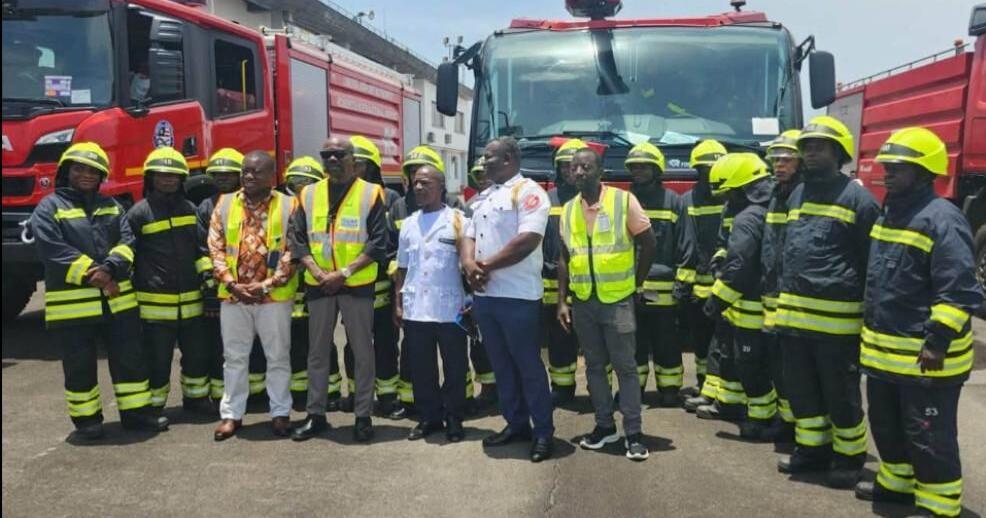
Africa-Press – Liberia. The Liberia Airport Authority (LAA) has taken a significant step toward modernizing Liberia’s aviation infrastructure with the commissioning of a state-of-the-art fire truck at the Roberts International Airport (RIA), as authorities intensify efforts to elevate the airport to Category 9 under international aviation safety standards.
The move, which saw the commissioning of a state-of-the-art fire truck that adds to its fleet of trucks, on April 8, 2026. The move signals a broader push by the government to align Liberia’s primary international gateway with global benchmarks set by the International Civil Aviation Organization (ICAO), at a time when the country is positioning itself as a more competitive destination for international airlines and investment.
In aviation terms, achieving ICAO Category 9 status is not merely a technical upgrade—it is a strategic milestone. The classification is part of a global system that determines the level of aircraft rescue and firefighting (ARFF) capability required at an airport, based on the size and type of aircraft it serves.
Category 9 airports are equipped to handle some of the world’s largest commercial aircraft—typically those exceeding 61 meters in length. To qualify, airports must meet strict requirements, including advanced firefighting vehicles with high-capacity foam and water discharge systems, rapid emergency response times, adequate staffing and continuous training of rescue personnel, and comprehensive safety infrastructure across the airfield.
Currently operating at Category 6, RIA’s transition toward Category 9 would significantly expand the types of aircraft—and airlines—it can safely accommodate.
“This is about positioning Liberia within the global aviation network,” an LAA official noted. “Without meeting these standards, major carriers simply will not consider your airport viable.”
Speaking at the commissioning ceremony, Acting Managing Director of the LAA, John Buway, described the acquisition of the new fire engine as a critical step in overcoming longstanding operational limitations.
“For years, some international airlines hesitated to come to Liberia due to safety and infrastructure gaps,” Buway acknowledged. “With this equipment, we have begun the formal process of upgrading our status to at least Category 9.”
He added that the authority has already initiated engagement with the Liberia Civil Aviation Authority for certification and compliance verification.
Beyond firefighting capability, the LAA also unveiled additional investments, including heavy-duty tractors for airfield maintenance—essential for vegetation control, wildlife hazard prevention, and runway visibility.
“These are not isolated improvements,” Buway emphasized. “They are part of a coordinated effort to meet global standards and ensure safe, efficient operations.”
The timing of the upgrade is particularly significant as Turkish Airlines prepares to launch twice-weekly flights between Istanbul and Monrovia beginning May 11, 2026.
Widely regarded among the world’s leading carriers, Turkish Airlines operates long-haul, wide-body aircraft that require higher safety classifications—making Category 9 status increasingly relevant.
Industry observers say the airline’s entry into Liberia could be transformative, opening new corridors for trade between West Africa, Europe, and Asia, tourism inflows, and business and investment travel.
However, sustaining and expanding such partnerships will depend heavily on RIA’s ability to meet and maintain international safety standards.
For Liberia, achieving Category 9 status goes beyond aviation—it directly affects the country’s economic credibility.
Airports serve as critical gateways for investment, and their operational standards often influence how countries are perceived by international investors, multilateral institutions, and global logistics and trade networks.
“An airport that meets ICAO’s highest safety requirements sends a strong signal,” a regional aviation the official explained. “It tells the world that the country is serious about safety, reliability, and international engagement.”
This is particularly important for a country like Liberia, which is actively seeking to expand foreign direct investment and strengthen its integration into global markets.
Chairman of the LAA Board, Nyan Matein, described the commissioning as a milestone in the authority’s reform agenda.
“This investment reflects our commitment to operational excellence and passenger safety,” he said. “It is about building confidence among airlines, passengers, and stakeholders.”
Matein also highlighted a broader vision for the aviation sector—one that extends beyond Roberts International Airport to include the rehabilitation and reopening of domestic airports across Liberia.
“Our mandate covers all airports in the country,” he noted. “We are thinking beyond RIA to ensure that domestic connectivity supports economic growth, job creation, and national development.”
The LAA credited Joseph Nyuma Boakai and the Government of Liberia, along with international partners, for supporting ongoing aviation reforms.
The administration’s focus on infrastructure modernization—spanning roads, ports, and airports—reflects a broader strategy to rebuild critical systems that underpin economic growth.
While the commissioning of the fire truck marks an important milestone, experts caution that achieving Category 9 status will require sustained investment and institutional discipline.
Key next steps include procuring additional firefighting equipment, training and certifying personnel, conducting compliance audits, and ensuring consistent maintenance and operational readiness.
If successfully achieved, the upgrade could reposition Roberts International Airport as a regional hub capable of handling high-capacity international traffic.
Ultimately, the LAA’s push toward Category 9 status represents more than a technical ambition—it is a strategic effort to redefine Liberia’s place in global aviation.
As new airlines enter the market and connectivity expands, the country’s ability to meet international safety standards will determine whether it can fully capitalize on emerging opportunities.
“This is how you open a country to the world,” one official remarked. “You build the systems that allow the world to come in—and trust that they are safe when they arrive.”
For More News And Analysis About Liberia Follow Africa-Press