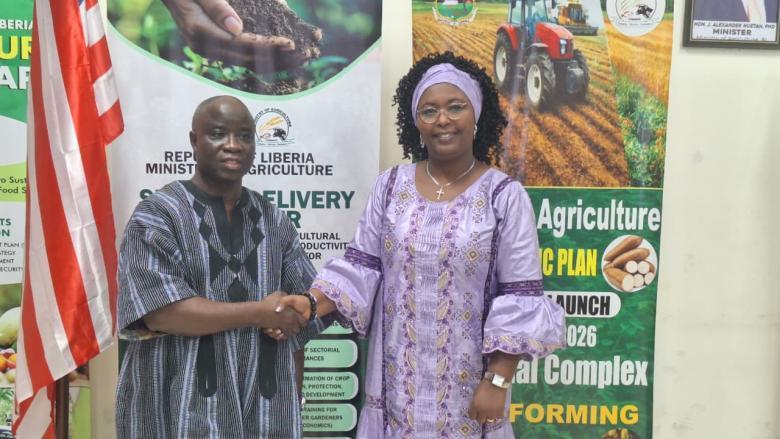
Africa-Press – Liberia. The Ministry of Agriculture has unveiled a new five-year Corporate Strategic Plan aimed at repositioning the sector around implementation, accountability, and measurable results, as the government intensifies efforts to reduce food imports and strengthen domestic agricultural production.
The Corporate Strategic Plan (2025–2030), funded by the International Fund for Agricultural Development (IFAD), sets out the institutional direction for implementing priorities under the National Agriculture Development Plan and advancing President Joseph Nyuma Boakai’s Vision for Liberians to feed themselves.
This strategy reflects a shift from policy ambition toward coordinated execution, with a focus on improving productivity, strengthening agribusiness, and ensuring that investments in agriculture translate into tangible outcomes for farmers and rural communities.
Launching the plan, Agriculture Minister Dr. J. Alexander Nuetah described the initiative as a national responsibility to transform how agriculture is managed and delivered across the country.
“This launch is a national commitment to ensure that Liberia feeds itself, creates opportunities for wealth creation, and builds a resilient agricultural economy for future generations,” Minister Nuetah said.
The Minister acknowledged Liberia’s strong agricultural potential, citing the country’s vast arable land, favorable rainfall, and youthful population, but noted that progress has been slowed by weak coordination and limited focus on execution.
“Our challenge is not potential. Our challenge is implementation, coordination, investment, and accountability. Resources committed to agriculture must produce measurable results,” he noted.
The new Strategic Plan prioritizes increasing domestic food production, expanding mechanization, strengthening private-sector participation, empowering youth and women, improving climate resilience, and reforming institutions to enhance performance and service delivery.
It is anchored on five pillars that include food and nutrition security, inclusive agribusiness development, strengthened research and extension services, sustainable management of natural resources, and institutional reforms within the agricultural sector.
Minister Nuetah also emphasized the importance of partnerships in delivering results, acknowledging IFAD’s role in supporting the development of the strategy.
“We appreciate IFAD’s support in the development of this Strategic Plan and its continued partnership with Liberia as we move from planning to implementation and results,” he added.
He further called on development partners, the private sector, civil society, and farmers’ organizations to align efforts behind the national framework to ensure coordinated implementation.
“This plan will only succeed if it is owned by all of us — government, partners, private sector, and farmers alike. Agriculture is not just a sector; it is the foundation of Liberia’s economic prosperity,” he said.
For her part, IFAD Country Director Pascaline Barankeba described the plan as a key step in translating Liberia’s agricultural vision into operational action, noting that stronger institutional direction and accountability will be critical to achieving results.
“The Strategic Plan plays a critical operational role by translating the national agriculture vision into clear institutional direction, aligned priorities, strengthened accountability, and results-oriented implementation,” she said.
“It serves as the bridge between policy ambition and effective delivery.” She noted that persistent challenges, including low productivity, climate vulnerability, limited access to finance, and weak value chains, continue to affect smallholder farmers and the broader agri-food system, adding that the strategy addresses these constraints through improved coordination and governance.
Reaffirming IFAD’s continued engagement, Ms. Barankeba stated, “IFAD remains committed to working closely with the Government of Liberia to support inclusive and climate-resilient agricultural development that delivers tangible results for smallholder farmers, women, and youth.”
Development partners, including the Food and Agriculture Organization (FAO) and the European Union (EU), also reaffirmed their commitment to supporting implementation of the Strategic Plan, emphasizing the importance of coordination, national ownership, and sustained investment in achieving inclusive and resilient agricultural growth.
The Ministry of Agriculture says implementation of the Strategic Plan will be guided by performance tracking, public reporting, and transparency measures, as Liberia seeks to position agriculture as a central driver of economic growth, rural livelihoods, and long-term food security.
For More News And Analysis About Liberia Follow Africa-Press