Africa-Press – Liberia. President Joseph Nyuma Boakai has underscored the immense potential of Liberia’s fisheries sector as a driver of economic revitalization, while cautioning investors against exploitative practices.
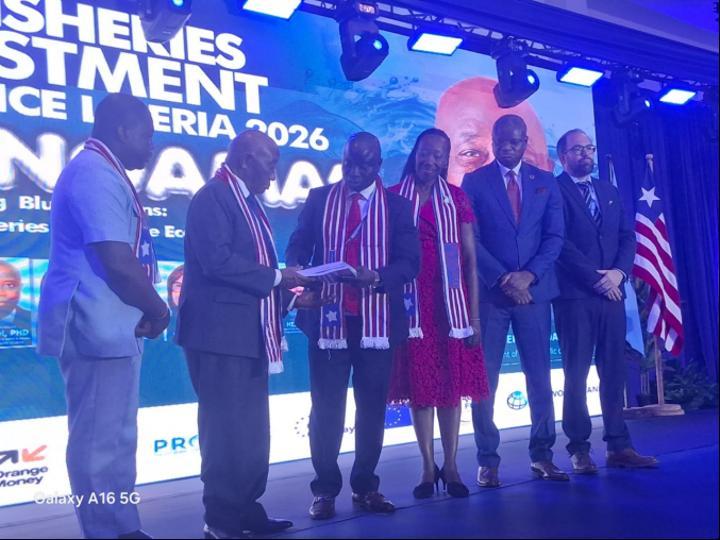
Speaking at the opening of the two-day National Fisheries Investment Conference, “Kpongama 2026,” held at the Farmington Hotel in Margibi County, the Liberian leader declared that although Liberia is open for business, it will not tolerate exploitation of its natural resources.
The conference, organized by the National Fisheries and Aquaculture Authority (NaFAA), is being held under the theme: “Unlocking the Blue Horizons: The Future of Fisheries and the Blue Economy.”
Caution Against Exploitation
President Boakai called on prospective investors to prioritize local capacity building, environmental protection, and equitable benefit-sharing with host communities.
“To those considering investment in Liberia’s fisheries, hear me clearly: we are open for business, but we are not open for exploitation. We seek partners who will build local capacity, respect our environmental standards, and share the benefits with our communities,” he emphasized.
He added that Liberia’s workforce is skilled, its waters are productive, and the government remains committed to creating an enabling environment through public-private partnerships (PPPs) and regulatory reforms.
Government’s Reform Agenda
The President disclosed that the government is shifting toward private-sector-led growth through PPPs and value-chain development aimed at retaining jobs and increasing domestic revenue.
He announced that Liberia has secured a €25 million grant from the European Union to strengthen the artisanal fisheries value chain. Additionally, a partnership with Orange Liberia will introduce mobile-based solutions and solar-powered cold storage to reduce post-harvest losses.
President Boakai further revealed that the “Sea King,” Liberia’s first semi-industrial fiberglass fishing vessel, and the long-idle Robertsport fishing cluster—constructed by the World Bank in 2016—are expected to become operational through PPP arrangements.
“These are not abstract policies; they are tangible steps to ensure that a fisherwoman in West Point or a canoe captain in Harper can earn more from their catch,” he noted.
He added that the design for a national fisheries harbor is nearing completion, while construction of a new fisheries complex is expected to begin later this year.
Expanding Opportunities
Looking ahead, President Boakai said the government is working with the World Bank on a follow-on initiative to deepen PPPs and expand investment opportunities.
Through the Liberia Integrated Fisheries Sector Strengthening Project, funded by the OPEC Fund for International Development, the government is investing in key infrastructure, including a modern fisheries laboratory to meet international export standards, a fisheries processing plant to add value and create jobs, dedicated landing sites for artisanal fishers and Liberia’s first integrated commercial aquaculture farm.
These initiatives, he said, are designed to position Liberia competitively in regional and global seafood markets.
Regional Cooperation Emphasized
The President also stressed the importance of regional collaboration in combating illegal, unreported, and unregulated (IUU) fishing.
Recalling a December meeting in Monrovia with fisheries ministers from Benin, Côte d’Ivoire, Ghana, Nigeria, and Togo, he reaffirmed Liberia’s commitment to regional fisheries management frameworks.
“The fish do not recognize our borders, but our cooperation must,” he urged.
Policy Framework Launched
The conference also witnessed the launch of three key policy instruments expected to guide Liberia’s fisheries sector over the next decade. They include a ten-year national fisheries strategic plan, an investment plan and a public-private partnership strategy.
A Vision for the Future
President Boakai painted an optimistic picture of Liberia’s blue economy, envisioning modern fishing ports, thriving aquaculture systems, and increased participation of women and youth in the sector.
“Imagine a Liberia where our youth are trained as marine biologists and aquaculture technicians, and where our fish products compete on international markets. This is the future we are building,” he said.
NaFAA, Regional Partners Weigh In
Earlier, NaFAA Director General J. Cyrus Saygbe described the government’s strategy as a transformative roadmap to make fisheries a major pillar of economic growth.
He highlighted plans to deploy artificial intelligence to monitor illegal fishing, expand cold storage infrastructure, and industrialize aquaculture production.
Saygbe said Liberia is actively seeking international investors to provide financing, expertise, and advanced technology to support the sector’s growth.
Meanwhile, Ghana’s Minister of Fisheries and Aquaculture Development, Emelia Arthur, pledged her country’s support to Liberia’s blue economy agenda.
She emphasized the need for strong political will, regional cooperation, and structured planning.
“Transformation happens by design, not by chance,” she said, urging West African countries to collaborate in unlocking the region’s maritime potential.
For More News And Analysis About Liberia Follow Africa-Press