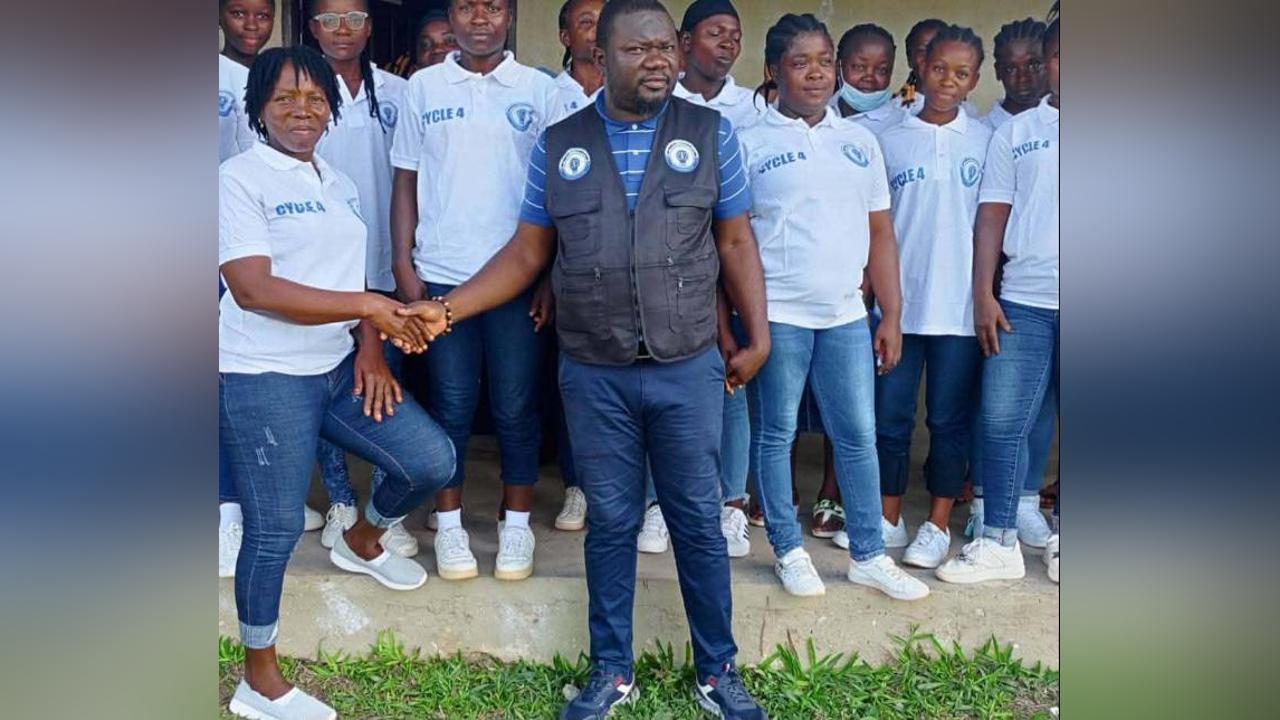
Africa-Press – Liberia. In a nation where unemployment continues to weigh heavily on the dreams of thousands of young people, one young Liberian is steadily changing the story from despair to determination. Alex Flomo, a passionate advocate for grassroots development, has emerged as a symbol of hope for young men and women seeking a pathway to self-reliance through vocational education.
Through his leadership of the Bong Progressive Entrepreneur Network Inc., he is not only equipping youths with practical skills but also restoring confidence and dignity in communities where opportunities are limited.
Flomo’s journey into youth empowerment was shaped by what he describes as painful but eye-opening experiences in his own community.
Reflecting on why he organized the group, he said, “I decided to organize this group because I saw too many young people sitting idle with talents that were never developed, and I realized that if we continue to wait for white collar jobs that are not available, we will lose
a whole generation to frustration and dependency, so I felt compelled to create a platform where young men and women can learn practical skills and begin to build their own futures.”
Under his guidance, the Bong Progressive Entrepreneur Network Inc. was established with a clear vision to create a future where rural women and underprivileged citizens thrive with dignity, independence, and opportunity.
The organization is committed to empowering rural women through vocational skills training programs that unlock creativity, resilience, and self-reliance, while also connecting them to mentorship networks and shared growth platforms.
It provides access to microfinance loans that enable women to establish and expand businesses, offers business management training to build confidence and sustainability, champions economic empowerment opportunities for single mothers and widows, and supports the education of children from disadvantaged families through scholarships.
Explaining the deeper motivation behind his work, Flomo noted, “My passion comes from understanding that empowerment is not about giving handouts but about giving people the tools and knowledge to stand on their own, because when a young woman can start her own business or a young man can use his skills to feed his family, that is when real change begins in our communities.”
At the heart of the organization’s work is a practical response to a pressing national challenge. Young people are trained in tailoring, soap making, cosmetology, catering, agriculture, poultry production, and small business management. These are not just courses but life-changing opportunities that allow beneficiaries to move from dependency to productivity.
For many participants, the impact of the training is deeply personal and transformative. Mary Kollie, a young single mother who completed tailoring training with the organization, shared her powerful testimony. “Before joining the training, I depended on relatives to feed my children, but today I run my own tailoring shop and pay my children’s school fees without begging anyone,” she said with pride.
James Wilson, who gained skills in soap making and small business management, described how the program shifted his outlook on life. “I used to sit in the community frustrated because there were no jobs, but after the training, I started producing soap, and now I supply several shops in my area,” he explained.
For Martha Johnson, cosmetology training opened doors she once believed were permanently closed. “The skills I learned gave me confidence, and today I own a small beauty center that employs two other girls who once had no hope,” she said.
Emmanuel Dennis, trained in agriculture and poultry production, highlighted how the knowledge he acquired is sustaining not only him but his family.
“This training turned my life around because I now produce eggs and vegetables for the market, and I am able to support my parents,” he noted.
Hawa Sheriff, who benefited from catering classes, expressed gratitude for discovering her hidden potential. “I discovered my talent through this program, and now I cater for programs and community events, earning enough to take care of myself,” she said.
Patrick Toe emphasized that the greatest lesson he learned extended beyond technical skills. “What I gained from Alex’s organization is not just a skill but a new mindset that I can create my own future instead of waiting for government jobs,” he remarked.
While the success stories are inspiring, the journey has not been without obstacles. Speaking candidly about the challenges he faces, Flomo explained, “One of our greatest challenges is limited funding and logistics, because sometimes we have more young people willing to enroll than the materials and equipment we can provide, and it is heartbreaking to turn anyone away simply because we lack the necessary support.”
He further elaborated on the operational difficulties of expanding across counties. “Extending our programs to different counties comes with transportation constraints, training materials shortages, and the need for more qualified instructors, but despite these difficulties, we remain committed because the demand for skills training continues to grow every day.”
These stories are repeated across communities touched by the organization’s work. Graduates are not only launching small businesses but are also mentoring peers, creating employment for others, and contributing to local economic growth.
Markets that once relied heavily on imported goods are beginning to feature locally produced items from trained youths, reflecting a quiet but significant economic shift.
The reach of Flomo’s initiative has expanded steadily over the years. What began as a localized effort has grown into a multi-county movement. He has extended vocational trainings to Bong, Rivercess, and Montserrado counties, maintaining the same focus on practical skills development and inclusive empowerment in each location.
In Bong County, the organization works closely with rural women and underprivileged youths in remote communities, providing training opportunities that were previously inaccessible. In Rivercess County, programs are tailored to align with local realities, including farming, food processing, and small-scale trading, ensuring that participants can apply their skills immediately within their environment.
In Montserrado County, where urban unemployment presents a different challenge, the focus includes cosmetology, catering, tailoring, and entrepreneurship training for vulnerable youths in densely populated communities. Across all three counties, the guiding mission remains consistent, to empower individuals with tools for self-reliance and to build stronger communities through economic participation.
Community leaders have observed a positive shift in areas where the trainings are sustained. Youth restiveness has reportedly declined as more young people become productively engaged. Parents speak of renewed hope as their children gain skills and income.
Small enterprises established by graduates are contributing to local development, demonstrating that empowerment at the grassroots level can yield tangible national benefits.
For More News And Analysis About Liberia Follow Africa-Press